Background:
Millions of people with HIV in sub-Saharan Africa have been switched from non-nucleoside reverse transcriptase inhibitor (NNRTI)-based antiretroviral therapy (ART) to tenofovir-lamivudine-dolutegravir (TLD) since 2018. Whereas clinical trials have rarely documented resistance to TLD after switch, limited programmatic data are available to estimate the incidence of acquired drug resistance on TLD in the region.
Methods:
We conducted a longitudinal cohort study of adults with HIV age >18 years in Uganda who were programmatically switched from NNRTI-based ART to TLD. We measured plasma HIV-1 RNA viral load (VL) using the Cepheid GeneXpert platform on the day of switch to TLD and at 24- and 48-weeks post-switch. We conducted Sanger sequencing of reverse transcriptase and integrase regions of the pol gene on any plasma specimen with a VL >500 copies/mL.
Results:
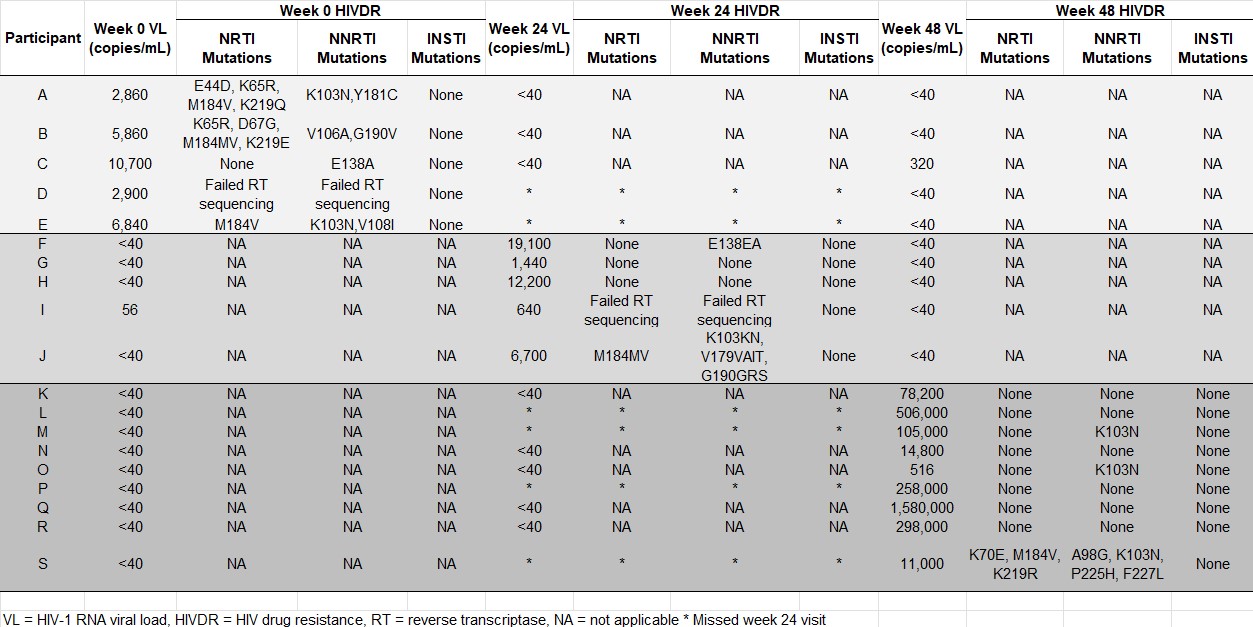
We enrolled 500 participants with a median age of 47 years (IQR 40 – 53); 41% were women. Sequencing was performed on specimens from 19 participants (Table) with a detectable VL at any of the three study visits. Sequenced participants had a median age of 40 years (IQR 32 – 52), and 16% were women. At the time of switch to TLD, five participants (1%) had a VL >500 copies/mL, and four of these were sequenced. None had integrase inhibitor mutations prior to switch to TLD. All had NNRTI mutations and three had nucleoside reverse transcriptase inhibitor mutations; yet all were suppressed by 24 or 48 weeks. In follow-up, 1% (n=5/448) and 2% (n=9/483) of participants who completed study visits at 24 and 48 weeks after switch to TLD, respectively, had a VL >500 copies/mL. Although two participants failed with M184V and five participants failed with NNRTI mutations, we did not observe K65R or integrase inhibitor mutations in any individuals after TLD transition. The one individual with M184V alone at 24 weeks resuppressed by 48 weeks. Thus, incidence of acquired integrase resistance in this cohort was 0% (95% CI 0 – 0.008%) by 48 weeks.
Conclusions:
No treatment-emergent resistance to dolutegravir was observed after 48-weeks in this large cohort study of ART-experienced adults transitioning to TLD in the Ugandan public sector. Furthermore, two individuals achieved viral suppression despite high-level resistance to both tenofovir and lamivudine at the time of switch from NNRTI-based therapy. These data are reassuring and affirm World Health Organization guidelines for the use of TLD as the preferred ART regimen in resource-limited settings.
HIV Drug Resistance Outcomes in the DISCO Cohort Study