Background:
ANRS 170 QUATUOR findings showed the non-inferiority of some intermittent maintenance treatment strategies, but treatment failures related to emerging disease-resistant mutations with rilpivirine as third therapeutic agent have been observed. The consequences of the 3-days-off strategy on non-nucleoside reverse transcriptase inhibitors (NNTI) concentrations are not known. The aim of this study was to evaluate in silico, using simulation from population pharmacokinetics models, the concentrations of rilpivirine (RLP) after 3 days off, with doravirine (DOR) as a comparator.
Methods:
Previously published population pharmacokinetic models for DOR (Yee et al, Antimicrob Agents Chemother. 2019) and for RLP (Aouri et al, Antimicrob Agents Chemother. 2016) were implemented in the mrgsolve R package. 10000 Monte Carlo simulations at steady state for typical dose of 25 mg/day for RLP and 100mg/day for DOR were drawn for two scenario: without drug cessation and after 3 days off. Filters were applied on simulated trough concentration (C24h) to keep the 2.5 to 97.5 simulated profiles. The validation of the implementation was performed based on the comparison of the median C24h to the one observed in the literature. The proportion of simulated patient with C24h and C72h after 3 day off (C72h/3do) higher than IC50 (5.2 µg/L (DOR) ; 20.5 µg/L (RLP)) and IQ (6 X IC50 (DOR); 4.5 X IC50 (RLP)) were calculated for both drugs. Finally, nomograms to estimate probability of having a concentration > IC50 after 72h of drug cessation for different range of C24h were built.
Results:
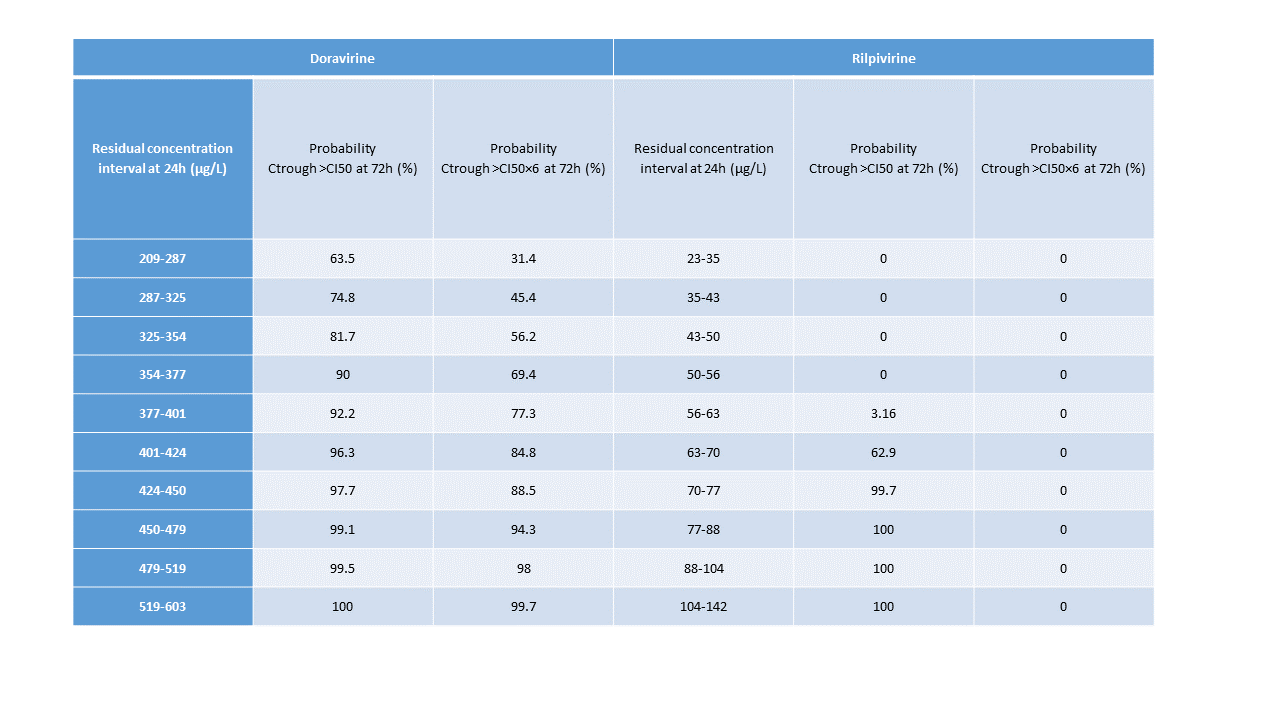
Simulated C24h median [range] for RLP were 62.8 [23-142] µg/L and for DOR 400 [209-603] µg/L. The proportion of patient with C24h >IC50, C72h/3do >IC50 and C72h/3do >IQ were 100%, 36.6% and 0% for RLP and 100%, 89.4% and 74.3% for DOR. The nomogram for probability of target attainment at 72h as function of C24 range is presented in Table 1.
Conclusions:
Based on these findings, treating with DOR would be more forgiving than with RLP since the former drug exhibits a larger proportion of patients with effective drug exposure. The main limit of this work is that we only evaluated the drug concentrations that cannot be a perfect surrogate of the drug effect. However, DOR is a promising third therapeutic agent suitable for an intermittent maintenance treatment strategy. Further studies are needed to confirm this assumption and evaluate the developed nomograms.
Table 1 Probability of effective concentration after 72h of forgiveness based on Ctrough at 24h.