Background:
Treatment interruption (TI) is a major contributor to poor HIV outcomes among men living with HIV (MLHIV). We report and compare results from two trials examining the impact of male-specific counseling (MC) and home ART on ART (re-)initiation in Malawi.
Methods:
We implemented the ENGAGE and IDEaL randomized trials in 22 Malawian health facilities (ClinicalTrials.gov#NCT04858243 and # NCT05137210). Trials have the same eligibility criteria and recruitment strategy: MLHIV; >15 years; and disengaged from HIV care (defined as never initiated or currently experiencing TI after initiation); were recruited through community tracing. In ENGAGE (10 facilities), randomization was 1:1 to MC + monthly home ART distribution for 3-months, or standard of care (SOC) counseling + routine facility ART. In IDEaL (12 facilities), randomization was 1:1:1 to MC + routine facility ART, MC + one-time home ART distribution, or stepped services every two-weeks until clients achieved primary outcome, starting with MC + advanced psychosocial counseling + one-time home ART. Primary outcome for this analysis is ART (re-)initiation at 2-months. We conducted protocol driven analyses to compare outcomes within each trial, using intention-to-treat analysis. We then conducted ad-hoc analyses to compare interventions from IDEaL to SOC from ENGAGE. In-depth interviews were conducted with a subset of men.
Results:
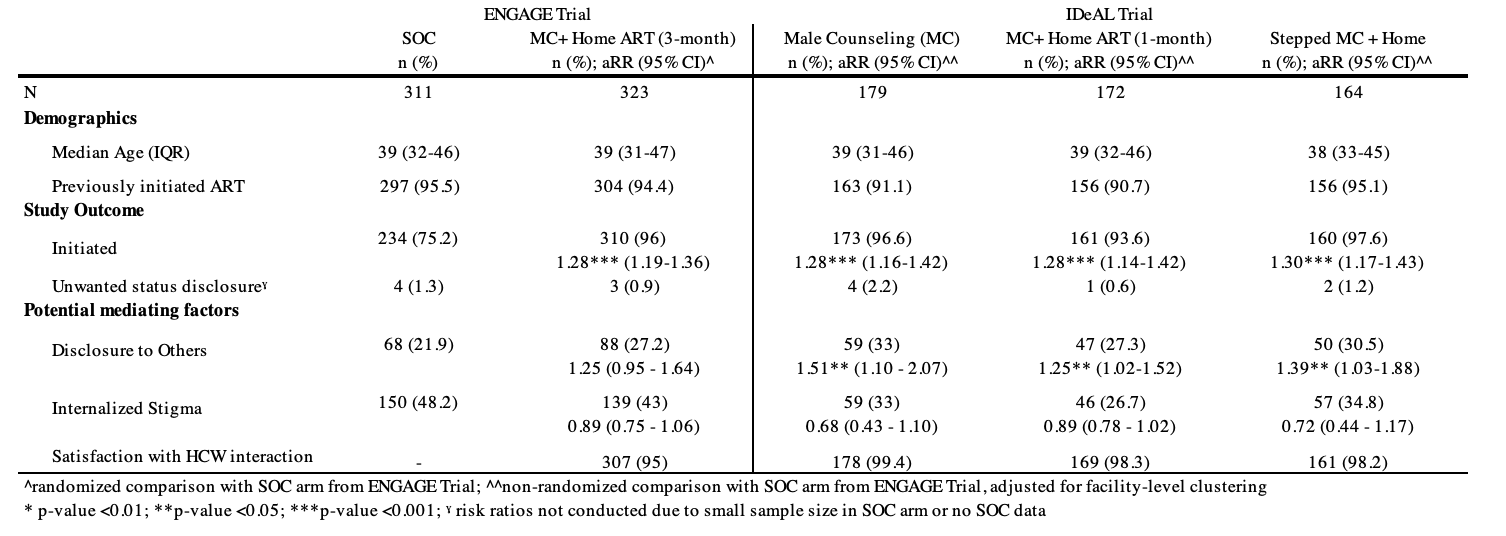
1149 MLHIV out of treatment were enrolled in IDEaL (n=515) and ENGAGE (n=634) between August 2021-September 2022. In ENGAGE, (re-)initation was significantly higher in the MC+Home ART (3-month) vs SOC arm (RR:1.28 [95%CI 1.19-1.36]). In IDEaL, (re-)initiation was equally high across all intervention arms with no significant differences (94-98%). In ad-hoc analyses, compared to ENGAGE SOC, (re-)initiation was significantly higher across all IDEaL intervention arms: MC+Facility ART (aRR:1.28 [95%CI 1.16 -1.42]); MC+Home ART (1-month) (aRR:1.28 [95%CI 1.14 -1.42]); and Stepped intervention (aRR:1.30 [95%CI 1.03-1.88]) (Table). All interventions had high satisfaction (~96%) and low unwanted disclosure (~1%). Men in interviews (Nf45) valued being active participants in HIV services and desired ongoing relationships with healthcare workers. To promote retention men requested longer drug dispensing and increased privacy at facilities.
Conclusions:
Male-specific counseling alone and combined with home-based ART improved men’s ART (re-)initiation in Malawi. Longer term outcomes will indicate if ART gains will be sustained.
HIV outcomes for MLHIV with treatment interruption across interventions in Malawi: reported by MLHIV (n=1149)