Background:
Long-acting injectable Cabotegravir-Rilpivirine (CAB-RPV LAI) offers people living with HIV (PLWH) a safe and effective alternative to daily oral ART. In 2021, Whitman-Walker Health, a Federal Qualified Health Center (FQHC), began scaling up implementation of CAB-RPV LAI in appropriate patients.
Methods:
A multidisciplinary working group developed a protocol for providers and a workflow to streamline processes involving insurance authorizations, coding/billing, and patient and medication tracking. Most patients were consistently virologically suppressed at baseline, consistent with FDA guidance and trial protocols. However, with early promising data in treating non-suppressed PLWH (Gandhi et al., CROI 2023), carefully selected viremic patients were also offered treatment, using a monthly dosing schedule. These were generally PLWH who were struggling with adherence but who maintained consistent care engagement, and who were verified to have no relevant resistance mutations. We conducted a cross-sectional analysis comparing virologic suppression in patients on CAB-RPV LAI with patients prescribed oral ART, recognizing the presence of selection bias. The two groups were similar across age, sex, gender identity, insurance status, and baseline CD4 count.
Results:
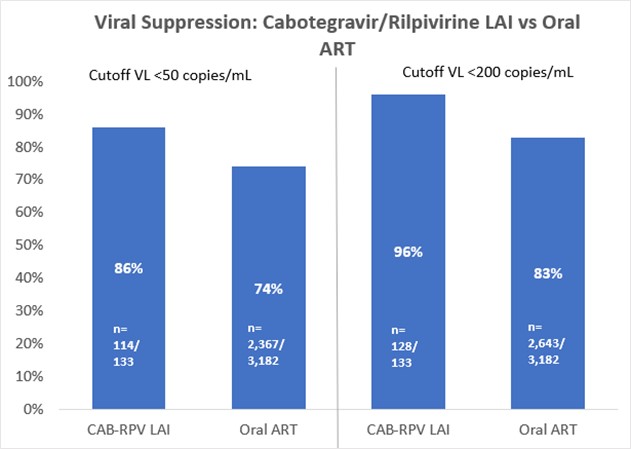
To date, we have 133 PLWH receiving CAB-RPV LAI, who have received a total of 715 doses of which 96% have been given within the appropriate treatment window. Navigators track to ensure injection visits are scheduled at the correct time intervals and work with medical providers to reschedule quickly for missed appointments. Most CAB-RPV LAI patients (86%,114/133) had a VL <50 copies/mL on most recent assay, compared to 74% (2367/3176) of PLWH receiving oral HIV medication, Χ2 (1, N=3309) = 8.7, p<.01. Twenty-one patients were started on CAB-RPV LAI with a VL ≥ 50 copies/mL who had a VL drawn at least one month after their initial dose. This group's median baseline VL was 100 copies/mL, and 76% (16/21) have subsequently achieved VL <50 copies/mL. Of the five patients who remain non-suppressed, median VL has dropped from 140 copies/mL to 60 copies/mL.
Conclusions:
We successfully developed a robust cohort of PLWH on CAB-RPV LAI in an FQHC setting. These patients have maintained viral suppression at a high rate. We also provide further evidence suggesting efficacy of CAB-RPV LAI in non-suppressed PLWH who struggle with adherence to oral ART. Research focused specifically on this at-risk population is urgently needed.