Background:
The feasibility of implementing CAB+RPV LA ART in the community has not yet been described. In the first UK-based study, we purposefully recruited participants more representative of the global population of PLWH to evaluate feasibility of implementation in 6 clinics (in & outside London) and in the community.
Methods:
ILANA is a 1-year UK-based implementation study in PLWH who switched to CAB+RPV LA 2-monthly within the label. Participants receive CAB+RPV in the clinic for 6 months with an option to receive the drug in the clinic or community (eg home or community organisation) from M6-M12. This prespecified M4 analysis evaluated PLWH perspectives on feasibility and acceptability of CAB+RPV LA and on potential community delivery through validated implementation questionnaires [Feasibility of Intervention Measure (FIM), Acceptability of Intervention Measure (AIM), Intervention Appropriateness Measure (IAM), HIV Treatment Satisfaction Questionnaire (HIVTSQ-12)] at baseline and 4 months.
Results:
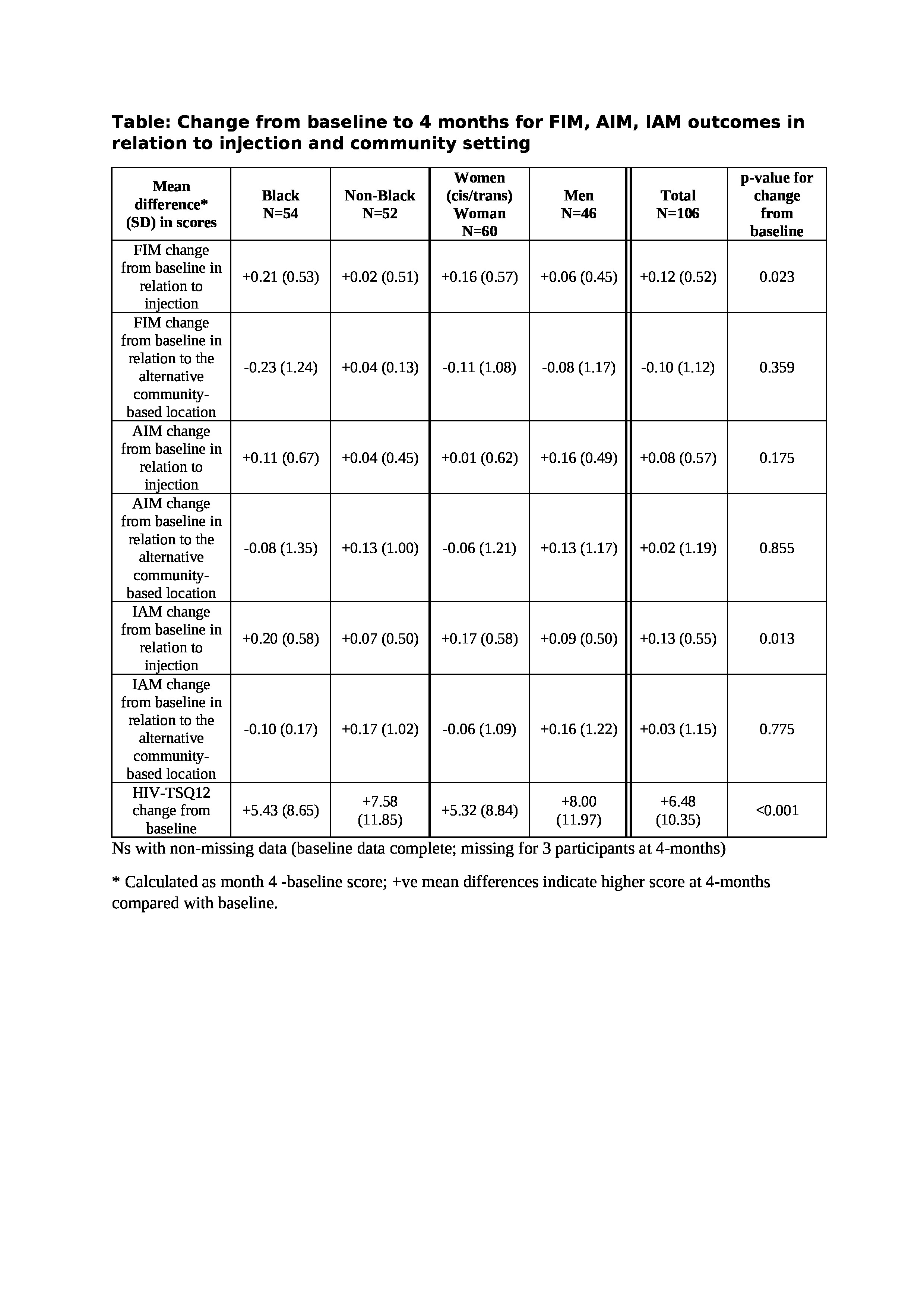
Between May-December 2022 we enrolled 114 virally suppressed PLWH [53% female, 51% Black, 30% White, 40%> 50yrs, 68% heterosexual,75% employed]. Median time since diagnosis was 13 yrs (IQR 8, 19), time on ART was 11 yrs (IQR 7,16) with a mean of 3 prior regimens. 57% had received NNRTIs. 84% had other co-morbidities, and 80% (91/114) were taking non-ART medications. 75% (68/91) were on >2 non-ART drugs. 99% of injections were given within the 7-day window. There were 5 discontinuations by M4 (2 injection-related, 3 participant choice). 1 participant with VL 478 at M4 continued. Regarding injectable treatment: FIM, IAM and HIVTSQ scores improved significantly (baseline to M4) (Table). FIM, IAM and AIM scores regarding perceptions of the future prospect of receiving ART in the community setting (at M6) did not improve from baseline. 96% preferred injectable to oral ART at M4. At M4, IAM mean scores were significantly less favourable in Black participants than in White participants with respect to the injection (4.44 vs. 4.67; p=0.029) and the community setting (3 vs 3.75;p=0.003).
Conclusions:
Over four months, participants found injections increasingly feasible, appropriate and satisfactory, and preferred them to oral ART. Pre-specified sub-group analyses based on gender and race and ethnicity revealed significant differences around perception of delivering LA ART in the community in Black participants. These findings will be further evaluated in relation to psychological challenges.