Background:
Developed in the 1930s by the US government, Home Owners’ Loan Corporation (HOLC) Security Maps classified residential neighborhoods with populations of 40000 or more into grades based on the alleged investment risk of resident borrowers. Grades ranged from A (mapped as green areas considered “Best”) to D (or red areas that were poorer and predominantly Black neighborhoods considered “Hazardous”), the latter colloquially referred to as “Redlined”. The ongoing impact of redlining on chronic diseases such as obesity and diabetes has been described previously. Similar associations with HIV outcomes could help direct local Ending the HIV epidemic (EHE) Initiatives. We seek to assess the association of structural racism through redlining policies on current time to viral suppression (VS) among people newly diagnosed with HIV in two cities in Louisiana, a state with one of the highest HIV incidence rates in the country.
Methods:
City boundaries were defined by 2020 U.S. Census Bureau Zip Code Tabulation Areas and spatially joined with HOLC-graded neighborhoods. Redlined neighborhood residences of new HIV diagnoses from 2011-2019 were determined using Louisiana HIV surveillance data. Unadjusted and adjusted estimates for time to VS by redline status were calculated using Kaplan-Meier and Cox proportional hazard models, adjusted for age, race/ethnicity, sex at birth, mode of HIV transmission, and AIDS status at diagnosis (Stage 3 vs other).
Results:
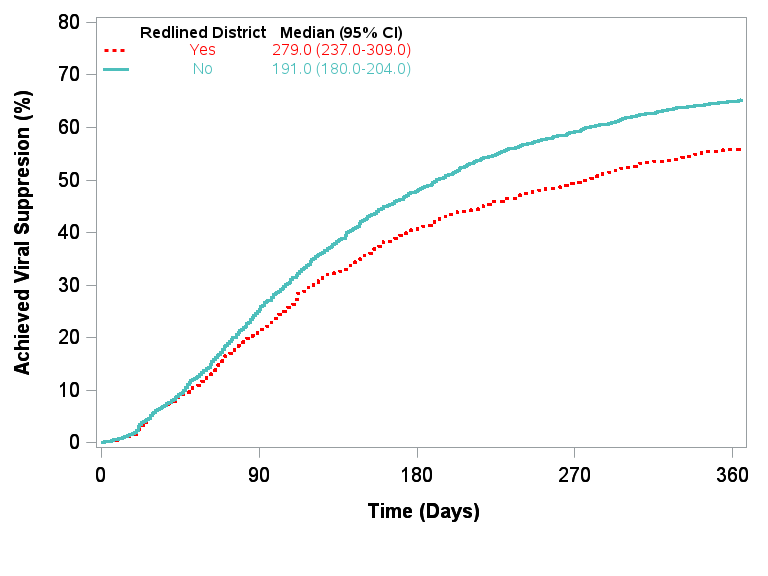
Of the 3227 PWH analyzed, 929 (28.8%) lived in a redlined neighborhood, 606 (18.8%) lived in A, B or C HOLC neighborhoods, and 1692 (52.4%) lived within the city but not in a HOLC graded area. In redlined areas, 74.1% of PWH were Black as compared to 63.5% in A, B, and C grade areas, and 78.3% in non-graded areas. The adjusted median time to VS among PWH in redlined areas was 262.0 days (95% CI: 219.0-294.0), compared to 195.0 days (95% CI: 182.0-207.0) among PWH in non-redlined areas. PWH in redlined areas were 0.88 (95% CI: 0.18-0.95) times as likely to achieve VS as PWH in non-redlined areas.
Conclusions:
Generational inequities and structural racism continue to impact present-day health outcomes. Time to VS was significantly longer for PWH in redlined vs non-redlined communities. Our analysis quantifies the importance of the physical environment on health outcomes in Louisiana, and these findings can inform local EHE strategies and beyond.
Time to VS from HIV diagnosis by residence within Redlined areas, Shreveport and New Orleans, 2011-2019