Scarce data exist regarding the efficacy of antiretroviral (ARV) treatment in patients with advanced HIV disease. The aim of the study was to assess the impact of ARV regimens on the clinical outcomes among naïve patients with advanced HIV presentation in real life settings.
A multicentre, population-based, prospective cohort study was performed. Treatment-naive subjects with advanced HIV diseases (CD4+T cell count < 200 cells/ml or presence of an AIDS-defining illness) who started therapy between 2010 and 2018, from 18 hospitals in Spain, were included. The primary outcome was the rate of mortality at three years. Secondary outcomes included discontinuation or change of ARV regimen, virological effectiveness (viral load of ? 200 copies/ml) and immune reconstitution (achieve CD4+T cell count > 350 cells/ml). Kaplan-Meier curves and long-rank test were used to analyse different outcomes. A Cox proportional hazard model was performed to identify predictors of death
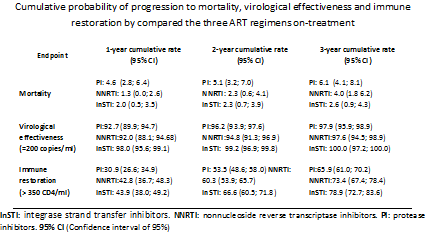
A total of 1170 naive patients with advanced HIV disease started ARV treatment: 44.9% with PIs based regimen, 29.6% with NNRTIs and 25.6% with InSTI. The most frequently third-drug was darunavir (73%), efavirenz (70.9%) and dolutegravir (47%), respectively. The median follow-up was 5 years (5695 person-years), median CD4+T cell count at baseline was 101 cells/ml and 30.3% had an AIDS-defining illness. Crude mortality rate at three years of follow-up was 6.1% (95% CI, 4.1-8.1) for PI based regimen, 4% (95% CI, 1.8-6.2) for NNRTI and 2.6% (95% CI, 0.9-4.3) for InSTI. In patients with an AIDS-defining illness, mortality rate was 14.6% (95% CI, 7.2-21.4) for PI, 9.1% (95% CI, 2.4-7) for NNRTI and 5.8% (95% CI, 1.0-11.4) for InSTI. Factors associated with mortality were higher age and AIDS-defining illness at inclusion, whilst treatment with InSTI regimen had a trend as protective factor (HR 0.53, 95% CI, 0.25-1.14). Patients who started with InSTI based regimen achieved viral suppression and immune reconstitution earlier (0.2 and 0.3 years, respectively), than those with PI and NNRTI based regimens, (1.1 and 1.4; 0.3 and 0.9, respectively). Over the follow-up period, 56.8% of patients with PI regimen, 53.9% with NNRTI and 13.6% with InSTI changed treatment.
In this large real-life cohort study, a lower mortality and a less rate of discontinuation in patients treated with InSTIs regimens were observed among naive patients with advance HIV disease.