Background:
Previous studies have shown the deleterious impact of access to care with an advanced HIV-disease (CD4 ≤200/ or AIDS, no primary infection) on the mortality risk in people living with HIV (PWH). Here, we explored the respective impact of access to care with AIDS or with CD4 ≤50/mm3 without AIDS or with CD4 50-200/mm3 without AIDS on the mortality risk up to 5 years after the first access to care, and whether availability of new antiretroviral regimen led to a smaller impact.
Methods:
Adult participants newly included in the ANRS-CO4-FHDH cohort between 2002-2016, with HIV-1 infection were selected. Besides the 3 categories of advanced HIV-disease at access to care, 2 others were defined as follows: intermediate HIV-disease as CD4 between 200-350/mm3 without AIDS and early HIV-disease as either CD4>350/mm3 without AIDS, or primary infection. The impact of the stage at first access to care on the mortality risk was analyzed by using Fine & Gray competing risk models considering lost to follow-up ≥18 months as a competing event. Follow-up after access to care was categorized into 0 – 6, 6 – 12, 12 – 24, 24 – 48, 48 – 60 months. Models were adjusted for age, sex, acquisition mode, region of origin, delay between diagnosis and access to care and period of access to care (2002-2013 vs 2014-2016).
Results:
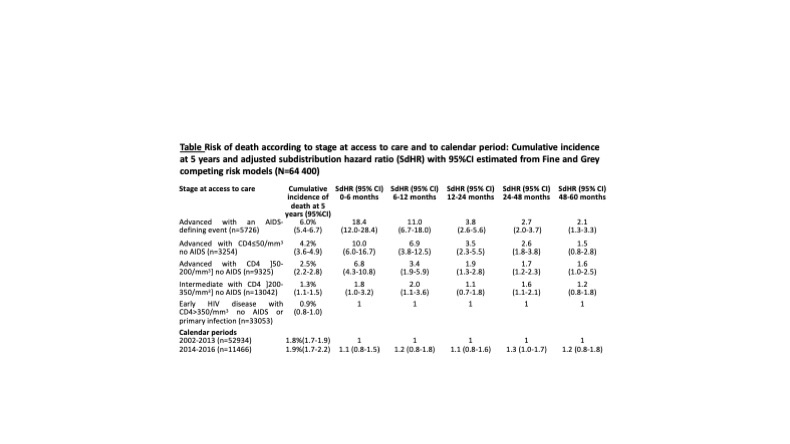
Among the 64400 PWH included, 18305 (28.4%) presented with an advanced HIV-disease and 13042 (20.3%) with an intermediate HIV-disease. At 60 months, the cumulative incidence of death was estimated as 1.8% (95%CI: 1.7–1.9) overall, from 6.0% (95%CI: 5.4–6.7) among those with AIDS to 0.9% (95%CI: 0.8–1.0) among those with early HIV-disease (Table). Compared to people with an early HIV-disease, those with AIDS had a very high risk of death, with a sub-distribution hazard ratio (SdHR) of 18.4 (95%CI: 12.0-28.4) in the first 6 months of follow-up, which remained significant 48-60 months after inclusion 2.1 (95%CI: 1.3-3.3) (Table). In the other categories of advanced HIV-disease, the risk of death was also significantly higher while to a smaller extent. There was no statistical difference between calendar periods.
Conclusions:
A delayed access to care remains associated with an increased risk of death even after 48 months of follow-up. There was no significant improvement in the risk of death after introduction of integrase inhibitors for combined antiretroviral initiation in 2014.