Background:
While people with HIV (PWH) on suppressive antiretroviral therapy (ART) have higher levels of inflammation and are at greater risk for morbidity and mortality than the general population, the immunologic pathways most strongly linked to this excess HIV-associated risk remain incompletely characterized.
Methods:
The first available plasma sample after 1/1/2010 was selected from a random sample of all PWH from 8 CNICS sites with ≥6 months of ART-mediated viral suppression. Plasma was assessed for 363 detectable inflammatory proteins (Olink Inflammation I Explore Panel). The relationship between each protein and all-cause mortality was assessed via Cox proportional hazards modeling, adjusted for VACS index (1.0) and CNICS site, controlling for the false discovery rate (FDR) via the Benjamini-Hochberg method. To identify pathways more relevant in PWH than in the general population, adjusted hazard ratios (aHR) were compared to published UK Biobank (UKB) data, which reported the association between the same Olink panel and all-cause mortality in 47,600 participants from the general population via FDR-corrected multivariate Cox modeling.
Results:
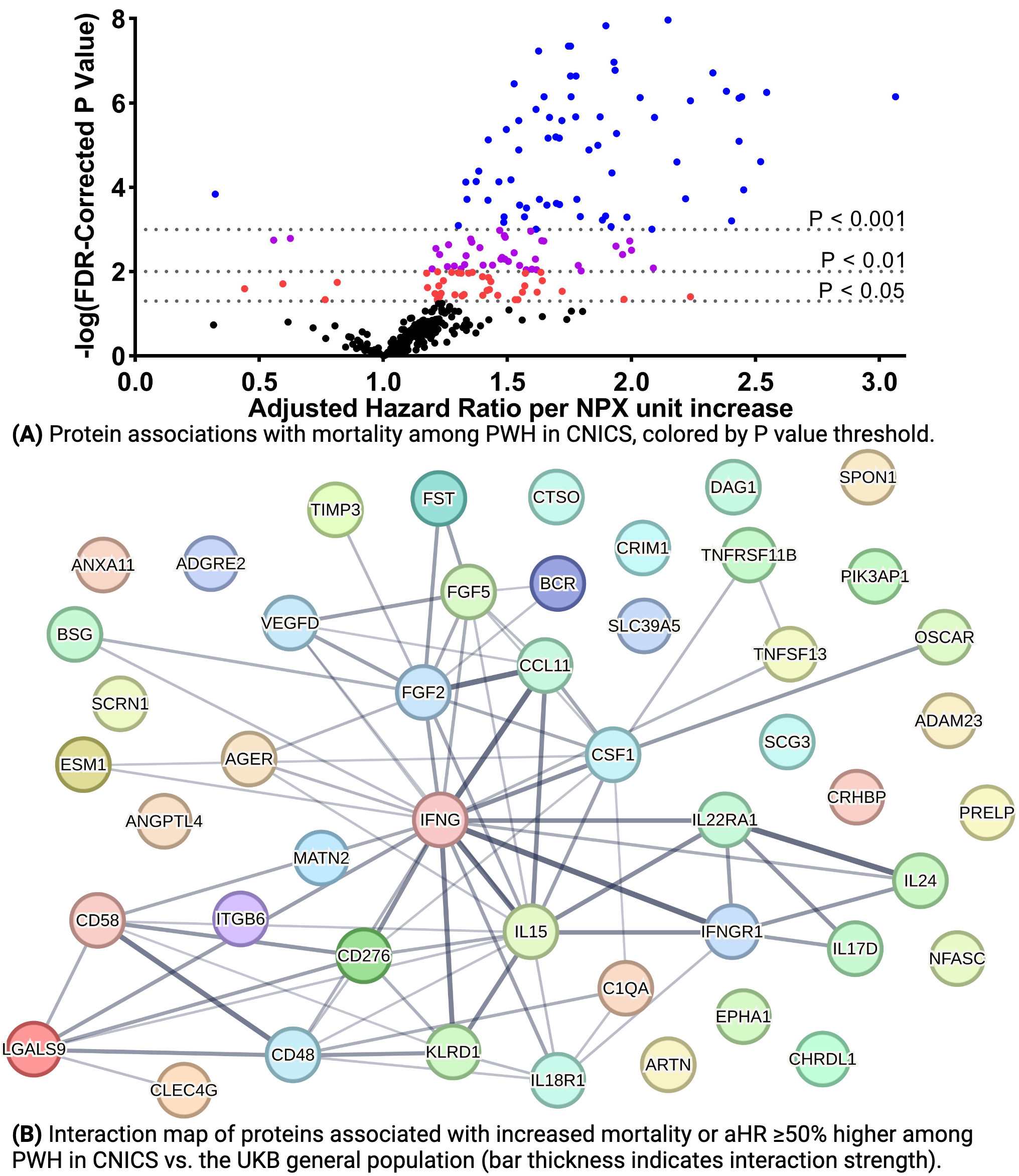
Among 922 PWH in CNICS, median age was 47 and 18% were women. Median current and nadir CD4 counts were 579 cells/mm³ and 245 cells/mm³, respectively. Over a median follow-up time of 9 years, 103 deaths occurred. After adjustment and FDR correction, 147 (40%) proteins were associated with an increased (N=140) or decreased (N=7) hazard of death in CNICS (all FDR-corrected P<0.05, Figure A). Compared to the same proteins assessed in UKB, higher levels of 48 proteins were uniquely associated with increased mortality in CNICS (N=21) or had an aHR at least 50% higher among PWH than in the UKB general population (N=27) (Figure B). While some of these HIV-associated mortality predictors were pro-inflammatory (IFNg, IFNgR1, IL-18R1, and IL-15), the largest cluster comprised immunoregulatory proteins linked to suppressing T, NK, and myeloid cell activation (CD276, CD58, CD48, ITGB6, CLEC4G, and KLRD1) or pro-fibrotic and endothelial cell regulatory processes.
Conclusions:
While numerous pro-inflammatory proteins are associated with mortality in both PWH and the general population, immunoregulatory rather than pro-inflammatory proteins were preferentially associated with mortality risk in PWH. Whether the immunoregulatory response to inflammation is an important causal mediator of increased morbidity and mortality in treated PWH should be explored.