The mechanisms through which HIV infection increases cancer risk are not well understood. We analyzed associations between immunodeficiency and cancer incidence in a nationwide cohort of people living with HIV (PLWH) in South Africa.
The South African HIV Cancer Match (SAM) Study is a nationwide cohort of PLWH in South Africa. It results from a linkage between HIV-related laboratory test records from the National Health Laboratory Services and cancer diagnoses from the National Cancer Registry for the period 2004-2014. Adults aged 18 years or over from this cohort with at least one year of follow-up after their first CD4 measurement were included. We examined associations between time-updated CD4 cell count and incidence rates of various infection-unrelated and infection-related cancers (further classified by underlying infectious agent). We estimated the adjusted hazard ratios (aHR) for cancer incidence, per 100 CD4 cells/µl decrease using Cox proportional hazards models. Models were adjusted for sex, age, calendar year, and comorbidity with other cancers. We assessed whether sex modified the association between CD4 cell count decrease and cancer incidence.
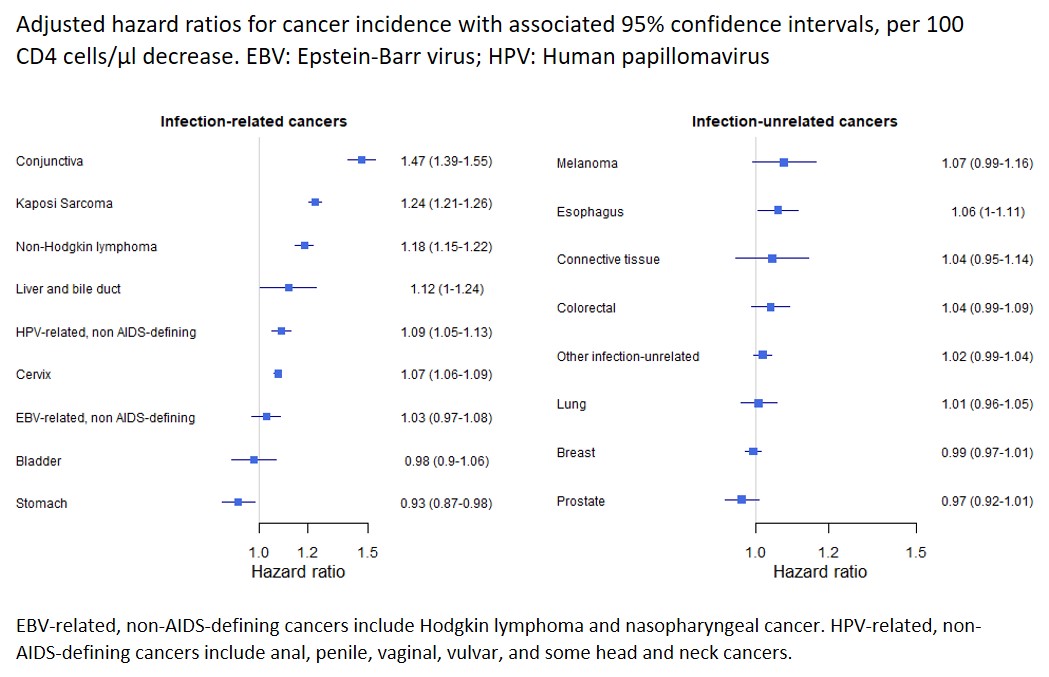
Of 3,454,651 PLWH, 15,059 developed cancer (overall incidence rate: 168/100,000 person-years [py]). The most common cancers were cervical cancer (4,146 cases; 62/100,000 py), Kaposi sarcoma (2,259 cases; 25/100,000 py), and non-Hodgkin lymphoma (1,058 cases; 12/100,000 py). The association between low CD4 cell count and higher cancer incidence was strongest for conjunctival cancer (aHR per 100 CD4 cells/µl decrease: 1.47, 95% confidence interval [CI] 1.39-1.55), Kaposi sarcoma (aHR 1.24, 95% CI 1.21-1.26), and non-Hodgkin lymphoma (aHR 1.18, 95% CI 1.15-1.22), see Figure. Among infection-unrelated cancers, low CD4 cell counts were associated with higher rates of esophageal cancer (aHR 1.06, 95 CI 1.00-1.11), but not breast, lung, or prostate cancer. The association between immunodeficiency and cancer incidence was stronger in women than in men for Kaposi Sarcoma (aHR 1.27 vs 1.18, p-value testing for interaction: 0.005) and non-Hodgkin lymphoma (aHR 1.22 vs. 1.12, p=0.007).
Low CD4 cell count was associated with an increased risk of developing various infection-related cancers among PLWH. Preventing HIV-induced immunodeficiency may be a potent cancer control strategy among PLWH in sub-Saharan Africa, a region heavily burdened by cancers attributable to infections.