It is unclear if chronic immune dysfunction in HIV might affect immune response in COVID19. Our aim was to analyze the inflammatory profile and the immune response to COVID19 of a cohort of patients (pts) with a previous AIDS diagnosis and SARS-CoV-2 infection in an assisted living facility in which an outbreak occurred, and to compare them to HIV-negative COVID-19 patients and advanced HIV-positive without COVID-19.
Levels of the inflammatory markers (IL1, IL6, IL8 and TNF?) were analyzed in advanced HIV+ pts without COVID-19 (group 1), in advanced HIV+ pts infected by SARS-CoV-2 (group 2) along with SARS-CoV-2 specific T-cell response, and in HIV- pts with mild/moderate COVID-19 consecutively hospitalized during the first pandemic wave (group 3). Inflammatory cytokines were quantified by automatic ELISA assay (ELLA system); antibodies titer was evaluated by Elisa assay (Diesse) and SARS-CoV-2 specific T cell response was quantified by Elispot assay. Mann-Whitney was used for comparison between each couple of groups
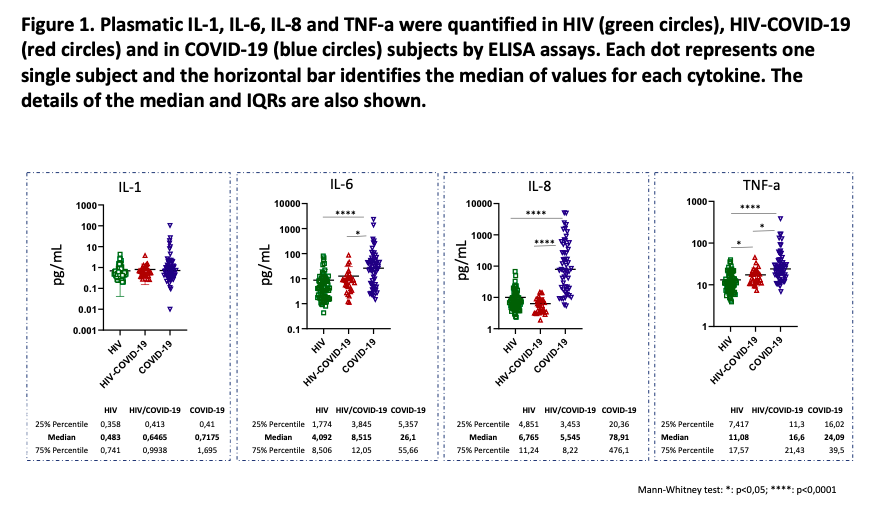
The analysis included group 1 (n=76 pts), group 2 (n=30), group 3 (n=58). Pts of group 1 and 2 did not differ by age, gender and duration of HIV infection. Median CD4 and CD8 was higher in group 2 vs group 1 (348/mm3 vs 118/mmc3 and 756 vs 518; p<.001). HIVRNA was <50cps/ml in 96.7% of pts in group 2 and 70% in group 1. HIV+/COVID19 pts had lower prevalence of COVID19 symptoms than HIV-uninfected COVID19 comparators (p<.001). Pneumonia was diagnosed in 66% of pts in group 2 and 86% in group 3 (p=0.141), and here was no difference for SpO2 at COVID19 diagnosis (p=0.146). 10% of pts in group 2 and 15% in group 3 died during follow-up (p=0.475). Of note, we observed significant higher level of IL6, IL8 and TNF? in group 3 vs group 2 (p<0.05) and group 1 (p<0.0001) (Figure 1). The median time to SARS-CoV-2 clearance was 18 (IQR 16-25) days in group 2, and 12 (IQR 6-23) days in group 3 (p=0.002). Focusing on group 2, 90% of pts showed positive antibodies titers and 100% positive SARS-CoV-2 specific T cell response, suggesting the ability to induce an effective specific immunity.
These preliminary results suggest that HIV infection, even in advanced stage, did not seem to negatively impact on COVID-19-related inflammatory state. Moreover, specific immune response in these patients did not differ than that observed in HIV-negative COVID-19 pts. Further investigations are needed to better define the interplay between HIV and SARS-CoV-2.