Background:
The COVID-19 vaccination campaign is considered the largest in history with over 70% of the global population having received at least one vaccine dose. While vaccination demonstrated outstanding results in cutting down the severity of the disease, breakthrough infections with the Omicron-derived variants occur frequently. Others and we have previously shown that vaccinated individuals develop a potent B cell response following the Omicron breakthrough infection. It is however not clear whether this is due to the reactivation of vaccine-induced memory or de novo response specific for the mutated regions of the spike protein.
Methods:
We compared the adaptive immune response of thrice-vaccinated individuals following Omicron breakthrough infection with those of unvaccinated Omicron-infected and thrice-vaccinated uninfected individuals. Plasma antibodies against Omicron were assessed by normal and competitive versions of ELISA and plaque reduction neutralization assay. Omicron-spike-specific memory B and T cells were assessed by flow cytometry.
Results:
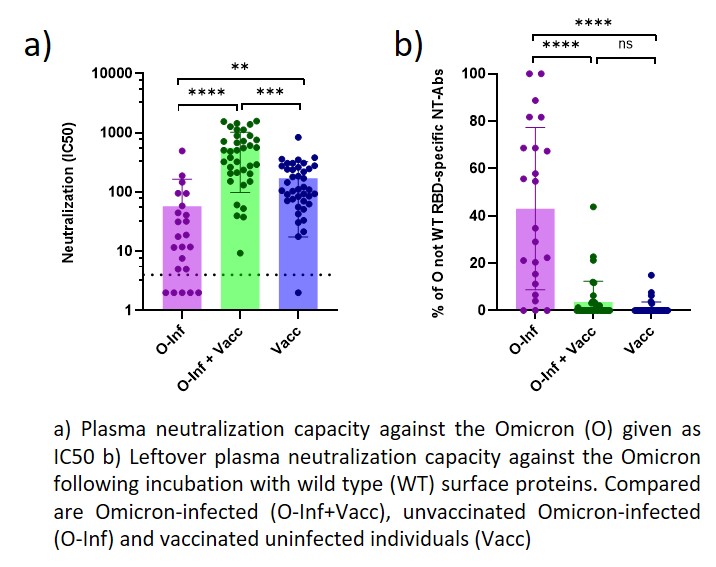
Our data demonstrate higher plasma neutralization potency in vaccinated individuals with Omicron breakthrough compared to the control groups (p<0.001). The levels of Omicron-spike-specific memory B and T cells were comparable between the groups. Importantly, the proportion of antibodies binding mutated regions of the Omicron spike protein was lower in the breakthrough infection group compared to the uninfected vaccinated group (p<0.0001) and equal compared to the vaccinated uninfected group. The same was also true for the proportions of spike-specific IgG+ B cells (p<0.001) and Omicron spike-specific CD4 T cells (p<0.01) targeting regions mutated in the Omicron variant. No significant differences were observed for CD8 T cells.
Conclusions:
Our findings suggest that Omicron breakthrough infection increases the plasma neutralization potency but not Omicron-specific B and T cell levels in previously vaccinated individuals. Both humoral and cellular responses against the Omicron are mostly a recall of preexisting vaccine-induced memory rather than de novo response towards the mutated regions of the spike protein.