Background:
HIV is comorbid with other chronic medical conditions. We have previously shown that HOMA-B as a measure of pancreatic beta cell function is impaired in ART-treated people with HIV (PWH) compared to untreated PWH and to people without HIV (PWOH). Furthermore, proinsulin to C-peptide ratio (PI:C), a marker of beta cell stress, is surprisingly lower in PWH not on ART and with lower CD4 counts, compared to those on ART and to PWOH, thereby suggesting that lack of ART and more impaired T cell function is associated with less beta cell injury. We hypothesized that the immune dysregulation, specifically heightened immune checkpoints (IC), found in untreated HIV is protective against beta cell impairment, similar to Type 1 DM and IC inhibitor-induced DM. Our objectives were to determine the relationships between IC and both HOMA-B and PI:C in HIV.
Methods:
We utilized a sample of 105 patients from four groups (39 PWOH, 15 ART naive PWH with CD4 count < 350 cells/µl, 28 ART naive PWH with CD4 count ≥350 cells/µl, 23 PWH receiving suppressive ART). Soluble IC levels were measured using a magnetic bead-based multiplex assay (Human ProcartaPlex™ panel). We used ANOVA to compare mean soluble IC (PD-1, TIM-3, CTLA-4, CD27 and CD40) between each PWH group and the PWOH group. We calculated Pearson correlations to assess the relationships between IC levels, HOMA-B, and PI:C ratio controlling for age, race, sex and BMI.
Results:
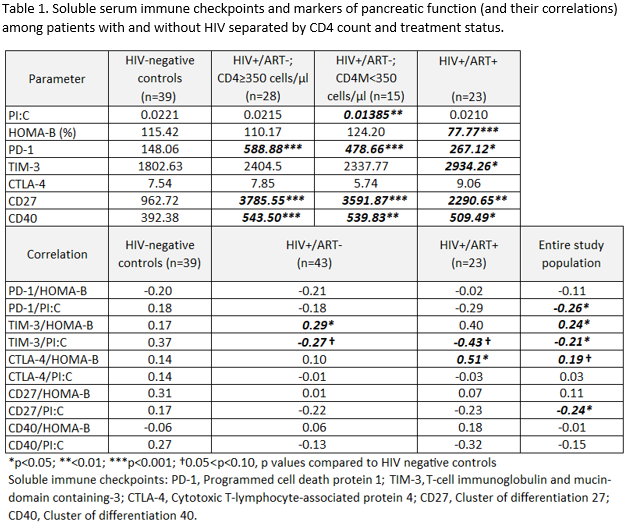
As shown in the Table, PWH had higher circulating levels of immune checkpoints PD-1, CD27 and CD40 (p< 0.001); PWH receiving ART had higher TIM-3 (p=0.037). In the entire study population, we found that PD-1, TIM-3, and CD27 were inversely correlated with PI:C ratio (each p< 0.05) and that TIM-3 was positively correlated with HOMA-B (p=0.022). Stronger correlations were found in the ART-treated PWH group between TIM-3 and PI:C (p=0.048) and between CTLA-4 and HOMA-B (p=0.015).
Conclusions:
In the entire study population, soluble TIM-3 was correlated with better pancreatic beta cell function and inversely correlated with beta cell stress. PD-1, CTLA-4 and CD27 were found to correlate with either HOMA-B or PI:C, but not both markers, making their role in beta cell injury or protection inconsistent. These data suggest that the soluble IC TIM-3 may play a role in the preservation of pancreatic beta cell function in HIV. How these data might reflect effects of cellular bound TIM-3 remains unknown. These results should be confirmed in longitudinal studies of patients initiating ART.
Soluble serum immune checkpoints and markers of pancreatic function