The interferon lambda (IFNL) single nucleotide polymorphism (SNP) rs368234815 has been associated with altered host responses to viral infection. We aimed to determine its impact on CD4:CD8 T-cell ratio normalisation in people with HIV (PWH)
We analysed T-cell responses in PWH enrolled in the All Ireland Infectious Diseases (AIID) cohort who initiated ART starting January 2001 and had more than one T-cell subset measured at least 6 months later. IFNL4 genotyping was performed on genomic DNA employing allelic discrimination. We collated demographic (age, sex, ethnicity, HIV acquisition risk), clinical and treatment (ART regimens, CD4 and CD8 T-cell counts, HIV RNA) data. Primary outcome was time to normalisation of CD4:CD8 ratio (?1). We used Cox regression models to evaluate associations between ratio normalisation and IFNL4 rs368234815 alleles (?G/?G or T/?G and T/T). Data are median [IQR] unless specified.
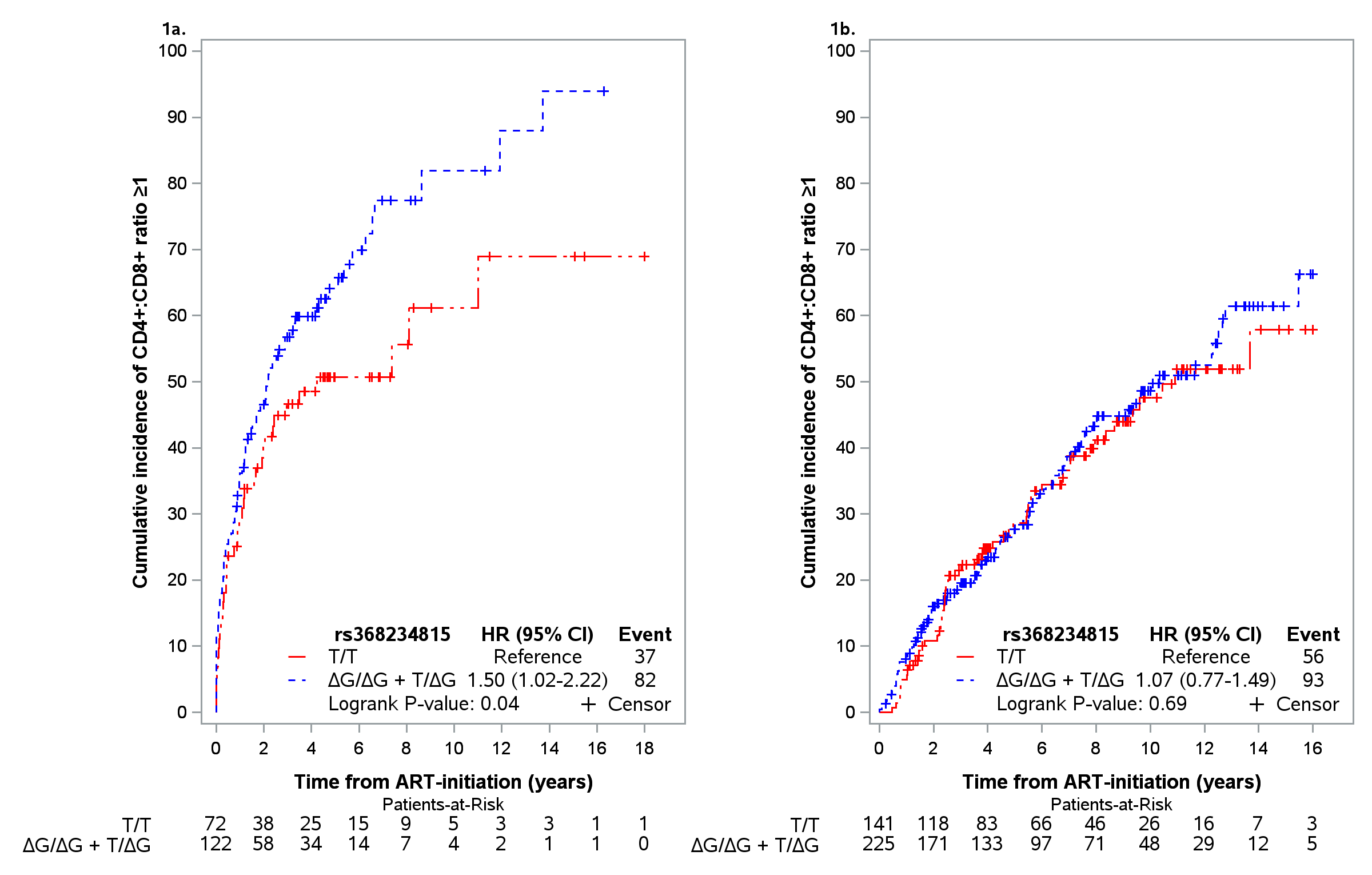
560 PWH, age 34.7 (29.5-40.7) years, 61% male, 53% Caucasian, 48% heterosexual transmission, followed for 7.4 (4.3-11.7) years after ART initiation were included. Nadir CD4 count was 267 (151-414.5) cells/mm3, 39% and 36% were initiated on an NNRTI or PI. Overall 268 (47.8%) achieved a CD4:CD8 ratio ?1, with median 7.6(95% CI 6.6-9.4) years to ratio normalisation. The probability of CD4:CD8 ?1 was estimated at 16 (13.0-19.1)%, 32 (27.5-35.5)%, 38.8 (34.3-42.9)% and 56.5 (51.0-61.3)% at years 1, 3, 5 and 10 respectively. Those with a baseline CD4 ?350 cells/mm3 were significantly more likely to achieve CD4:CD8 ?1 (HR=2.73 (2.13, 3.49) p<0.001). PWH with baseline CD4 T-cell count ?350 and expressing IFNL4 rs368234815 (?G/?G or T/?G) were more likely to achieve CD4:CD8 ?1 compared to those with T/T major homozygosity (HR=1.51, 95% CI (1.02, 2.23), P=0.038, Figure 1a). There was no association between rs368234815 and CD4:CD8 normalisation in subjects with baseline CD4+ <350 cells/mm3 (Figure 1b). The association between rs368234815 (?G/?G or T/?G) and CD4:CD8 normalisation persisted in analyses adjusted for gender, ethnicity, HIV transmission risk and age fitted as either a continuous (HR=1.59 (1.06, 2.38), P=0.024) or fractional polynomial (HR=1.49 (1.00, 2.23), P=0.049) variable.
In PWH starting ART with a CD4 count ?350, rs368234815 IFNL4 (?G/?G or T/?G) is associated with an increased likelihood of CD4:CD8 ratio normalisation. The role of IFN4 in modulating persistent inflammation on ART warrants further investigation