Sustained viral suppression (VS) following early treatment initiation among people diagnosed with HIV is key to reducing mortality, opportunistic infections, and transmission. We examined viral load (VL) patterns and associated demographics 2 years after diagnosis for the District of Columbia (DC).
Using DC’s surveillance data, we included people diagnosed with HIV in 2016-2017 residing in DC at diagnosis, age ?13 years at diagnosis, ?2 VL tests after HIV diagnosis, and alive ?2 years after diagnosis. We categorized VL patterns as Sustained VS (achievement and maintenance of VL <200 copies/ml for 2 years after diagnosis) or Unsustained VS (all others). We separately calculated the % time with VL above 200 copies/ml (TA200), categorized as 0-10% or 11-100%. Descriptive statistics including time from diagnosis to VS were assessed. We performed multivariable (MV) analyses to determine associations between demographic and clinical characteristics and sustained VS and 0-10% TA200.
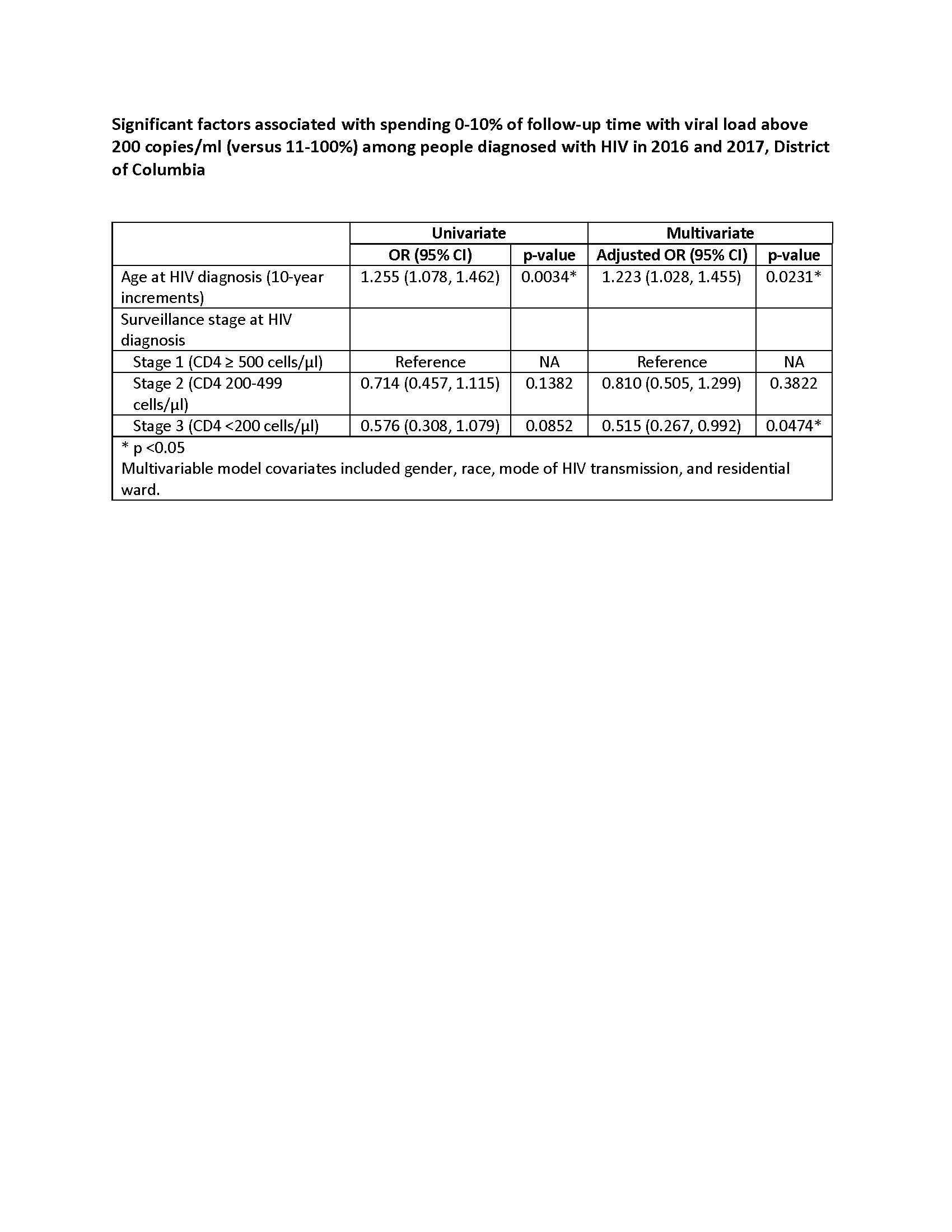
Of the 508 in the VL pattern analysis, 399 (79%) had Sustained VS and 109 (21%) had Unsustained VS. In the MV analysis, older age at diagnosis (aOR 1.24, 95% CI 1.01, 1.53; 10-year increments) and Ward 7 residence (aOR 2.92, 95% CI 1.02, 8.35) were associated with Sustained VS. Injection drug use as an HIV transmission risk factor was negatively associated with Sustained VS (aOR 0.20, 95% CI 0.07, 0.60). Of the 504 in the %TA200 analysis, 142 (28%) had 0-10% TA200 and 362 (72%) had 11-100% TA200. The median time from diagnosis to first viral suppression was 45 days (IQR 61) for the 0-10% TA200 group and 142 days (IQR182) for the 11-100% TA200 group. In the MV analysis, age at diagnosis (aOR 1.22, 95% CI 1.03, 1.46) and HIV stage (CD4 <200 cells/µl: aOR 0.52, 95% CI 0.27, 0.99) were associated with 0-10% TA200 (see Table).
Younger age, injection drug use, and stage 3 HIV were associated with worse VL patterns; people with these characteristics may need focused efforts to successfully enter HIV care. The findings can be used towards DC’s efforts to End the HIV Epidemic by shortening the time from HIV diagnosis to ART initiation and VS. The absence of association with other demographic factors strongly suggests that factors not historically measured in surveillance should be examined to determine correlates of successful engagement in HIV treatment.