Background:
The majority of patients newly diagnosed with HIV in the Netherlands are late presenters and had multiple prior missed opportunities to test for HIV. To stop the HIV epidemic, adequate identification of people unaware of their HIV diagnosis is necessary. A proven key strategy, recommended by (inter)national guidelines, is indicator condition-guided testing. The aim of this study is to evaluate the impact of HIV teams on HIV indicator condition-guided testing in hospitals.
Methods:
A single center prospective implementation project was conducted at Erasmus University Medical Center Rotterdam. A two-step approach was used to identify possible HIV indicator conditions by automatic ICD-10 screening, followed by cross-comparing with standardized health insurance (DBC) codes. Data were collected on all patients ≥ 18 years who entered care between January 1st 2020 and June 12th 2022. Flagged indicator conditions were systematically reviewed by the HIV team. Multi-angle intervention started at August 1st 2020 and included proactive testing recommendations from the HIV team for physicians treating patients with HIV indicator conditions. We evaluated HIV indicator condition prevalence and the impact of HIV teams on HIV testing rate overall, per interventional phase and per specialty.
Results:
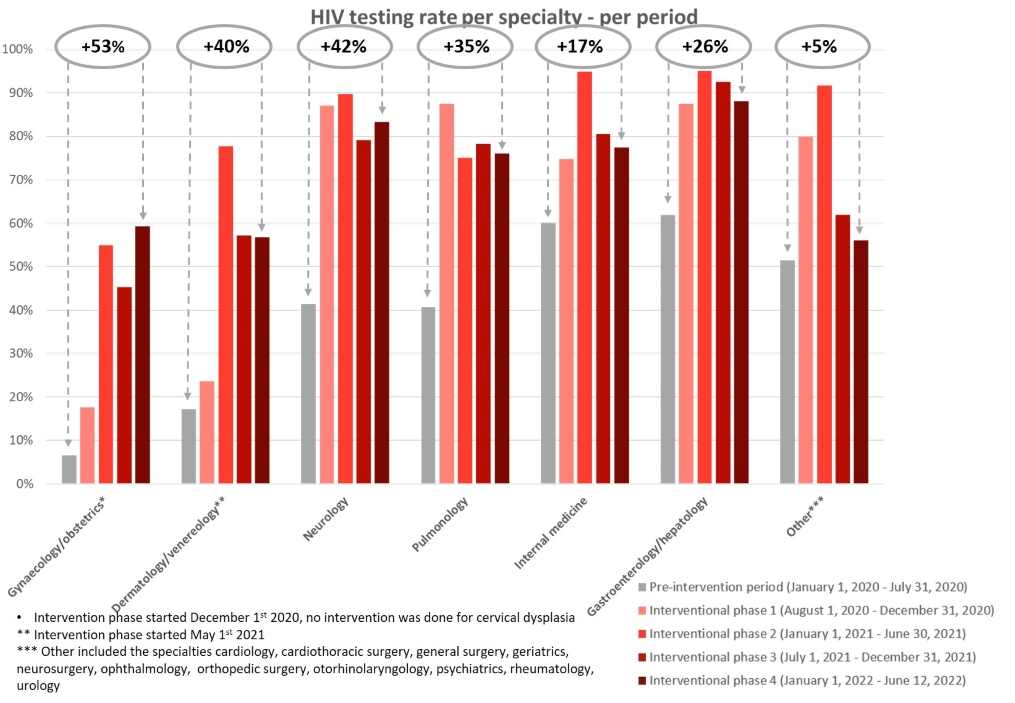
During the study period, a total of 218,211 diagnoses were newly registered. Of these, 18,743 (8.6%) were flagged as possible HIV indicator conditions. After manually reviewing, 2,026 HIV indicator conditions were identified. The overall HIV testing rate was 61.4% (1,244/2,026). In the pre-intervention period, the HIV testing rate was 43%, while after implementing HIV teams, the HIV testing rate was 52.1%, 80.7%, 68.7% and 70.4% for interventional phase 1, 2, 3 and 4, respectively. The overall HIV positivity rate was 0.7% (9/1,244) (pre-implementation 0.4% and post-implementation 0.8%). Looking further at HIV test rates per specialty an increase in HIV testing rate was seen in all specialties with a peak in the first or second interventional phase (figure 1).
Conclusions:
Implementing HIV teams increased the HIV testing rates with continued clinical benefit after an initial peak. Our data confirms a gap between indicator condition identification and HIV testing, even after proactive HIV testing advice. Future studies should focus on improving this gap and evaluate the barriers to test for HIV after HIV testing advice is given.
HIV testing rate per specialty – per period