Background:
The Miami-Dade HIV epidemic is one of the largest and most active regional epidemics in the US. While predominantly an epidemic among men who have sex with men (MSM), there is significant diversity across ethnicity, race, risk group and geography. We characterized the dynamics of HIV transmission between neighborhoods and risk groups in the Miami-Dade region to inform the development of focused interventions.
Methods:
A comprehensive public health dataset of 7274 HIV-1 subtype B partial pol sequences sampled from unique persons with HIV (PWH) between 2015-2020 was combined with a closely related background dataset of 4,250 publicly available sequences. A multistep phylogenetic approach was applied: (1) maximum likelihood phylogenetic inference to identify well-supported monophyletic clades of size ≥5 including ≥2 distinct Miami-Dade neighborhood groups (NBHD), as defined by Florida Department of Health; (2) local clades were used to perform a discrete phylogeographic inference to evaluate transmission dynamics between NBHD (but not within a NBHD) after 2010. Additional metadata including stage of infection was also incorporated into the analysis to estimate migration between NBHDs to evaluate migration between risk groups.
Results:
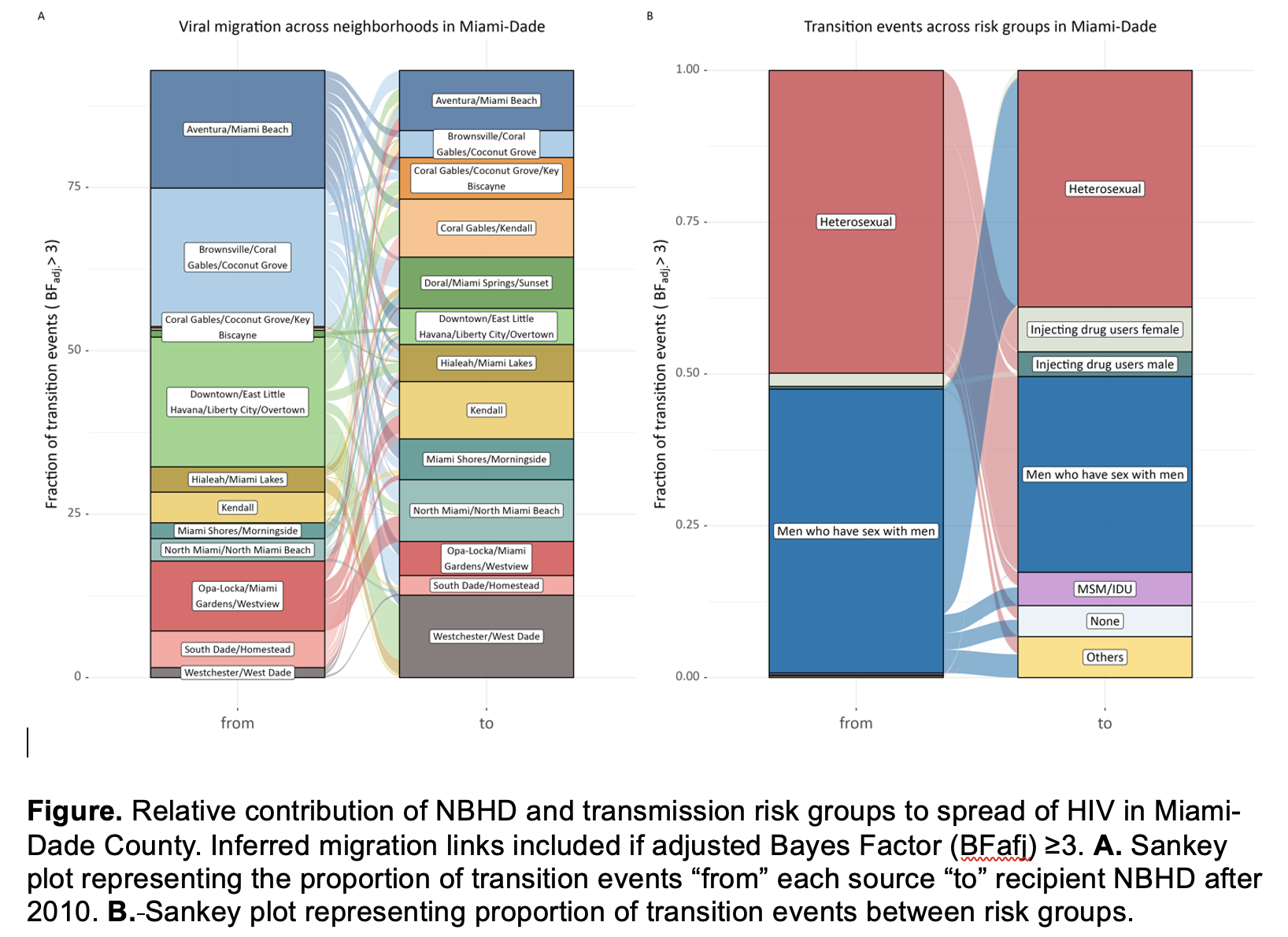
We identified 3,737 HIV sequences forming 315 transmission clusters of ≥5 sequences (range 5–130) that included PWH from at least two NBHDs. PWH belonging to these clades were predominantly male (76%), Hispanic (53%), and MSM (55%). Discrete phylogeographic analysis of identified clades suggested that the NBHD of Downtown/East Little Havana/Liberty City/Overtown (21% of all dispersal events, after 2010), Brownsville/Coral Gables/Coconut Grove (22%), and Aventura/Miami Beach (19%), were the major sources of viral flow to other NBHD in the Miami-Dade region (Fig. 1AB). Overall, heterosexuals and MSM accounted for 49.9% and 46.8%, respectively of putative sources of transmission linking different risk groups.
Conclusions:
Phylodynamic analyses revealed complex HIV dispersal across NBHD in the Miami-Dade region with some key areas predominating as sources of viral dispersal in recent years. HIV transmissions between risk groups were nearly equally likely to arise from MSM and heterosexuals. These results highlight the role of the central east region in the geographic spread of HIV within Miami-Dade County. These analyses suggest earlier diagnosis and treatment of individuals in these neighborhoods may have outsized impacts across the region.