Background:
Female bar workers (FBW) in eastern Africa often engage in sex work. However, population-level data on HIV seroprevalence, incidence, and viral suppression among FBW are rare.
Methods:
FBW were identified through longitudinal population-based HIV surveillance in southern Uganda via the Rakai Community Cohort Study between 2012 and 2019. Surveillance was conducted across five surveys in four high HIV prevalence (>35%) Lake Victoria fishing communities and 36 moderate HIV prevalence (~12%) inland agrarian and trading communities. Participants were classified as FBW if they reported bar work as a primary or secondary occupation. Sociodemographics and sexual behaviors of FBW were compared with participants never classified as FBW (non-FBW). Primary outcomes included laboratory-confirmed HIV seropositivity, seroincident HIV infection measured via paired serologic testing, and HIV viral load suppression (<200 copies/ml). Prevalence and incidence rate ratios (PR, IRR) were estimated using age-adjusted Poisson regression models with 95% confidence intervals (95%CI).
Results:
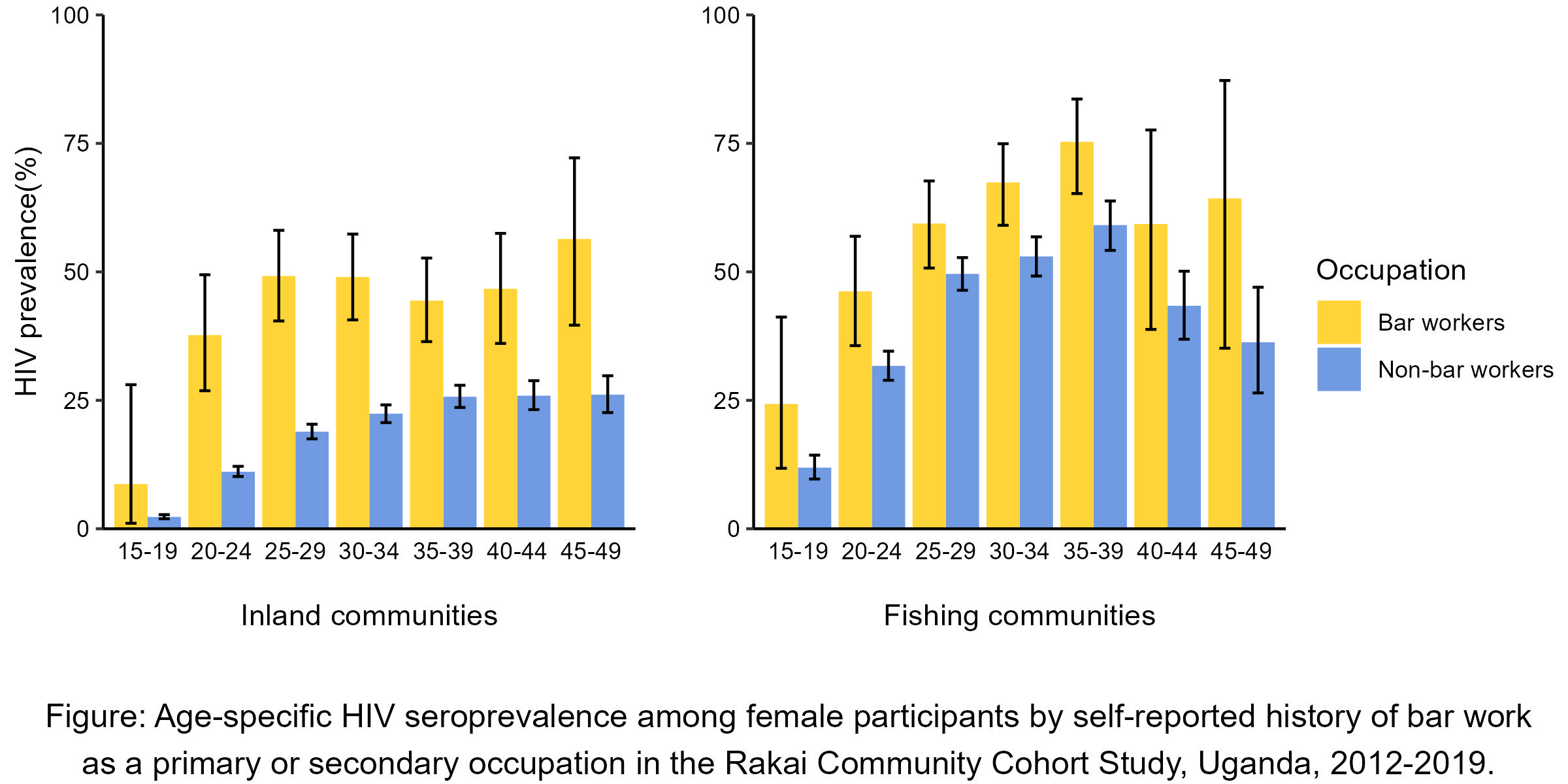
A total of 23,556 female participants contributed 52,708 person-visits. Overall, 1,205 (5.1%) women self-identified as FBW at one or more study visits. FBW were significantly older, more likely to report recent migration, and had substantially higher levels of HIV-associated risk behaviors, including higher numbers of lifetime and prior-year sexual partners and alcohol use before sex, compared to non-FBW. FBW also had significantly higher HIV seroprevalence irrespective of age or community (Figure). Among 364 FBW participating in at least four surveys, only 50 (13.7%) self-reported being a bar worker at all surveys, while 128 (35.2%) reported bar work at only a single survey. Overall, 377 HIV incident events occurred over 41,030 years of participant follow-up. Incidence among FBW was 1.76/100 person-years versus 0.90/100 person-years among non-FBW (adjIRR:2.24; 95%CI: 1.27-3.63). However, FBW living with HIV irrespective of antiretroviral use tended to have higher levels of population HIV viral load suppression compared to non-FBW (62.9% vs 54.9%; adjPR=1.08, 95%CI: 1.01-1.17).
Conclusions:
Enhanced prevention services for female barworkers in Uganda are needed and may reduce HIV incidence in this population. However, high mobility and frequent fluctuation in and out of bar work may complicate delivery of interventions, such as long-acting injectable pre-exposure prophylaxis.