Background:
HIV genetic sequencing enables identification of growing transmission clusters, but typically occurs after a person diagnosed with HIV is linked to care and undergoes drug resistance testing. Many surveillance systems utilize these sequences to assess for outbreaks but could miss members who have not engaged in clinical care. We assessed whether additional sequencing from remnant diagnostic specimens could enhance cluster detection and response activities in a statewide surveillance system.
Methods:
We built an analysis platform to monitor HIV clusters in North Carolina (NC). To date, >20,000 pol sequences from routine “clinical” genotypes have been systematically reported to state surveillance from reference laboratories. From 2018 to 2021, we performed next-generation sequencing (NGS) on remnant diagnostic specimens from individuals with new HIV diagnoses at the NC State Laboratory for Public Health to augment molecular surveillance. We evaluated clinical and cluster characteristics of persons who had subsequent clinical sequences compared to those who only had NGS at diagnosis. Clusters were defined at < 1.5% genetic distance threshold between ≥2 sequences using the TN-93 model, including sequences from persons diagnosed prior to 2018.
Results:
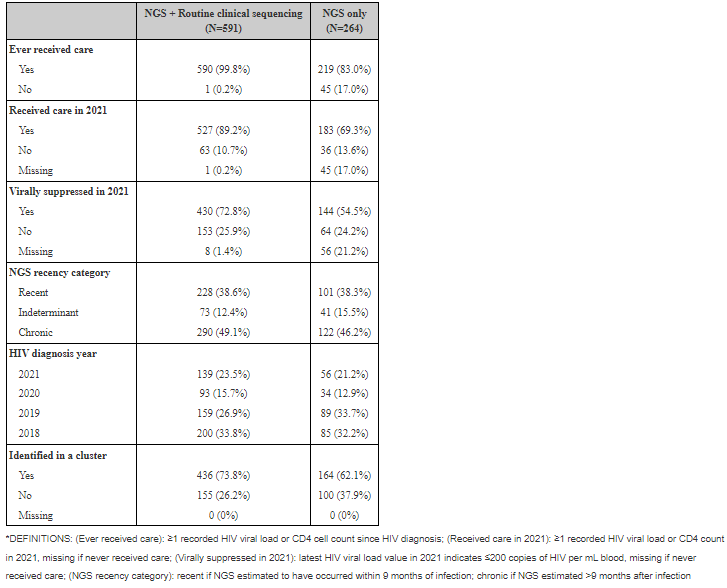
In total, 855 persons newly diagnosed with HIV had NGS from remnant specimens; 591 (69%) had a subsequent clinical sequence reported to surveillance and 264 (31%) had NGS only. Of persons with clinical sequences, 89% had at least one care visit (≥1 recorded viral load or CD4 cell count) and 73% were virally suppressed in 2021. Among persons with only NGS, 83% had linked to care since diagnosis, 69% had at least one care visit in 2021, and 55% were virally suppressed in 2021. Persons with only NGS were less likely to be identified in a cluster (62% vs. 74% with a subsequent sequence). There were 319 unique clusters (median size: 5 members [Range: 2-106]). 122 (38%) clusters included ≥1 newly diagnosed member with only an NGS (median: 1 member [Range: 1-5]). In 22 (7%) clusters (size: 2 [2-6]), all new diagnoses had only an NGS.
Conclusions:
Almost a third of individuals newly diagnosed with HIV did not have a clinically reported HIV sequence following diagnosis. These persons were somewhat less engaged in care, and over half were linked to HIV clusters, including membership in over one-third of clusters. HIV sequencing at the time of diagnosis enhances cluster detection, highlighting areas where intervention and monitoring could be intensified.
Table 1. Clinical* and cluster characteristics among persons who received NGS at diagnosis followed by routine clinical sequencing compared to persons who received NGS only.