Background:
Eswatini’s HIV-1 Recent Infection Surveillance (EHRIS) program, implemented since 2019, identifies trends in recent and long-term HIV infections. EHRIS flags hotspots (HIV testing centers with ≥4 monthly recent infections) for public health responses focused on fidelity to index testing, partner notification, and linkage to PrEP for contacts testing negative. We used synthetic control methods (SCM) to evaluate the impact of this public health response on PrEP enrollment.
Methods:
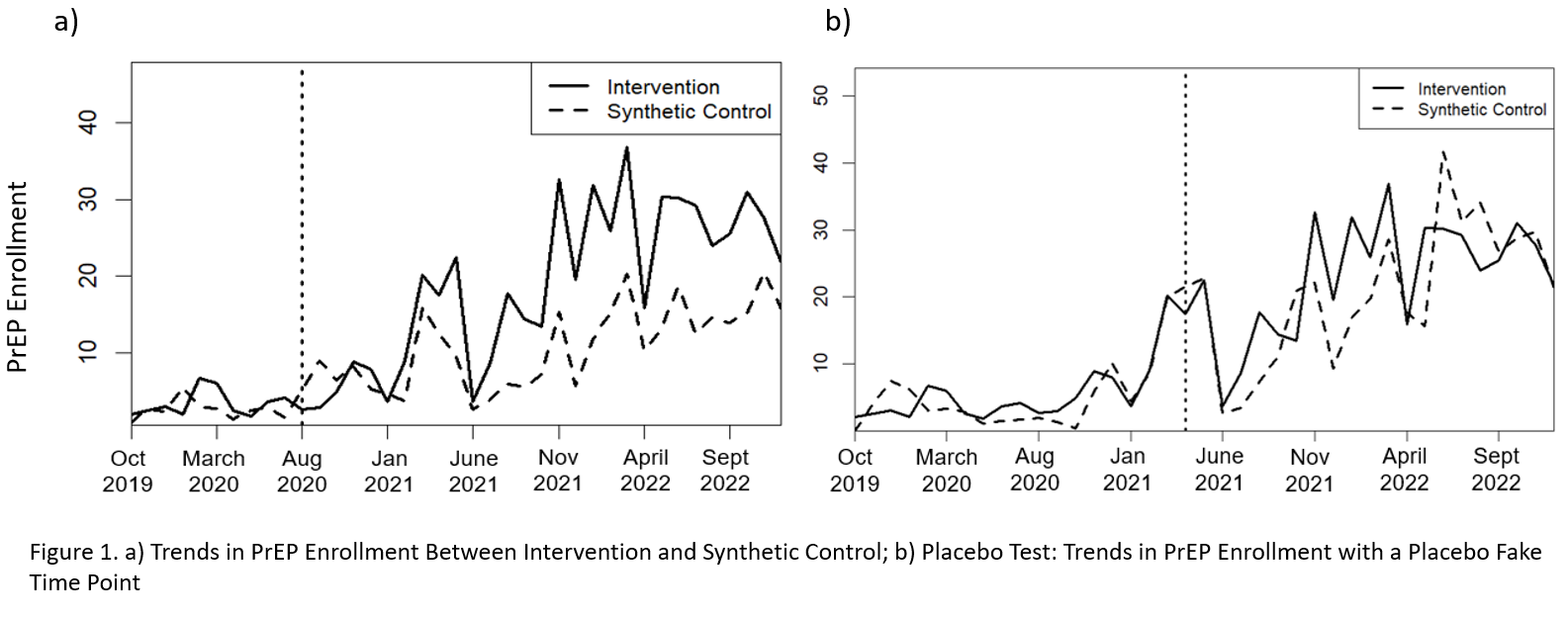
We used October 2019-December 2022 data to conduct a difference-in-difference analysis with SCM to compare trends in PrEP enrollment between intervention (n=9) and non-intervention facilities (n=93) pre- and post-intervention. SCM is a data-driven technique that manufactures a weighted synthetic control (SC) from a pool of possible controls to best approximate pre-treatment trends observed in the intervention unit(s). The intervention point was August 1, 2020. Pre-intervention trends were estimated using facility-level characteristics associated with historic PrEP enrollment trends. To ensure the SC did not create differences unrelated to the intervention, we completed an ‘in-time’ placebo test, using March 1, 2021 as our fake intervention time.
Results:
Similar pre-intervention trends were observed in the intervention clinics and the SC (Figure 1a). The average treatment effect for the post-intervention period was 10.2 additional PrEP enrollees a month, from an average of 6.7 in the SC to 16.9 in the intervention (p=0.004). Six months post intervention, PrEP enrollment increased in both groups but increased more in intervention facilities; this was sustained during the rest of the study period. Between April-December 2022, intervention clinics averaged roughly twice the monthly PrEP enrollment of the SC. Decreases in June 2021 in both arms occurred during a period of political unrest. The mean squared prediction error for the model was 3.41, demonstrating adequate predictive accuracy of the model for program data. The placebo test (Figure 1b) showed no difference in outcome trends unrelated to the intervention.
Conclusions:
EHRIS-informed interventions resulted in increased and sustained PrEP enrollment in intervention facilities in Eswatini compared to the SC. Recency data strengthened linkages to PrEP services among HIV negative contacts and increased PrEP uptake.