Youth account for a disproportionate number of new HIV infections and bacterial STI infections; however, pre-exposure prophylaxis (PrEP) use among youth is limited. We evaluated rates of PrEP counseling among non-Hispanic Black youth after bacterial STI diagnosis.
We conducted a retrospective cohort study of non-Hispanic Black youth who received care at two academically affiliated clinics in Philadelphia, PA between June 2014 and June 2019. All met CDC PrEP eligibility criteria due to qualifying bacterial STI in the past 6 months based on sex assigned at birth and sex of sexual partners. Using episode-level multivariable mixed effects logistic regression analyses, we compared PrEP counseling rates for youth who received primary care services versus those who did not (521 qualifying STI episodes among 416 PrEP-eligible youth).
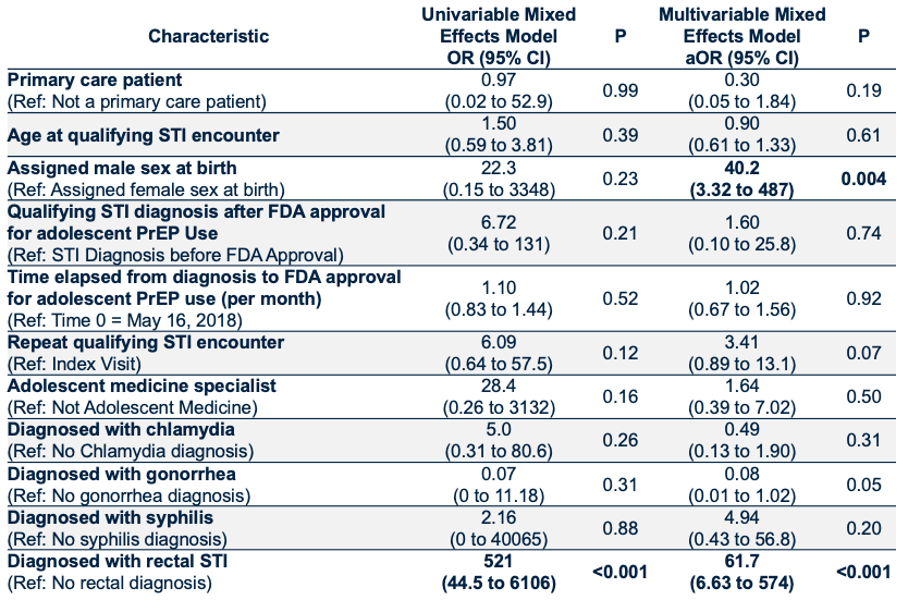
Among this cohort of 416 PrEP-eligible youth, 35 (8%) received PrEP counseling within 6 months of qualifying STI diagnosis. As shown in Table 1, receipt of primary care services was not significantly associated with receipt of PrEP counseling after adjusting for patient- and health care-level factors (aOR 0.30 (95% CI 0.05 to 1.84)). Being assigned male sex at birth (aOR = 40.2, 95% CI 3.32 to 487) and having a rectal STI (aOR = 61.7, 95% CI 6.63 to 574) were strongly associated with receipt of PrEP counseling. Fourteen patients started emtricitabine (FTC) / tenofovir disoproxil fumarate (TDF) PrEP; 12 of whom were sexual gender minority (SGM) patients assigned male sex at birth who received primary care services. We found an 11% (5) HIV seroconversion rate among SGM assigned male sex at birth and an overall rate of 1% among the cohort-none were diagnosed with HIV at index qualifying STI encounter.
These findings demonstrate that PrEP-eligible non-Hispanic Black youth receive PrEP counseling at low rates. Patients assigned female sex at birth were disproportionately and significantly less likely to receive PrEP counseling than patients assigned male sex at birth. Although our findings clearly indicate that PrEP counseling occurred primarily among SGM patients assigned male sex at birth, our effect estimates were unstably large due to the rare occurrence of the outcome among non-SGM patients. These findings support the need for robust investment in PrEP-inclusive sexual health services that are widely implemented and culturally tailored to non-Hispanic Black youth at risk of HIV acquisition, particularly cisgender heterosexual females.