Background:
HIV post-treatment controllers (PTCs) are individuals who control viremia to low or undetectable levels following ART discontinuation. While functional CD8+ T cell responses have been shown to be a defining feature of spontaneous (‘elite’) control of HIV, characterization of features of CD8+ T cell responses in PTCs has been limited. Here, we aimed to characterize the frequency, functionality, and specificity of CD8+ T cells in PTCs following ART cessation.
Methods:
We evaluated HIV-specific CD8+ T cell responses of 7 PTCs alongside a group of 8 spontaneous controllers who had received and later discontinued ART (treated controllers, TC) and 11 non-controllers (NC) during the post-treatment interruption (TI) period. Both PTCs and TCs were defined as having plasma viral loads <10,000 copies/mL for at least 52 weeks post-TI; individuals meeting these criteria were defined as TC if their viral load immediately preceding ART initiation was <10,000 copies/mL, and PTC if otherwise. [i]Ex-vivo[/i] CD8+ T cell reactivity was evaluated by IFN-γ ELISpot and functional proliferative capacity through a six-day CFSE-based proliferation assay with individual optimal clade B epitopes matched to each participant's HLA haplotype.
Results:
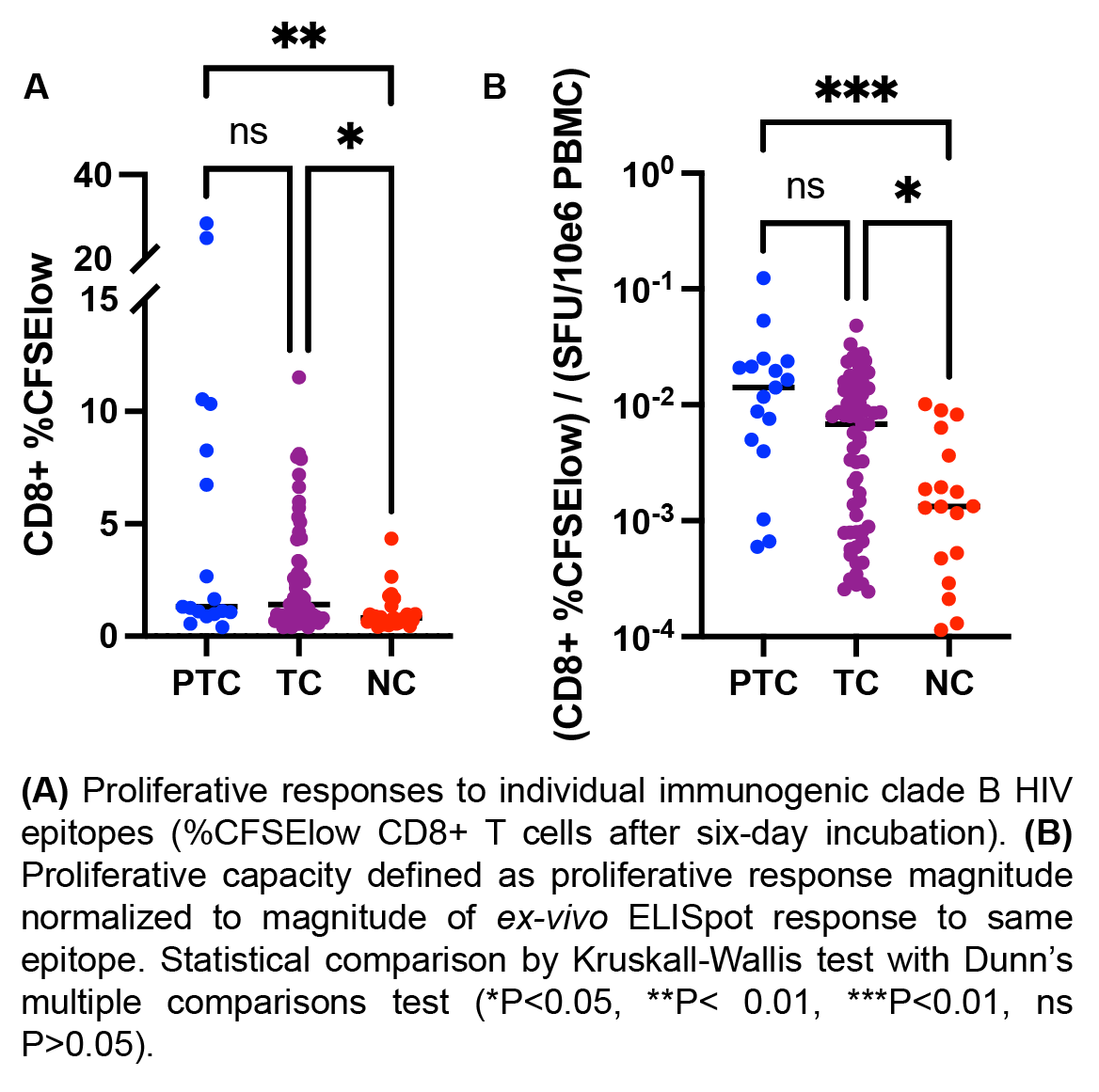
HIV-specific CD8+ T cell reactivity post-TI as measured by ELISpot was significantly lower in PTCs compared to TCs (P<0.01), with no significant differences observed between TCs and NCs. Of note, median plasma viral loads at time of analysis were 50, 638, and 36200 copies/mL in the PTCs, TCs, and NCs respectively. In contrast, both PTCs and TCs had significantly stronger proliferative responses to HIV epitopes than NCs (P<0.01 and P<0.05, respectively). Additionally, we calculated the capacity for antigen-specific CD8+ T cells to expand after antigen exposure by normalizing the magnitude of proliferation to direct ex vivo ELISpot magnitude and observed an even substantially higher proliferative capacity in both PTCs and TCs compared to NCs (P<0.001 and P<0.05, respectively).
Conclusions:
Compared to NCs, PTCs exhibited a distinct HIV-specific CD8+ T cell profile, with less direct ex vivo reactivity but greater proliferative capacity following antigen exposure. These findings warrant further investigation into the mechanisms by which highly expandible antigen-specific CD8+ T cell populations are formed and maintained, and lend further support to therapeutic vaccine strategies aimed at inducing T cell responses that retain high proliferative capacity.