Background:
Understanding gut microbiota variations in HIV is confounded by factors like antiretroviral therapy (ART), immune status, and sexual orientation. We aimed to isolate the impact of integrase inhibitor (INSTI)-based ART on gut microbiota among men who have sex with men (MSM) across varying conditions of HIV status and immune recovery.
Methods:
We conducted an observational study with three cohorts: 1) MSM HIV-negative (HIV-) initiating post-exposure prophylaxis (PEP) with raltegravir, tenofovir disoproxil fumarate, and emtricitabine, sampled on days 0 and 28. 2) MSM with advanced HIV (HIV+ <350 CD4+ T-cells), sampled before and 48 weeks after starting INSTI-based ART. 3) MSM with HIV and adequate immune recovery (HIV+ >500 CD4) after an average of 9.5 years on ART. Stool samples were processed for DNA extraction, sequenced for the V3-V4 regions of the 16S rDNA gene using the Illumina platform and analyzed through the QIIME2 workflow. DADA2 was used to infer Amplicon Sequence Variants, which were assigned to taxonomic entities up to the genera level with a Silva-based 16S Naive Bayes classifier. Differential abundance testing to identify specific taxa was executed with ANCOM.
Results:
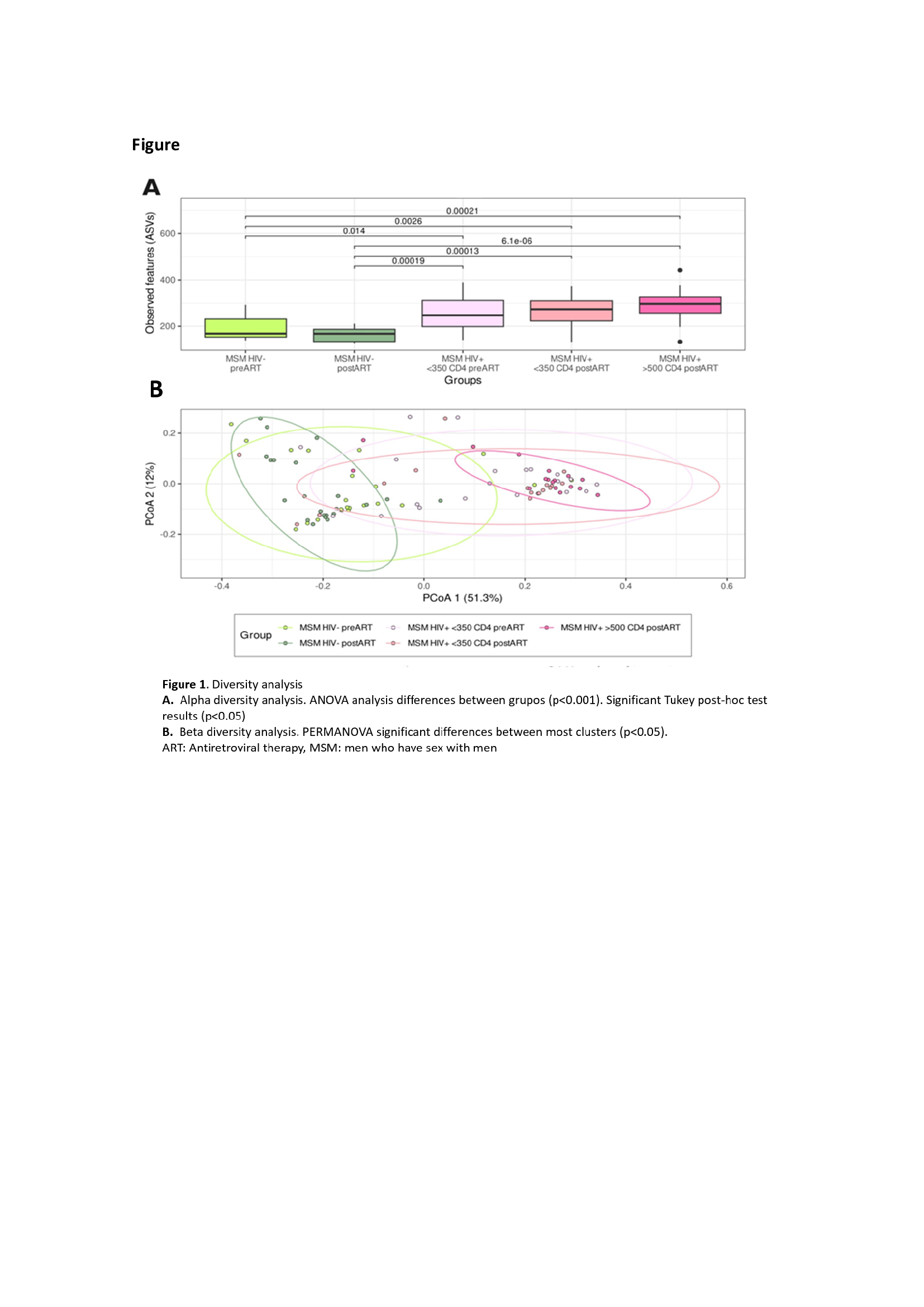
We included 22 MSM HIV-, 23 MSM HIV+ <350 CD4, and 29 MSM HIV+ >500 CD4 participants. Pairwise comparisons were performed to delineate the effects of ART, HIV status, and immune function on microbiota composition. Alpha diversity varied significantly between specific groups (Figure 1A), with highest values in HIV- MSM compared to HIV+ MSM. Weighted UniFrac analysis also demonstrated microbial composition differences between MSM with and without HIV (Figure 1B). Lachnoclostridium genera was more abundant in MSM HIV+ < 350 CD4 (p = 0.0017). Alloprevotella was significantly higher in MSM HIV+ <350 CD4 before ART (p=0.0002) than in MSM HIV-. ART itself showed no significant impact on microbiota composition across all cohorts.
Conclusions:
In this study not confounded by sexual orientation, HIV and immune status significantly affected gut microbiota composition. However, we found no evidence to suggest that INSTI-based ART negatively influences gut microbiota composition.