Increased risk of cardiovascular disease has been reported in people living with HIV (PLWH). Little is known about the prevalence of aortic aneurysms among PLWH compared to uninfected individuals. Here we investigate if HIV status is independently associated with having aortic aneurysms. Furthermore, we determine risk factors associated with aortic aneurysms in PLWH.
PLWH aged 40 years or older were recruited from the Copenhagen Comorbidity in HIV Infection (COCOMO) study and matched on age and sex with uninfected controls from the Copenhagen General Population Study. Aortic dimensions were assessed using contrast enhanced CT images. Aortic aneurysms were defined according to the European Society of Cardiology; i.e. an aortic dilation at least 50% larger in diameter compared to the expected normal diameter or an infrarenal aortic diameter ? 30 mm.
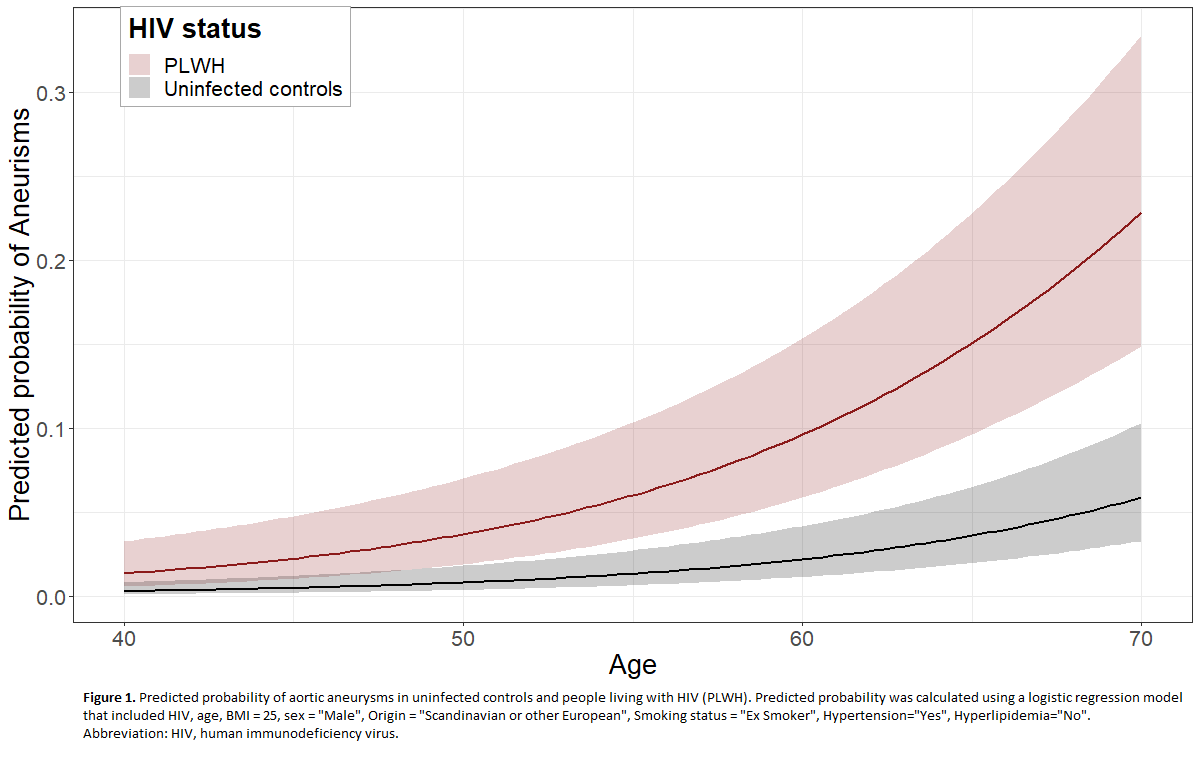
We included 594 PLWH and 1188 uninfected controls, of which 88% and 90% were male and median (IQR) age was 52 (47-60) and 52 (48-61) years, respectively. We found 46 aneurysms in 42 (7%) of PLWH and 31 aneurysms in 29 (2.4%) of the uninfected controls (p<0.001). PLWH had a significantly higher prevalence of ascending, suprarenal and infrarenal aortic aneurysms, but not of descending aortic aneurysms, than the controls. After adjusting for age, sex, hypertension, smoking status, BMI, hyperlipidemia and country of origin, HIV was independently associated with aortic aneurysms (adjusted odds ratio: 4.50 [95%CI: 2.54-7.99], p<0.001). Within PLWH, obesity and hepatitis B co-infection were associated with higher odds of aortic aneurysms, whereas other risk factors, including syphilis and antiretroviral therapy, were not. Predicted probability of aortic aneurysms in PLWH and uninfected controls according to age is shown in Figure 1 (p interaction 0.510).
PLWH had increased odds of aortic aneurysms compared to uninfected controls. HIV was independently associated with a fourfold higher odds of aortic aneurysms. Our findings suggest that increased attention of aortic aneurysms in PLWH is warranted, and further studies should be conducted to determine if screening for aortic aneurysms in PLWH is beneficial.