Background:
Tissue reservoirs constitute a significant source of latent and persistent HIV infection in people living with HIV (PLWH) on antiretroviral treatment (ART). While extensive research has focused on understanding HIV reservoirs in the blood, the intrinsic characteristics of viral reservoirs within tissue compartments remain largely unknown. In this study, using tonsillar and intestinal explant models of HIV persistence, we characterized the cellular composition of these anatomical reservoirs and evaluated the effectiveness of latency reversal agents (LRAs) in inducing viral reactivation after ART.
Methods:
Human tonsillar (n=5) and intestinal (n=7) tissue resections from uninfected donors were ex vivo infected with HIVBAL for 5-6 days, followed by ART treatment for 2 days to establish persistent viral infection. CD4+ T cells were then isolated and cultured for 22 hours in the presence of various LRAs. Using unsupervised clustering analysis (FlowSOM) we identified distinct CD4+ T subsets. We confirmed the presence of viral reservoirs and assessed the effectiveness of LRAs by quantifying intracellular p24 levels after viral reactivation.
Results:
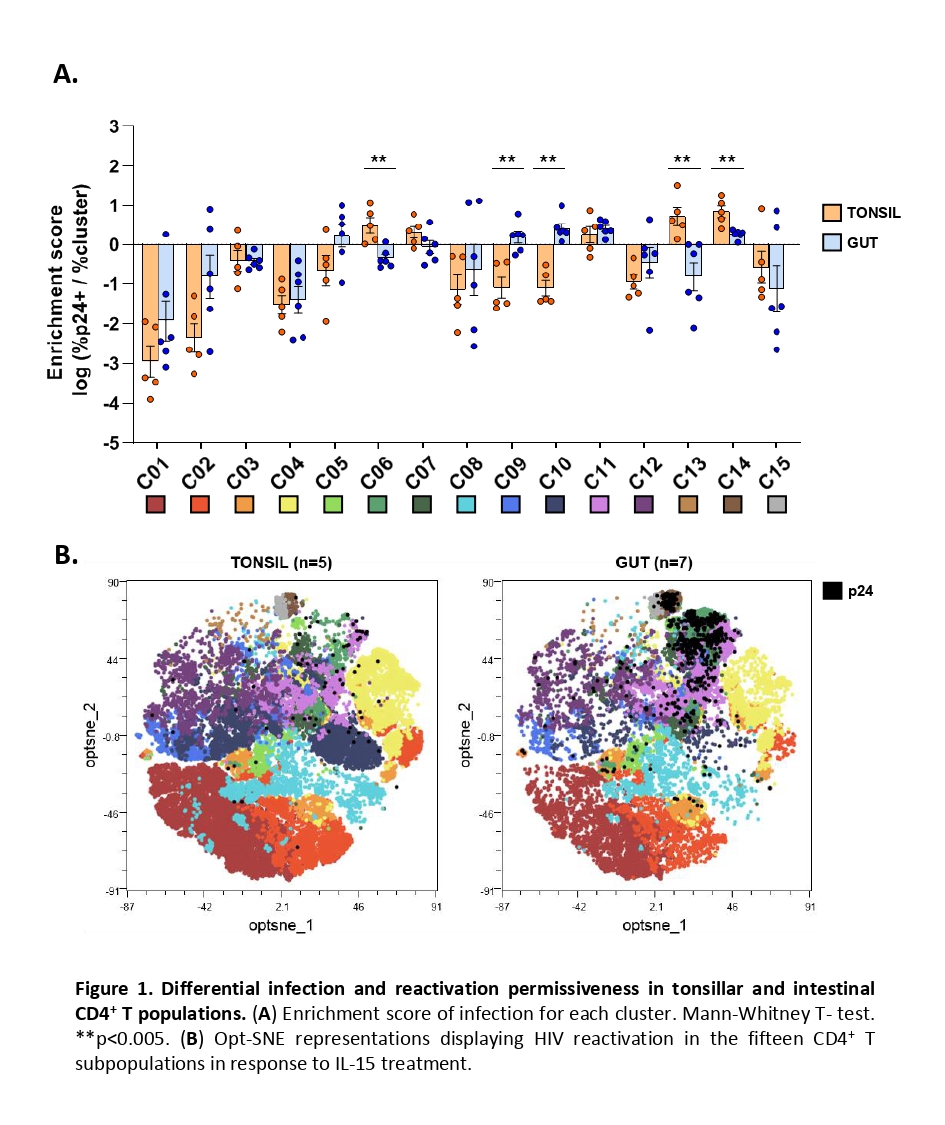
We identified fifteen CD4+ T cell clusters exhibiting significant inter-tissue variations in the proportions of the majority of these subsets (p<0.05). In both tonsillar and intestinal tissues, viral infection predominantly occurred in various populations of effector memory (TEM: C06, C09, C11 and C14), central memory (TCM: C03 and C07) and T follicular helper (TFH: C10 and C12) cells. However, we found differential enrichment of infected CD4+ T subpopulations between tissues (Fig. 1A). Intestinal latently infected CD4+ T cells exhibited greater reactivation with IL15 and AZD5582; whereas the tonsillar reservoirs responded better to ingenol (ING) and the combination of ingenol and romidepsin (ING+RMD). Notably, IL-15 induced potent reactivation in intestinal C06 and C10 (Fig. 1B) while ING and ING+RMD in tonsillar C09. Notably, we observed no significant differences in the proportion of these clusters before and after LRA treatment. Furthermore, no significant changes were observed for the LRAs RMD and panobinostat.
Conclusions:
In our tonsillar and intestinal tissue models of HIV persistence, CD4+ T cell populations exhibited varying susceptibility to viral infection and reactivation, showing significant differences between tissues. Further research is required to identify LRAs effective against distinct HIV cellular reservoirs within these tissues.