Background:
For efficacy trials of novel agents with an active control, cross-sectional recency testing could estimate HIV incidence in the population screened. There is limited experience with use of recency testing to estimate HIV incidence for this purpose.
Methods:
From Aug-Dec 2022, women ages 16-30 were enrolled into the prospective INSIGHT cohort from South Africa (15 sites), eSwatini, Kenya, Malawi, Uganda, and Zambia. Women who screened HIV+ had samples collected for LAg avidity and HIV RNA testing, those with LAg avidity ≤1.5 and viral load (VL)≥1000 copies/ml were classified as recent infections. Women who were HIV-negative were offered enrollment into an open-label PrEP cohort for 6 months. At screening, all were asked about their HIV testing history and prior results. Reporting includes only South Africa and Eswatini, where recency testing is complete. Incidence estimates used ABIE v3.
Results:
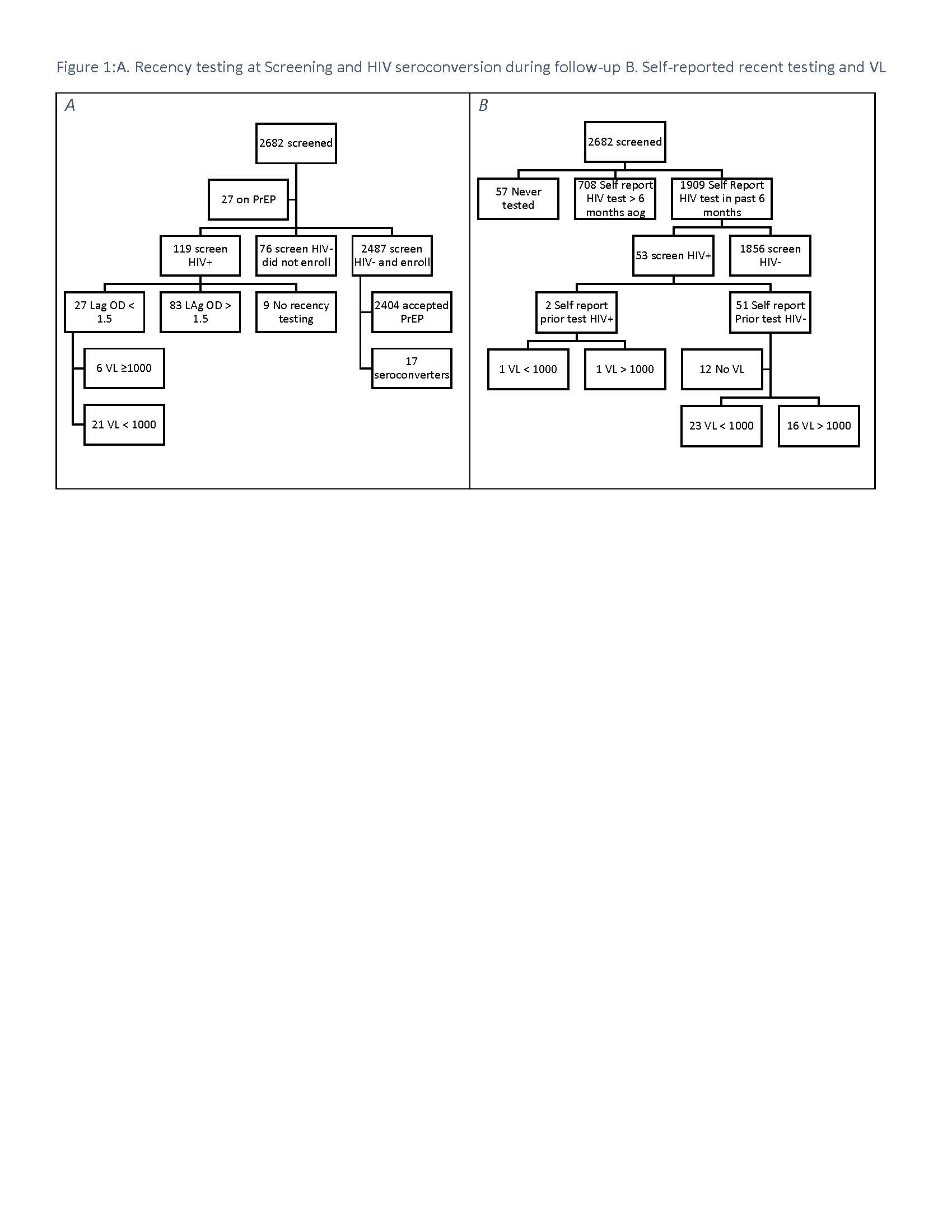
In South Africa and Eswatini, 2682 women were screened (87% of the INSIGHT cohort) and 119 (4.4%) tested HIV-positive, among whom 6 were classified as recent infections (27 had LAg avidity ODn≤1.5 and 21 had VL<1000 copies/ml, Figure A), for an estimated HIV incidence rate (IR) of 0.71 (95% CI 0.14-1.28). Among the 2487 in the HIV-negative cohort followed for 6 months, 97% accepted TDF/FTC PrEP, and there were 17 incident infections, IR=1.23/100 p-y (95% CI 0.77-1.97). 1909 (71%) of this cohort self-reported an HIV test within the past 6 months, including 51 HIV-positive at screening who self-reported a prior HIV negative test (Figure B). Among these 51 possible new infections, 39 had VL obtained; 23/39 (59%) had VL<1000 copies/ml, suggesting ART had been initiated. If the remaining 16/1909 were infections occurring in the prior 6 months, this would be consistent with an IR of at least 1.7/100 p-y, although self-reported test timing and results were unverified.
Conclusions:
In this first reported use of recency testing during screening of women in Africa, estimated incidence using recency was lower than our observed incidence in prospective follow-up with high PrEP uptake and recent placebo incidence rates of 3-4% in HIV prevention trials. Cross-sectionally assessed HIV incidence may have been underestimated due to 1) selection bias if HIV testing is frequent and women with HIV are reluctant to screen, and 2) viral suppression from undisclosed early ART. Understanding sources of bias is critical for refining the recency approach and obtaining accurate contemporary HIV incidence estimates.