Background:
New HIV cases are increasing among young men who have sex with men (YMSM) in Brazil. Research is needed to monitor new infections and examine HIV prevention engagement, including HIV testing. For this study, we estimated HIV incidence and explored HIV testing and factors associated with never testing for HIV in a large study of YMSM in Brazil.
Methods:
Data are from the Conectad@s study of YMSM aged 18-24 years in Rio de Janeiro, Brazil. Participants were recruited between Nov/2021-Oct/2022 using respondent driven sampling. Participants were offered HIV testing and were surveyed on demographics, behavior, sexually transmitted infection (STI) and HIV knowledge (validated 12-items measure with scores ranging from 0 to 12; higher scores mean higher knowledge). Recent HIV infection was determined using the Maxim HIV-1 LAg-Avidity EIA assay as part of recent infection testing algorithm (RITA). Annualized HIV incidence and 95% confidence intervals (95%CI) were calculated using the UNAIDS/WHO incidence estimator tool, excluding participants with known HIV diagnosis and those currently on PrEP. We used logistic regression models to assess factors associated with never testing for HIV.
Results:
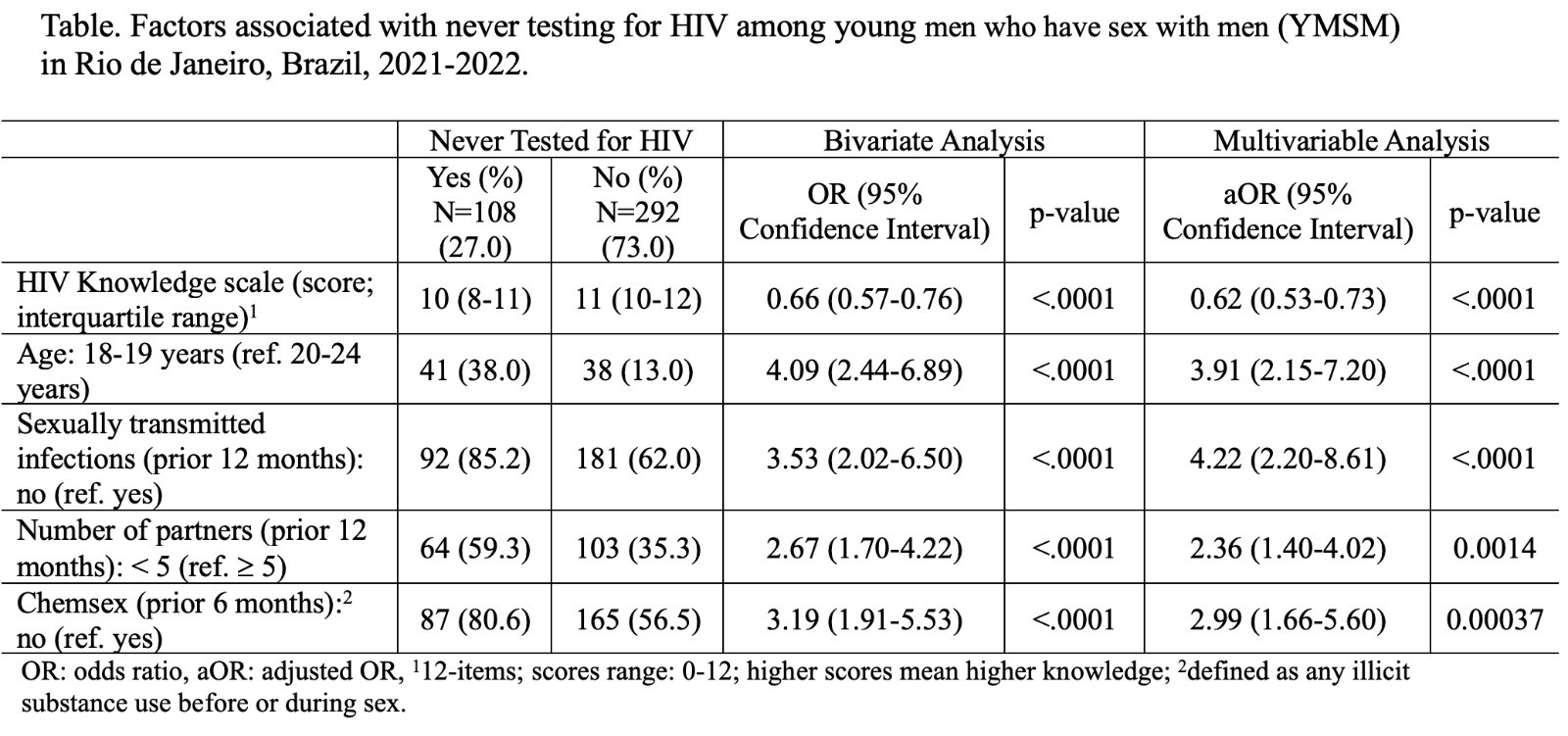
We enrolled 400 cisgender YMSM; median age was 21 years (IQR: 20-23), 166 (41.6%) self-identified as Black, 241 (60.2%) completed secondary school, and 3 (0.8%) were currently using PrEP. Forty participants tested positive for HIV (HIV prevalence: 10%), 5.0% (N=20/400) newly tested positive for HIV, and of those, 5 (25.0%) had a recent HIV infection. The annualized HIV incidence rate was 2.81% (95%CI: 0.32-5.30). Overall, 108 (27.0%) never tested for HIV. Lower HIV knowledge was associated with never testing for HIV. Never testing was associated with being aged 18-19 years, reporting no STI in the last 12 months, fewer sexual partners and no chemsex (Table).
Conclusions:
HIV prevalence and incidence among YMSM in our sample was high. Almost a third of YMSM in our study had never been tested for HIV, although all participants accepted testing when offered. These results point to an urgent need for focused policies and interventions to reach and improve HIV prevention engagement among younger MSM in Brazil. Strategies to raise knowledge and awareness of the impact of HIV among parents, in schools and among youth may be needed to create demand for HIV prevention methods such as testing and PrEP that are readily available in Brazil.