Background:
Despite effective antiretroviral therapy (ART), people with HIV (PWH) develop comorbidities such as chronic kidney disease (CKD) at higher rates and earlier ages than their HIV-seronegative counterparts. PWH are at risk of CKD due to HIV-specific risk factors (e.g., Tenofovir Disoproxil Fumarate or TDF) and traditional CKD risk factors (e.g., age, race). Specific genotypes also increase CKD risk: apolipoprotein L1 (APOL1), glutathione-S-transferase-μ1 (GSTM1), and sickle cell trait (SCT) are all associated with CKD and are common among African Americans. Because TDF is still used for HIV prevention and treatment, we sought to understand the relationship between TDF exposure, high risk genotypes, and CKD risk in African American PWH.
Methods:
We conducted a retrospective follow-up study in African America (AA) PLWH participating in the Center for AIDS Research (CFAR) Network of Integrated Clinical Systems (CNICS) from 2012 to 2018. We collected both clinical data and samples for genotype analysis. We defined CKD60 as eGFR < 60 on two consecutive assessments with at least 60 days between values; eGFR was calculated using the 2021 CKD-EPI equation. Uni- and multi-variable Cox proportional hazards analyses were performed to determine associations with CKD60.
Results:
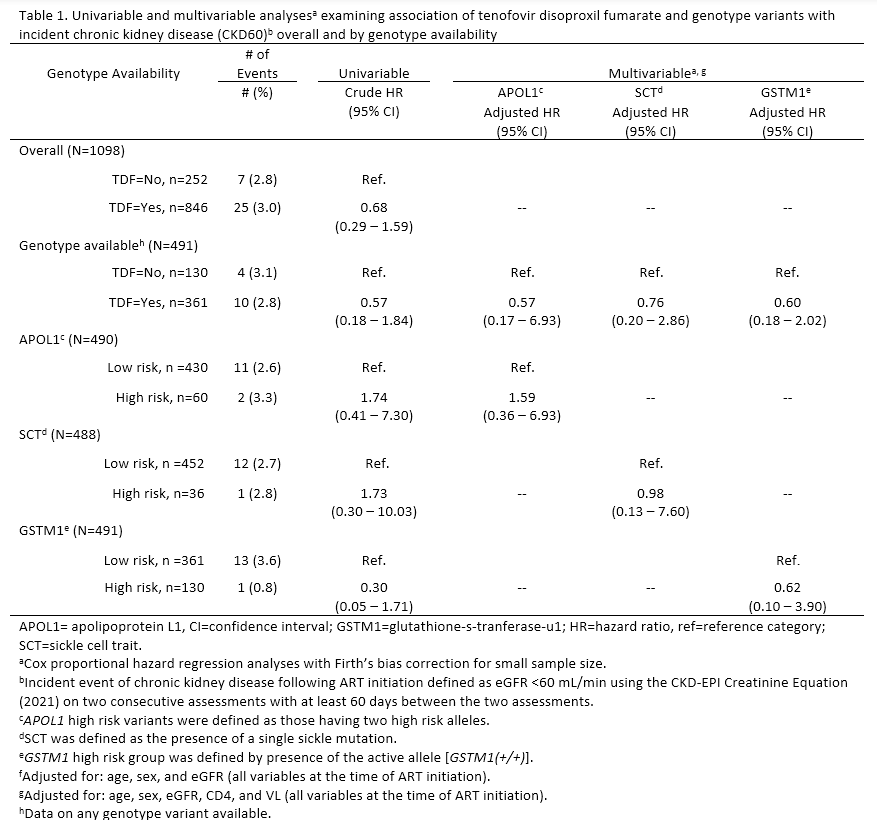
Of 1,098 patients, 846 (77%) received a TDF-based regimen. Overall, 60 (12.2%) had a high-risk APOL1 genotype, 130 (26.5%) had a high risk GSTM1 variant, and 36 (7.4%) had SCT. Of the TDF-receiving group, 25 (3.0%) met the criteria for CKD60 compared to 7 (2.8%) of those not receiving TDF. When analyzing CKD60 risk considering APOL1 genotype and TDF exposure, there were no statistically significant relationships. Low rates of CKD60 in those with other high risk genotypes made it difficult to determine relationships with CKD60.
Conclusions:
In this multisite cohort of AA PLWH, over 25% had one or more high-risk genotypes. TDF exposure did not significantly increase the risk of CKD60, regardless of genotype. Future studies should evaluate CKD risk with TDF and TAF exposure in larger diverse cohorts, as well as analyze other HIV-associated comorbidities associated with high-risk genotypes.
Table 1. Univariable and multivariable analyses examining association of tenofovir disoproxil fumarate and genotype variants with incident chronic kidney disease (CKD60) overall and by genotype availability