Background:
HEU infants are at risk for adverse metabolic, infectious, and neurodevelopmental outcomes when compared to HIV unexposed uninfected (HUU) infants. However, the relationships between maternal immunity in pregnant women with HIV (PWWH) and their HEU infants are largely unexplored. Proinflammatory immune pathways from PWWH and their HEU infants were examined in comparison to pregnant women without HIV (PWWOH) and their HUU infants.
Methods:
Archived plasma samples from 46 ART-treated PWWH prior to delivery and their HEU newborns enrolled in PACTG 316, a Phase III Randomized, Double Blinded Study of Nevirapine for the prevention of maternal-fetal transmission in pregnant HIV-infected women were evaluated. Age-balanced PWWOH (n=18) and their HUU infants served as reference groups. A panel of 21 immune biomarkers associated with germinal center formation, inflammation, and macrophage or lymphocyte activation were measured using Mesoscale Diagnostics multiplex assays. Manifold Approximation and Projection (UMAP) was applied to test for biomarker relatedness of study groups. Comparisons of individual biomarkers between HEU and HUU infants were performed by Mann-Whiney U test, and biomarker correlations between mothers and their babies were assessed by Spearman’s rank test.
Results:
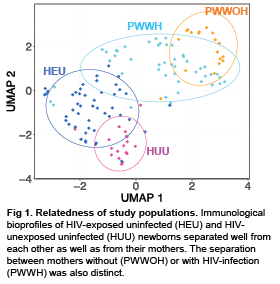
Bioprofiles of HEU and HUU infants separated well from each other as well as from their mothers with distinct separation between mothers by HIV status. HEU infants compared with HUU infants displayed significantly higher plasma levels of biomarkers for germinal center development (APRIL, BAFF, IL-21), macrophage (sCD14, sCD163) or lymphocyte activation (sCD27, IFNγ, IL-22), and pro-inflammatory cytokines and chemokines (CXCL9, CCL4, TNFα, IL-1β, IL-1RA, IL-6). All mother-infant dyads, independent of maternal HIV status, showed positive correlations for BAFF, IL-21, sCD14, IL-17A and CXCL9. In addition, mothers with HIV and their infants showed unique significant positive correlations for APRIL, sCD163, IL-22, CCL4, CCL5, TNFα, IL-1β, IL-1RA and IL-6.
Conclusions:
HEU infants have elevated inflammatory markers associated with innate and adaptive immunity that are distinct from HUU. Levels of some, but not all biomarkers in infants are positively correlated with the levels in their mothers, implying modulation by maternal immunity. Therefore, HIV-associated inflammation in mothers may have long-term implications for early immune development in their HEU infants.
Fig 1. Relatedness of study populations.