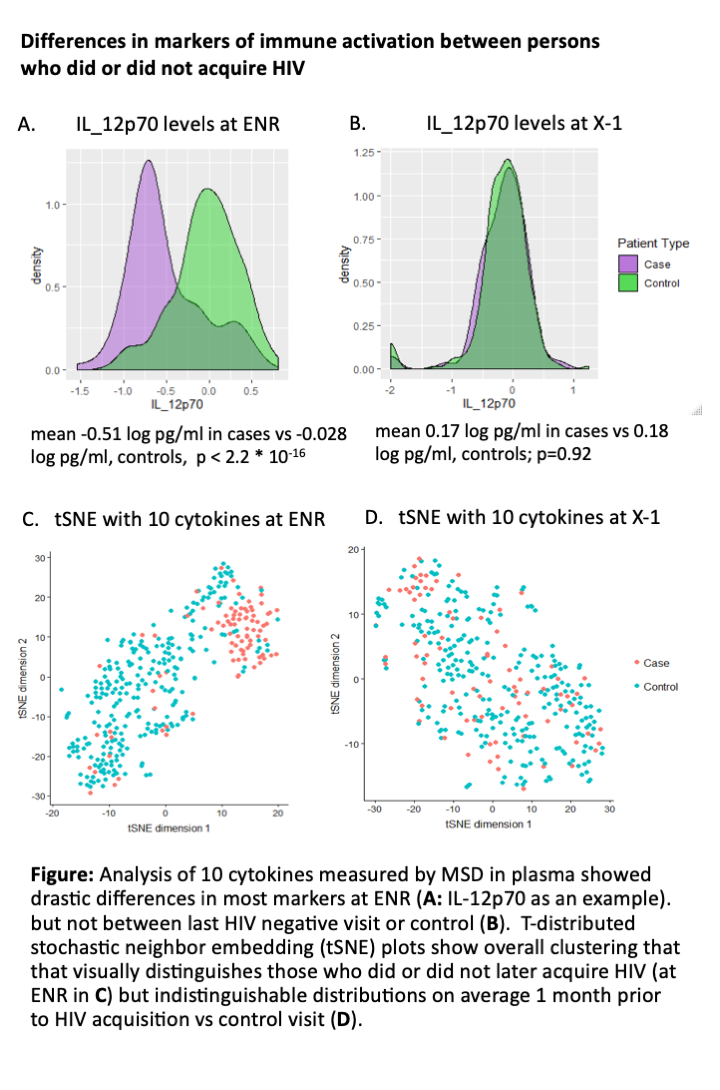
Although immune activation is associated with HIV acquisition, the exact high-risk immune profiles and mechanisms are not well understood. Prior studies attempting to answer this question relied on cross sectional samples, most without close proximity to HIV acquisition.
The Sabes study followed 2,109 MSM and transwomen in Lima, Peru with monthly HIV testing (Ab, RNA). We selected 90 cases who acquired HIV during up to 24-month follow-up and 270 controls who did not, matched 3:1 on time under observation. We conducted a panel of 10 plasma immune activation markers using MSD at enrollment (ENR) and at the visit one month prior to first HIV detection in cases, or matched study visit in controls (X-1). We used linear mixed models to associate biomarker levels at ENR, X-1, and between-visit change with HIV acquisition; we used machine learning (LASSO) to select important biomarkers and covariates, including demographic and behavioral risks factors.
The median time between ENR and HIV acquisition for cases was 361 days (IQR 180, 517). For all tested markers except IL-7 (MIP-1, IL-2, IL-6, IL-10, IL-12p70, TNF-a, IP-10, IFN-?, TNF-?) cases had significantly lower values than controls at ENR but were nearly indistinguishable at X-1 (Figure). LASSO selected increase in IP-10, IL-7, IL-12p70, and IL-10 as jointly predictive of HIV acquisition, and relationships of these markers to outcome were modified by younger age, alcohol consumption, sexual role (versatile, receptive), having post-secondary education, and participating in sex work. Sensitivity analyses for time to HIV acquisition and potential for undetected eclipse-phase (HIV RNA-ve) infections at X-1 sampling did not change these results.
Unexpectedly, markers of immune activation in persons who acquired HIV in the subsequent month were indistinguishable from controls. However, almost all measured markers were significantly lower at enrollment in those who later acquired HIV; among cases, pre-infection levels in those with the largest increases did not exceed levels in controls at X-1. While changes over time may reflect regression to the mean, this study is novel in revealing that absolute changes in several markers were most predictive of HIV acquisition. This work may support a hypothesis that the process of activation, rather than chronic activation, increases risk. Further analysis of VirScan results in this study is ongoing and may shed light on viral infections that could explain these observations.