Background:
The majority of cells that are latently infected with HIV-1 do not produce viral RNA, making it difficult for the immune system and current antiretroviral therapy (ART) to target them. To study the underlying mechanisms governing latent HIV-1 infection, a panel of reverse transcription droplet digital polymerase chain reaction (RT-ddPCR) assays specific for different HIV-1 transcripts has been described that define distinct blocks to transcription.
Methods:
We designed the Rainbow transcriptional HIV-1 RNA 4-plex digital PCR assay, compatible with the QIAcuity 5-plex system, to quantify elongated (long LTR), unspliced (pol), multiple-spliced (Tat-Rev) and completed transcripts (polyA). To evaluate technical performance, a 2-fold dilution curve was prepared containing J-Lat copy DNA (cDNA), ranging from 0.005 to 2.5 ng input, and measured in 20 replicates. This assay was then applied to samples from 40 people living with HIV (PLWH) on ART. Additionally, the HIV-1 DNA reservoir was quantified by the Rainbow proviral HIV-1 DNA assay. Intactness levels were defined by two target regions: psi and env (IPDA), and by four target regions: psi, env, gag and pol (D4PCR). Levels of defective proviruses were measured by the difference between total and intact HIV-1 DNA levels (D4PCR).
Results:
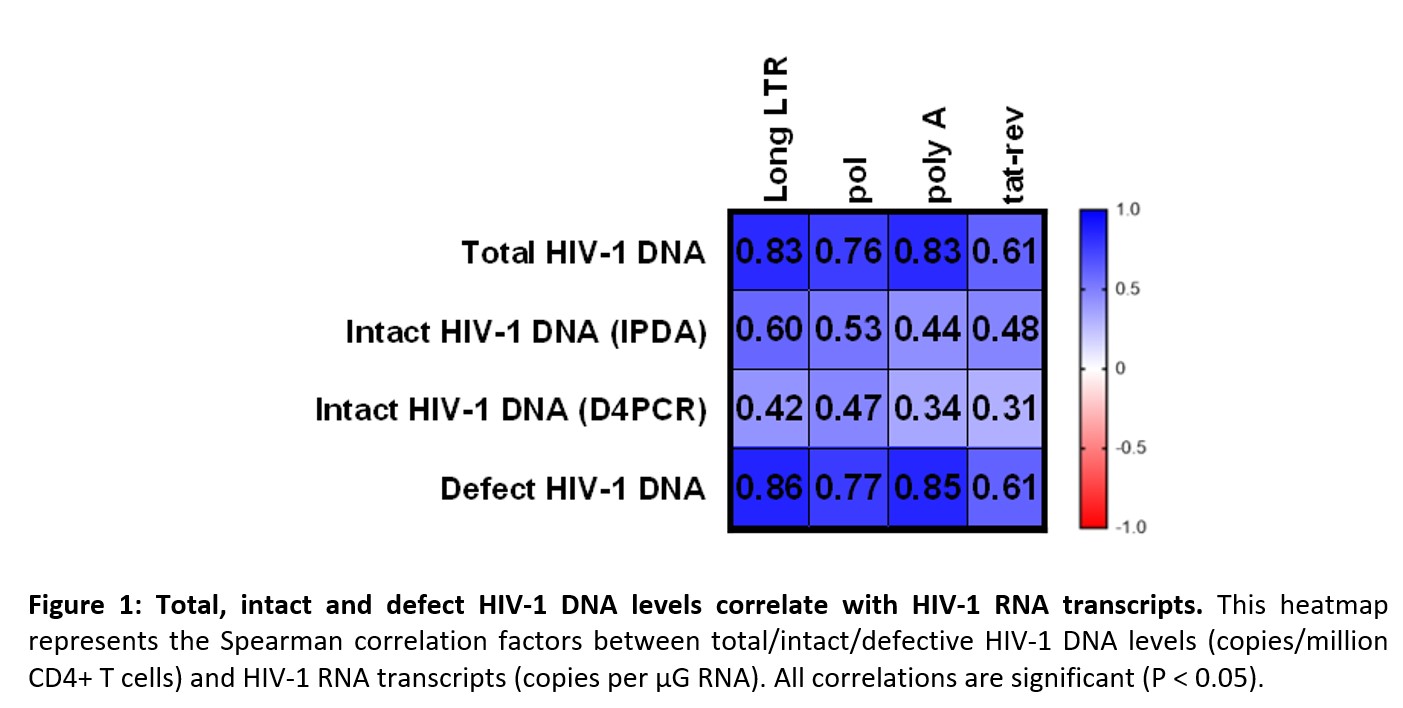
Linear quantification was observed for each HIV transcript (slope: 0.98). The Limit of Detection (LoD) was <10 copies/well for all HIV-1 RNA transcripts, except poly A (average: 11.1 copies/well, range: 5.6-24). The Limit of Blank (LoB) was calculated by using 90 negative template control (NTC) samples, resulting in an LoB of 1 copy/well or less in long LTR, pol and Tat-Rev. The LoB of polyA was 15.75 copies/well. In samples from 40 PLWH, HIV-1 RNA levels were compared to total and intact HIV-1 DNA levels (Figure 1). We found that intactness levels by IPDA correlated better with HIV-1 RNA transcripts than intactness levels by D4PCR. Interestingly, defective proviruses showed a stronger correlation with HIV-1 RNA transcripts compared to intact proviruses.
Conclusions:
The Rainbow proviral HIV-1 DNA and transcriptional HIV-1 RNA assay allow us to map the characteristics of the viral reservoir by using a minimal amount of sample. This analysis resulted in a strong correlation between defective proviruses and HIV-1 RNA transcripts, suggesting that the HIV transcriptional activity is largely driven by defective proviruses.