Background:
The prevalence of aged-associated Alzheimer’s-like disease is increasing in people living with HIV. Disease mechanisms are linked to interactions between progressive HIV infection, neuroinflammation, CD4+ T cell depletion, and aggregation of misfolded proteins. Sustained viral replication in the brain and immune dysfunction accelerates neuroinflammation. Simultaneous HIV and Alzheimer’s disease (AD)studies have been limited due to the lack of appropriate animal models. A relevant animal model would require human microglia and a robust adaptive immune system in an immune-deficient background amenable to human cell reconstitution.
Methods:
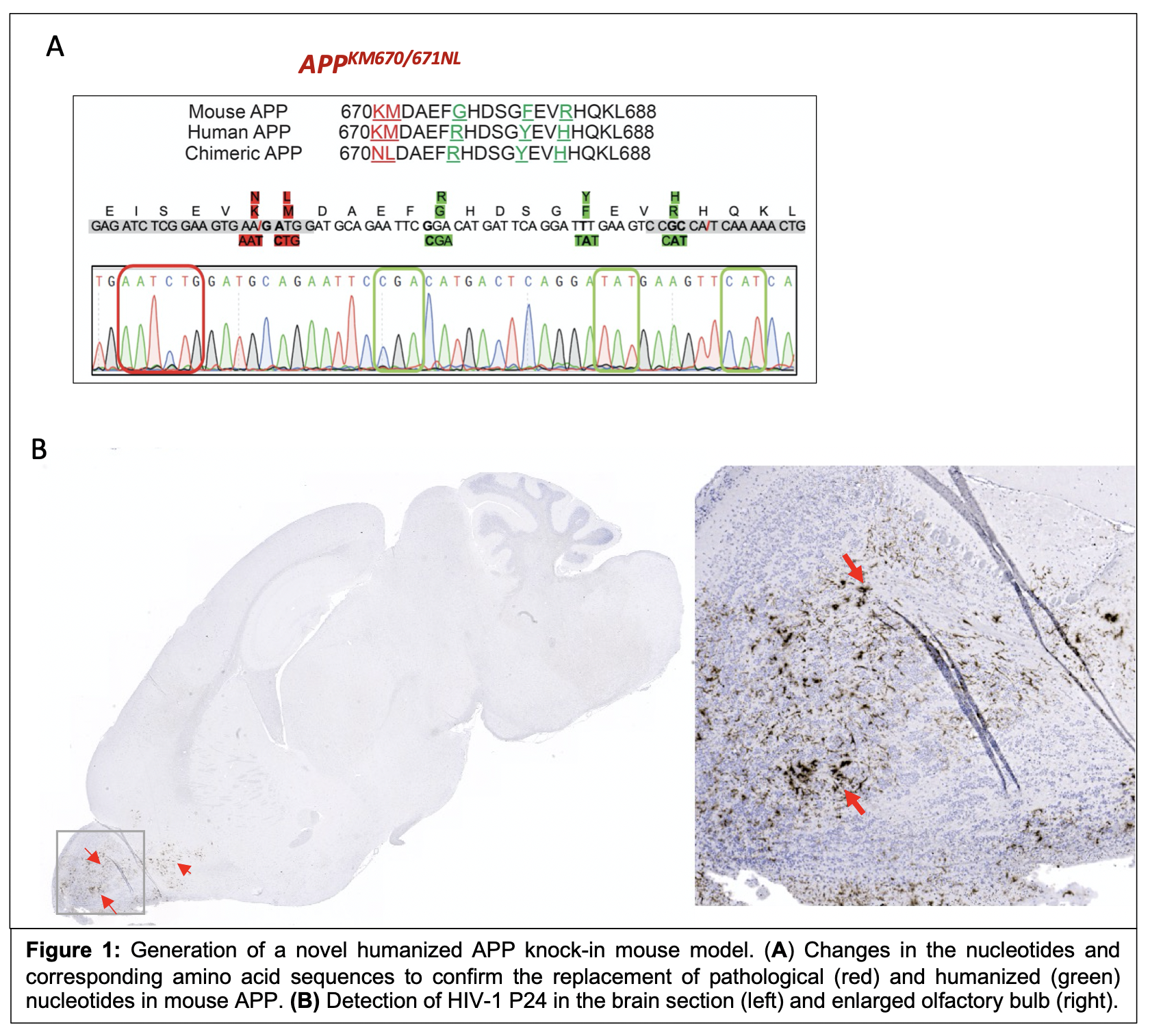
We created a novel humanized AD mouse using CRISPR-Cas9 technology to address the need for an appropriate animal model to study HIV and AD simultaneously. This was accomplished by knocking in (KI) human APPKM670,671NL, PS1M146V, or MAPTP301S in an immunodeficient NOG mouse (Fig 1A). The APP-KI mice were crossed with NOG/hIL34 [NOG/Tg (CMV-IL34], supporting the development of human microglia. This allows the reconstitution of a human innate and adaptive immune system in the brain and periphery (APP/NOG/hIL34 mice). APP-KI/NOG/hIL34 mice were reconstituted with human hematopoietic progenitor cells to evaluate progressive HIV-1 infection. Four-month-old, humanized mice were infected with a macrophage-tropic HIV-1ADA at a tissue culture infectious dose (TCID50) of 10e4/mice. Mice were sacrificed at four and eight weeks after viral infection.
Results:
After four weeks of infection, plasma viral load demonstrated productive HIV-1 infection with an average of plasma HIV-1 RNA levels of 8.96E+03 at 2 weeks and 2.82E+05 at 8 weeks after infection. HIV-1p24 was readily detected in the brain (Fig 1B). After four weeks, the insoluble amyloid burden in HIV-1 -infected mice was markedly increased compared to uninfected controls as determined by amyloid-beta42 (Aβ42) ELISA (Fig 1C). Immunofluorescence staining revealed co-localization of Aβ fibrils and human IBA1+ microglia. Similarly, IHC staining of the brain showed more reactive microglia in the HIV-infected mice compared to the control mice.
Conclusions:
We observed that HIV-1 infection accelerates AD pathology by increasing Aβ accumulation. Our results highlight, for the first time, the utility of this humanized CRISPR AD mouse model for evaluating the interconnections between progressive HIV infection and AD pathobiology.