Background:
Changing the course of the human immunodeficiency virus type I (HIV-1) pandemic is a high public health priority with approximately 39 million people currently living with HIV-1 (PLWH) and about 1.5 million new infections annually worldwide. Broadly neutralizing antibodies (bnAbs) target vulnerable sites on HIV-1 envelope glycoproteins (Envs), which mediate viral entry, and block the infection of diverse HIV-1 strains. But different mechanics of HIV-1 resistance bnAbs prevent robust application of bnAbs therapeutics and preventative intervention. Here we have developed a specialized database, HIResist (HIV-1 Resistance to bnAbs), to analyze patterns of HIV-1 resistance to different bnAbs. HIResist is freely available online (at hiresist.umn.edu) and is a comprehensive online resource with analysis and visualization tools designed to support the HIV-1 research community, scientists, and the public.
Methods:
HIResist is a Flask web application with Gunicorn production server and Apache reverse proxy and is written in Python (50%) and HTML/CSS/JavaScript (50%). Version control is achieved by using private GitHub repositories. The HIResist web server resides on a Linux virtual machine having eight 2.20 GHz Xeon E5-260 processors and 16 GB RAM. Data retrieved from the CATNAP database (www.hiv.lanl.gov) are stored in a periodically updated SQLite database.
Results:
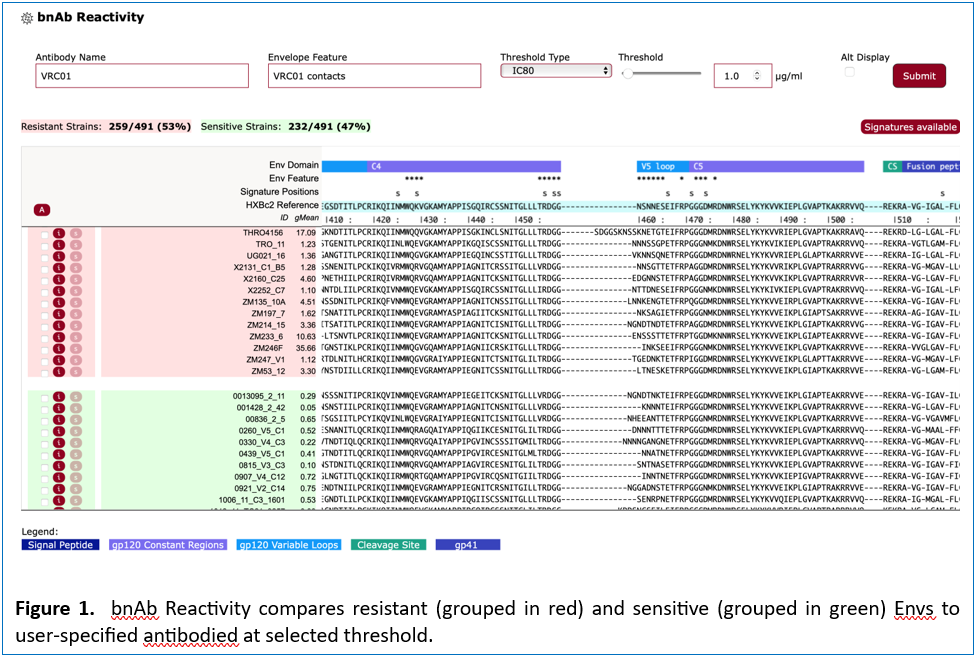
HIResist is a bioinformatics tool that allows identification of patterns of resistance and mechanisms of HIV-1 escape; comparison of resistant and sensitive HIV-1 strains for each bnAb; identification of resistance and sensitivity signatures associated with specific bnAbs or groups of bnAbs; and visualization of antibody pairs on cross-sensitivity plots. Additionally, several graphical interfaces are available including heatmaps to cluster selected sets of HIV-1 strains and antibodies, and alignment tools with output displayed in a standard HIResist format, and visualization of resistance/sensitivity signatures of HIV-1 Envs.
Conclusions:
In addition to the tools mentioned previously, we continue to develop HIResist and plan to add several new interfaces including tools for comparison of bnAb resistance/sensitivity in HIV-1 strains from different populations of PLWH (e.g., drug users or elite controllers) and tools for assessment of emerging HIV-1 strains. HIResist is being developed to encourage engagement and exploration without the need for programming expertise of these highly relevant data by the broader scientific community.