SARS-CoV-2 infected children are often asymptomatic or paucisymptomatic compared to adults. The immune response plays a pivotal role in dictating the clinical outcome in infected adults, but it is still poorly investigated in the pediatric population.
Fifty-seven family clusters of SARS-CoV-2, attending the Department for Women’s and Children’s Health (University of Padova), were enrolled between March and September 2020, for a total 209 subjects. SARS-CoV-2 infection was confirmed in 155 patients (SARS+: 93 ?15 years [group A]; 34 children ?6-15 years [group B]; 28 children <6 years [group C]) by virus molecular detection and/or serology. In 41 available samples, measurement of SARS-CoV-2 levels (VL) was performed by an in-house quantitative One-Step ddPCR method. A blood sample was obtained at a median [IQR] of 2.8 [2.1-3.7] months after baseline (symptom's onset and/or first positive virus detection). Neutralizing antibodies (Nabs) were detected by a Plaque Reduction Neutralization Test (PRNT). Activated (CD8+CD38+HLA-DR+) and regulatory T cells (T-regs; CD4+Foxp3+CD127-CD25+) were analyzed by flow cytometry.
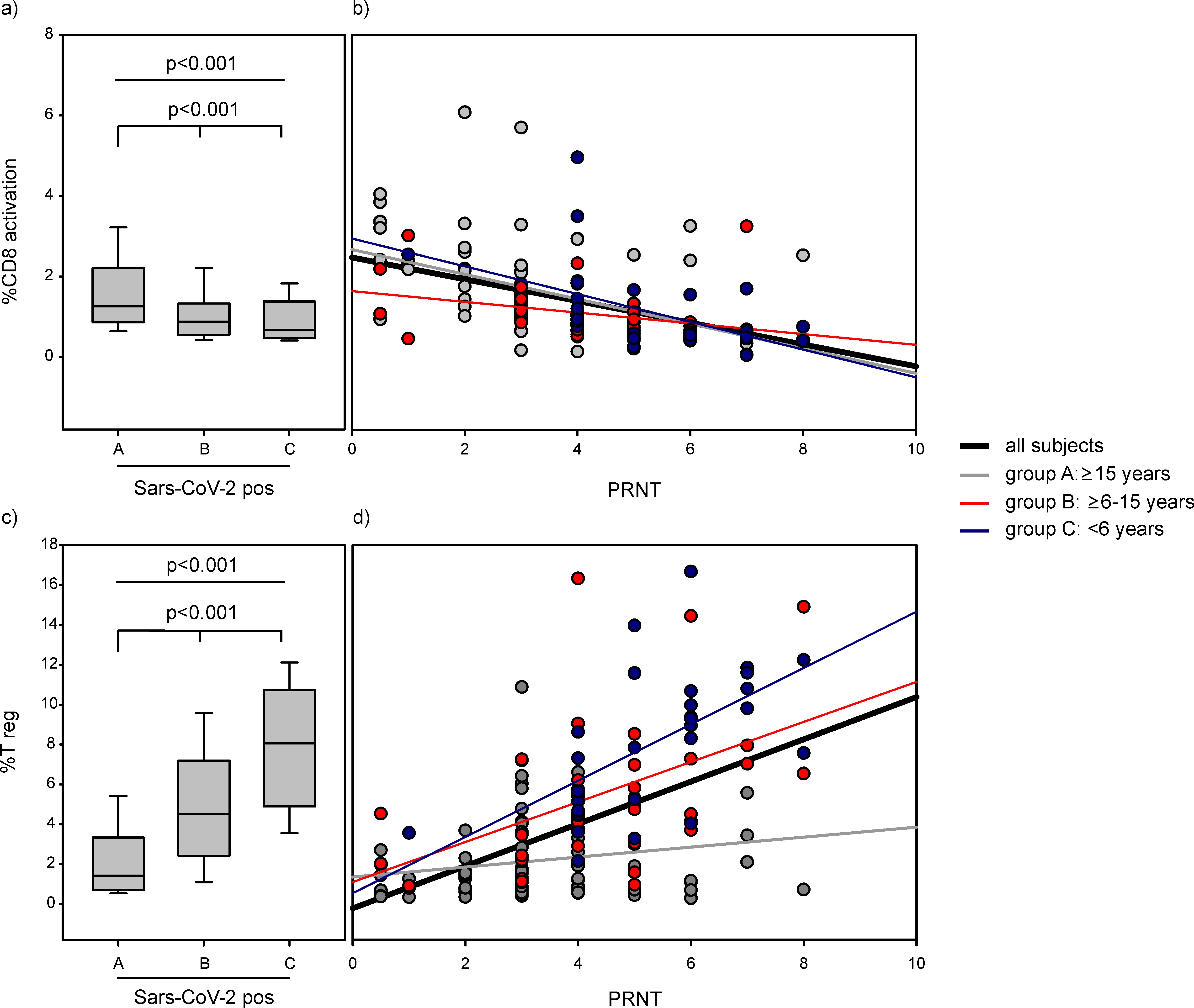
VL did not differ by age (18507 [326-339315], 6723 [3427-114587], and 21106 [162-152500] copies/5µl, in group A, B and C, respectively; overall, p=0.955). Group C had the highest PRNT titer compared to the other groups (overall, p<0.0001). Activated CD8 and regulatory T cells were significantly higher in SARS+ than in SARS- subjects (p<0.001). CD8 activated cells were significantly higher in group A compared to the other groups (p<0.001; Figure a), and were inversely correlated with PRNT titer (group A: rs=-0.527, p<0.0001; B: rs=-0.494 p=0.003; C: rs=-0.547 p<0.0001; Figure b). Conversely, T-regs were significantly higher in group C compared to the others (p<0.001; Figure c), and were positively correlated with PRNT values in children (group C: rs=0.662 p=0.0001, B: rs =0.532 p=0.001; A: rs =0.160, p=0.125; Figure d).
Levels of SARS-CoV-2 did not differ among age classes, but adults displayed a higher T cell activation and a lower production of anti-SARS Nabs than children. Conversely, younger infected children had the highest production of anti-SARS Nabs and the lowest non-specific T cell activation, most likely due to their higher expression of regulatory T cells.