Background:
The global transition to 1st-line antiretroviral treatment (ART) with tenofovir+lamivudine+dolutegravir (TLD) has shown high rates of viral suppression (VS) in adults and children but little is known about pregnant and postpartum women.
Methods:
Pregnant women with HIV (PWH) already on TLD (Continuers, PWHc) or starting TLD <14 days prior to enrollment (Initiators, PWHi), were enrolled in ORCHID, an observational study of metabolic health, in Cape Town, South Africa, Sept 2021-Sept 2023. PWH were enrolled <18 weeks (wks) gestational age (GA); ART was managed by routine clinical services; viral load (VL) samples were collected at enrollment, trimester2 (T2, 24-28 wks), T3 (32-34 wks) and Q6-12wks postpartum (PP). Analyses described VS (<50 cps/mL), the incidence of major (>1000 cps/mL) and minor (50-1000 cps/mL) viremic episodes (VE) and associated factors among PWH using Poisson models.
Results:
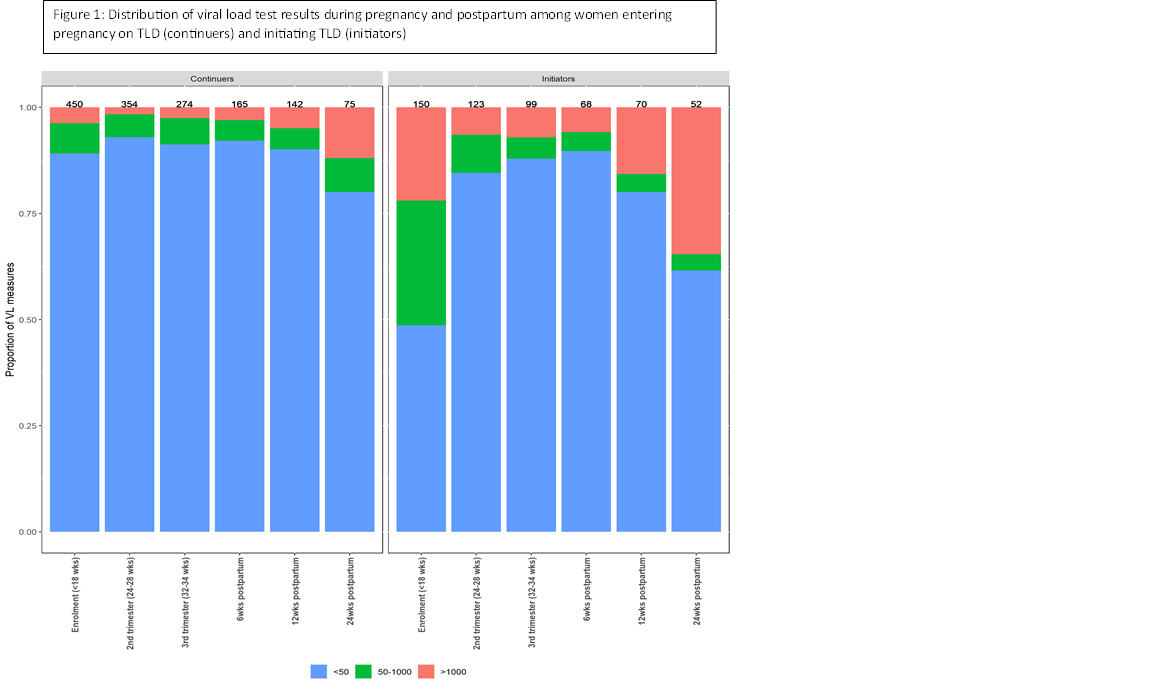
Among 600 PWH, 450PWHc/150PWHi, median (IQR) age was 30.0 yrs (16-47), GA was 13 wks (10-16), and duration on TLD was 218 days (15-554) at enrollment [366 (149-716) and 1(0-7) for PWHc and PWHi respectively]. Median VL at enrollment was 19 cps/mL (range 19-980,148): 475 (79%) PWH had VL<50 cps/mL (89%PWHc, 49%PWHi), 76 (13%) had 50-1000 cps/mL (PWHc7.1%, PWHi29%) and 49 (8.2%) had >1000 cps/mL (PWHc3.8%, PWHi21%) [fig1]. Overall, 3142 woman-months of observation were accrued: 567 (95%) PWH had ≥1 VL <50 cps/mL; of these women 45 (8%) had ≥1 minor VE (8%C vs 7%I, p=0.8) and 39 (7%) had ≥1 major VE (4%C vs 15%I, p=<0.001). The proportion of VL measures with VS increased from enrollment (79%), was high at T2 (91%), T3 (90%), and 6wks PP (91%) but decreased thereafter. By 24wks PP, 21% of 127 VL measures were >1000cps/mL, (12%C vs 35%I, p=0.007). In multivariable analyses the incidence of VE >1000 cps/mL after VS was independently associated with decreased age [incidence rate ratio (IRR) 16-22yrs vs 34+yrs, 3.26; 95% confidence interval (CI) 1.1-10.5) and elevated VL (>1000 cps/mL) at enrollment (IRR 4.65, 95%CI: 2.0-10.5).
Conclusions:
This is among the first reports of VL in pregnant and postpartum women on TLD. We found high rates of VS in pregnant women, but postpartum viremia remains a pressing concern, particularly for younger women and those initiating ART during pregnancy.