Background:
We used proviral HIV-1C sequences from adults with documented HIV-1 seroconversion in Botswana, to determine HIV drug resistance mutations and predict (in silico) resistance to 33 known broadly neutralizing antibodies (bNAbs).
Methods:
We analyzed proviral sequences from adults with documented HIV-1 seroconversion (Nf140) from a population-based household study (Botswana Combination Prevention Project, 2013-2018). HIV-1C near-full length proviral sequences were generated and adjusted for hypermutations using Hypermut. Surveillance drug resistance mutations (SDRMs) associated with protease inhibitors (PI), integrase strand transfer inhibitors (INSTI), nucleoside reverse transcriptase inhibitors (NRTI) and non-nucleoside reverse transcriptase inhibitors (NNRTI) were analyzed according to Stanford Calculated Population Resistance program. HIV gp120 region was used to predict sensitivity of contact sites to 33 known bNAbs using the bNAb-ReP algorithm (https://github.com/RedaRawi/bNAb-ReP). A cutoff of 0.5 probability value was used to classify sensitivity ( >0.5) or resistance (< 0.5). All gp120 alignments were also used to determine the number of potential N-linked glycosylation sites (PNGS) and compared among bNAb resistant and sensitive strains.
Results:
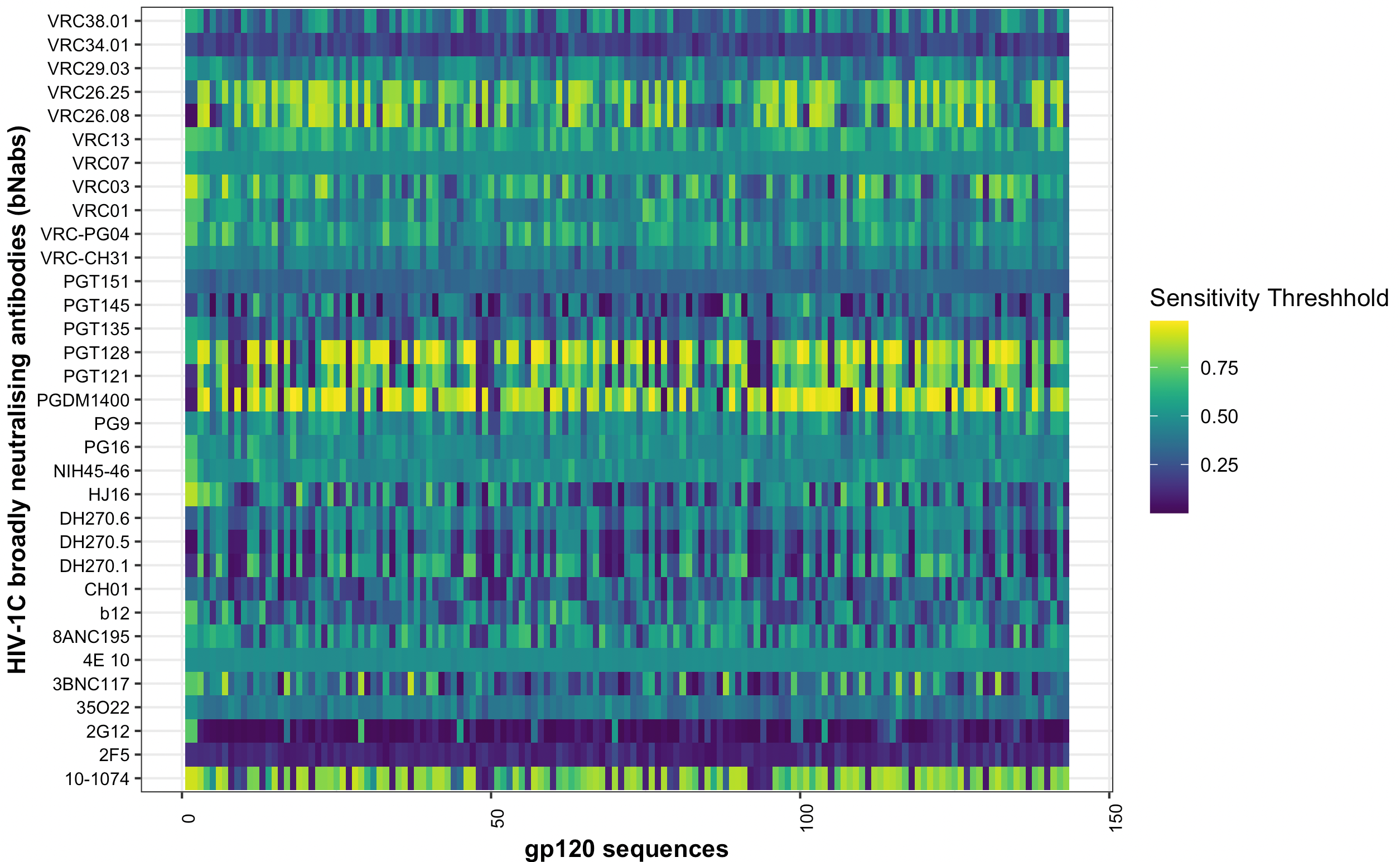
One-hundred-and six (76%) adults with documented seroconversion were ART-naïve at the time of sample collection, with a median viral load of 3.9 (Q1, Q3: 3.2,4.4) log10 copies/mL. Median age was 27 years (Q1, Q3: 22,33) and most (79%) were female. The overall prevalence of any SDRMs at baseline was 6.6%. We found PI-, NRTI-, NNRTI- and INSTI-associated SDRMs in 1.9% (95%CI 0.2–6.6), 3.8% (95%CI 1.0–9.4), 1.9% (95%CI 0.2–6.6), 1.9% (95%CI 0.2–6.6), respectively. Prevalence of predicted resistance to 1 or more bNAbs was high among seroconverters (Fig 1); 100% of sequences showed resistance to 2F5, PG16, PGT151 and VRC34.01. In contrast, most sequences ( >60%) were likely susceptible to 10-1074, PGDM1400, PCT128, VRC13 and VRC25.25. No difference was observed in the frequency of PNGS compared to bNAb resistance/sensitivity.
Conclusions:
We report low levels of transmitted HIV drug resistance mutations but high prevalence of predicted bNAb resistance in adults with HIV-1 seroconversion in Botswana.
Fig 1. Predicted bNAb resistance based on in silico models using HIV proviral sequences from seroconverters in Botswana