Background:
Measuring cerebrospinal or plasma levels of brain injury markers may provide useful information on HIV neuropathogenesis and help characterize cognitive impairment in PWH. We compared plasma levels of these markers to cognitive function, physical performance and history of HIV in PWH≥50 years
Methods:
102 ART-treated PWH ≥50 years and 40 age-matched controls without HIV infection were prospectively assessed for Neurofilament Light Chain (NFL), Glial Fibrillar Acid Protein (GFAP), Tau and Ubiquitin C-terminal hydrolase-L1 (UCH-L1) by Simoa Human Neurology 4-Plex. PWH were evaluated for neurocognitive performance [TMT-A, TMT-B, Digit Symbol (DS)], depression and anxiety (Hospital Anxiety and Depression scale), physical function (handgrip, chair-stand test for muscle strength, mini-BEST test for balance and mobility), current and nadir CD4+ counts and years of HIV infection. Values are shown as median (IQR); group comparisons were analysed by Mann-Whitney test and correlations by Spearman’s correlation test and linear regression
Results:
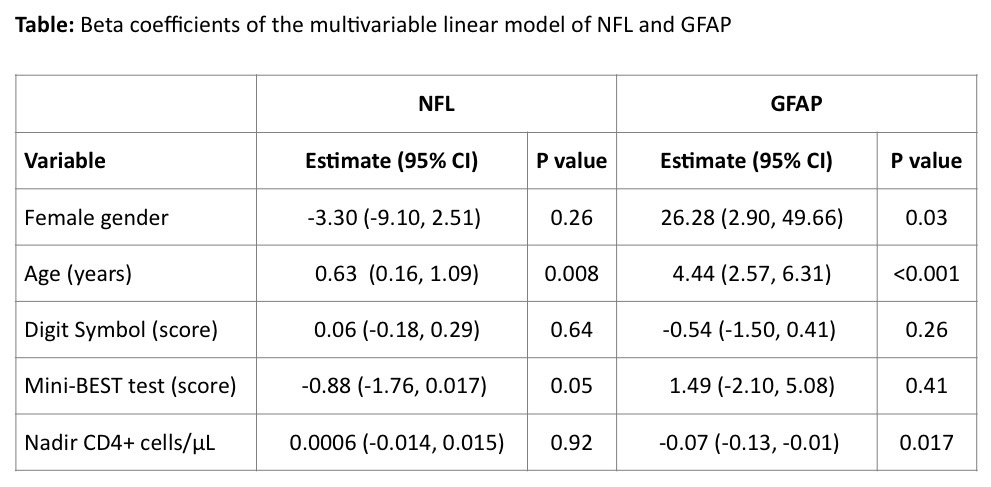
No significant differences between PWH and controls were observed for age [60 (57-63) vs. 57 (52-62)] and any of the four markers [NFL: 11.5 (8.2-16.5) vs. 10.6 pg/µL (9.4-14.3); GFAP: 108.3 (76.2-144.2) vs. 95.4 (76.5-138.7); Tau: 2.69 (1.88-4.30) vs. 3.30 pg/mL (2.24-4.89); UCH-L1: 18.7 (10.6-28.8) vs. 19.5 pg/mL (11.4-34.2)]. In PWH, NFL and GFAP were highly correlated (p=0.0002, r=0.356); higher NFL and GFAP correlated to older age (both p<0.0001, r=0.356 and 0.496, respectively) and GFAP levels were higher in women (p=0.01); higher NFL was associated with lower performance at mini-BEST test (p<0.0001, r=-0.334), and higher GFAP with lower performance at DS (p=0.043, r=-0.201), handgrip (p=0.0001, r=-.0367) and mini-BEST test (p=0.015, r=-0.239), lower nadir CD4+ counts (p=0.0004, r=-0.343) and longer duration of infection (p=0.045, r=0.199). By multivariate analysis (Table), higher NFL levels were associated with older age and better performance at the Mini-BEST test; higher GFAP with older age, female gender and low nadir CD4+ count.
Conclusions:
Beyond the expected correlation of higher GFAP and NFL with age, the specific association of high GFAP level with low nadir CD4+ counts and long infection duration may reflect a legacy injury with reactive gliosis, of a previous untreated CNS HIV infection. Practically, physical performance may help define the functional status associated with elevated markers of CNS cell injury