Background:
Limited data is available regarding population size and burden of HIV-related disease among adults living with perinatally-acquired HIV (paHIV) in Latin America. This study is aimed at describing HIV-related burden of disease in a cohort of adults living with paHIV from Buenos Aires, Argentina.
Methods:
This is a retrospective cohort study. People living with paHIV aged >16 and linked to care in an HIV referral clinic in Buenos Aires, Argentina between Oct-2008 and Sep-2023 were included. Data was collected from clinical records and epidemiological surveillance systems. Clinical status was classified as per WHO HIV staging system, and advanced HIV disease was defined as WHO stages 3-4. Ethics approval was obtained as appropriate.
Results:
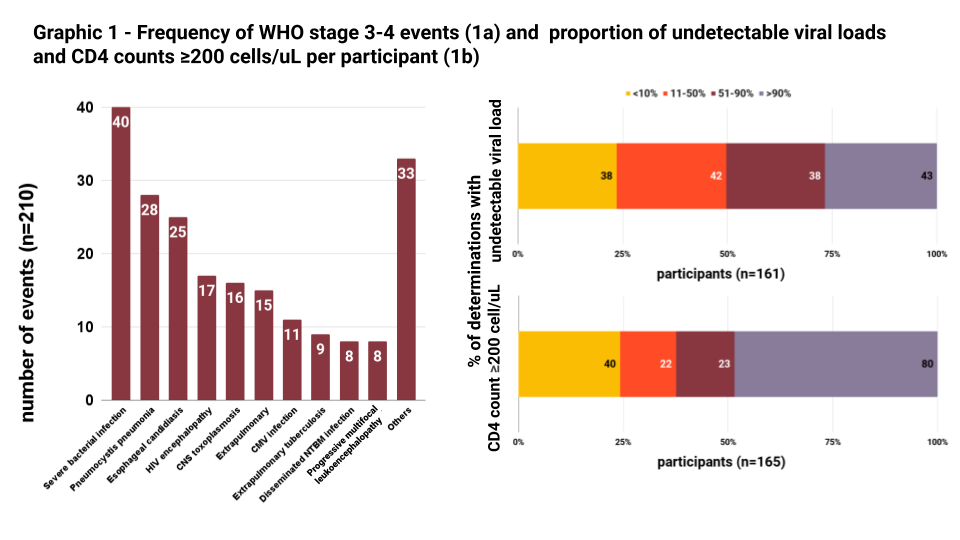
A total of 170 adults (60% females) with paHIV were included in the analyses. Median age at baseline was 19 years and median individual follow-up was 5.7 years (Q1-Q3 3.6-9.5). Prevalence of clinically advanced HIV disease was 47% (79/170); 34/79 participants presented 1, 36/79 presented 2-5 and 9/79 presented >5 WHO stage 3-4 events. Graphic 1 shows frequency of incident WHO stage 3-4 events (1a) and proportion of undetectable viral loads and CD4 counts ≥200 cells/uL per participant (1b)(data available for 161 and 165 individuals, respectively). There were 133 HIV-related hospital admissions in 49 participants. Global mortality was 11% (18/170) and median age at the time of death was 23.5 years (Q1-Q3 21.2-27). The majority (11/18) of the deaths were HIV-related and one third (6/18) occurred within the first year after transition to adult care.
Conclusions:
Adults living with paHIV have high HIV-related morbimortality and HIV-related complications are the leading cause of death in our cohort. To our knowledge, this is the largest description of a cohort of adults living with paHIV in Latin America. Further research is needed to complete the characterization of this population in order to design and implement differentiated service delivery models that contemplate their singularity.