Chronic hepatitis B (HBV) is the predominant cause of hepatocellular carcinoma (HCC) worldwide. Although HBV coinfection is common in HIV, the determinants of HCC in HIV/HBV coinfection are poorly characterized. We examined the incidence and predictors of HCC in a multi-cohort study of HIV/HBV-coinfected individuals.
We examined all HIV/HBV-coinfected persons (defined by positive HBV surface antigen, e antigen, or HBV DNA) within 22 cohorts of the North American AIDS Cohort Collaboration on Research and Design from 1995-2016. The main outcome, first occurrence of HCC, was verified by medical record review and/or cancer registry. We used multivariable Cox regression to determine adjusted hazard ratios (aHRs [95% confidence intervals]) of factors assessed at cohort entry (age, sex, race, body mass index), ever during observation (hepatitis C coinfection, heavy alcohol use defined as alcohol use disorder diagnosis and/or ?3 drinks/day or ?7 drinks/week for females; ?4 drinks/day or ?14 drinks/week for males on AUDIT-C), or that were time-updated (HIV RNA, CD4+ cell percentage, diabetes mellitus, HBV DNA, HBV-active antiretroviral therapy [ART]).
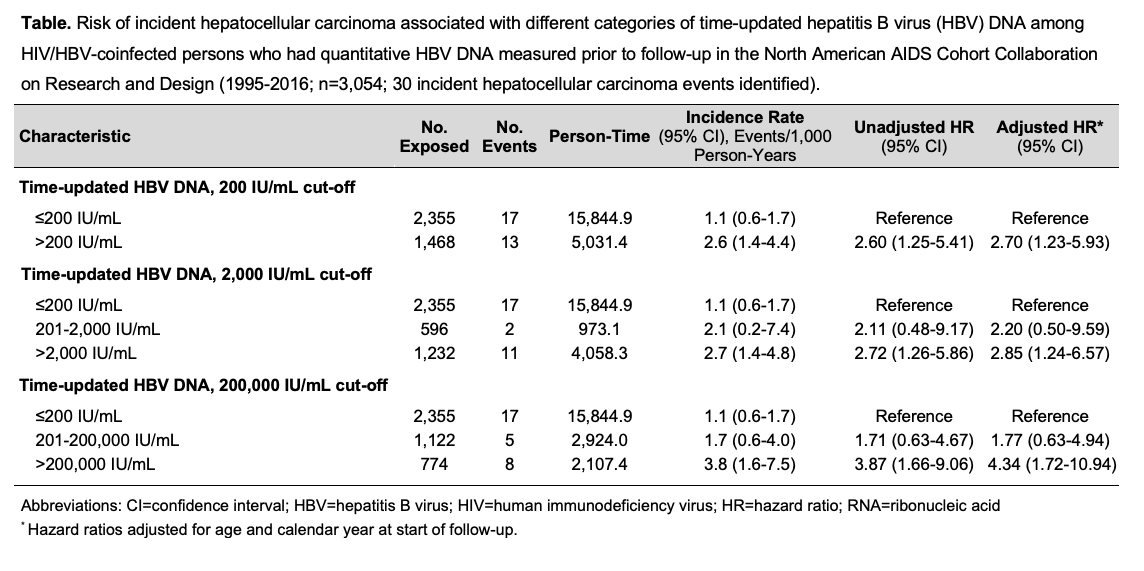
Among 8,354 HIV/HBV-coinfected individuals (median age, 43 years; 93% male; 52.4% non-white), 115 HCC cases were diagnosed over 65,392 person-years of follow-up (incidence rate, 1.8 [95% CI, 1.5-2.1] events/1,000 person-years). Independent risk factors for HCC were age ?40 years (aHR, 2.14 [1.36-3.37]), hepatitis C coinfection (aHR, 1.60 [1.07-2.39]), and heavy alcohol use (aHR, 1.51 [1.03-2.21]), while time-updated HIV RNA >500 copies/mL (aHR, 0.88 [0.55-1.41]) and time-updated CD4+ percentage <14% (aHR, 1.03 [0.56-1.90]) were not. Among the 3,054 who had HBV DNA quantified, the risk of HCC was increased with HBV DNA >200 IU/mL (aHR, 2.70 [1.23-5.93]) and especially at levels >200,000 IU/mL (aHR, 4.34 [1.72-10.94], see Table). HCC risk was also higher with each 1.0 log10 IU/mL increase in HBV DNA (aHR, 1.18 [1.05-1.34]). HBV suppression <200 IU/ml with HBV-active ART for ?1 year significantly reduced the risk of HCC (aHR, 0.42 [0.24-0.73]).
HIV/HBV-coinfected individuals on ART with detectable HBV DNA >200 IU/mL remained at increased risk for HCC. Heavy alcohol use and hepatitis C coinfection were prevalent in our cohort and also important determinants of HCC. To gain maximal benefit from ART for HCC prevention, sustained HBV suppression may be necessary.