Background:
Testing for hepatitis C (HCV) is the first step toward ultimately curing HCV infection and preventing transmission. Emergency departments (EDs) are key clinical settings for screening given that they serve at-risk patients who commonly do not access healthcare elsewhere. Determining the best approach to HCV screening in ED settings is imperative to maximize the benefit of this public health intervention. The goal of this study was to evaluate the effectiveness of HCV screening in EDs with the hypothesis that nontargeted screening is significantly associated with identification of new diagnoses when compared to targeted screening.
Methods:
Design & Setting: Prospective multi-center randomized pragmatic trial in EDs in Denver, CO, Baltimore, MD, and Jackson, MS. Population: Patients ≥18 years of age presenting for ED care. Exclusions: critical illness, inability to consent, prior HCV diagnosis. Interventions: Eligible patients underwent concealed randomization as part of routine care to either nontargeted screening, where all were offered HCV testing, or targeted screening, where all were asked risk questions and any affirmative response led to an offer for HCV testing. Screening was fully integrated into ED care using opt-out consent; antibody positive tests were followed by reflex RNA testing. Outcomes included newly diagnosed HCV (RNA-detected) and elements of the HCV care continuum through 12 months of follow-up. Analyses: Intention-to-treat, chi-square, and risk ratios (RRs) with 95% confidence intervals (CIs).
Results:
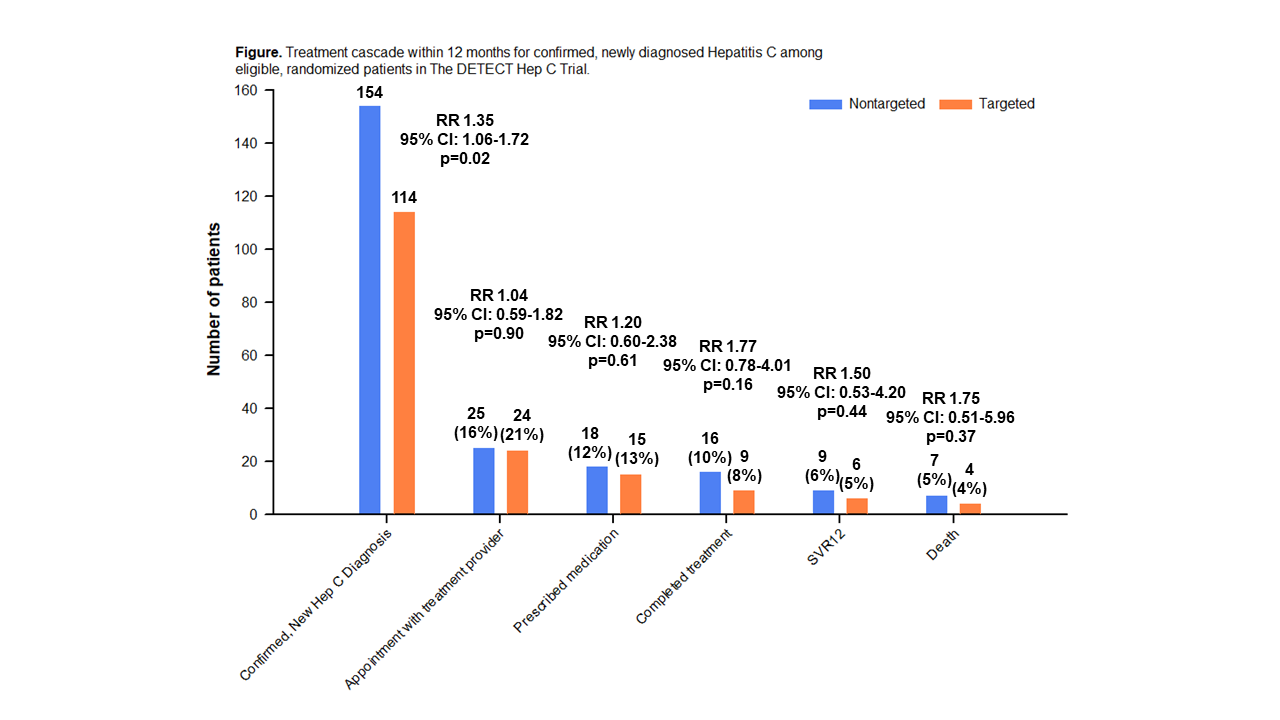
From 11/19/2019 through 8/4/2022, 147,498 eligible patients were randomized with excellent balance of characteristics. Of the 73,651 allocated to targeted screening, 23,339 (31.9%) were identified as high risk, 7,110 (30.4%) accepted testing and 4,634 (65.3%) completed testing, resulting in 114 (2.5%) new diagnoses. Of the 73,847 allocated to nontargeted screening, 16,516 (22.5%) accepted testing and 9,825 (59.5%) completed testing, resulting in 154 (1.6%) new diagnoses. Compared to targeted screening, nontargeted screening was significantly associated with new diagnoses (RR 1.35, 95% CI 1.06-1.72, p=0.02). Small proportions had treatment appointments, initiated and completed treatment, or attained SVR12 (Figure).
Conclusions:
Nontargeted HCV screening was superior to targeted screening for identifying newly diagnosed HCV in the ED. The significant decay from diagnosis to SVR12 suggests innovative models of HCV treatment from the ED are needed.