Background:
Anticore antibody (antiHBc) in absence of hepatitis B surface antigen (HBsAg) is defined as an isolated antiHBc status that may be associated with HBV reactivation. We decided to investigate HBV reactivation in antiHBc-PLWH (with isolated anti-HBc or with anti-HBc and anti-HBsAg) after the switch from ART including drugs active on both viruses (tenofovir disoproxil fumarate, TDF and tenofovir alafenamide, TAF) to an antiHBV sparing regimen (antiHBVsr) because in PLWH the loss of HBsAg with or without anti-HBsAg seroconversion is probably consequent to ART treatment including drugs active on both viruses (HIV/HBV) rather than past HBV infection. Additionally, HBV reactivation has been described in immunocompromised anti-HBsAg positive people.
Methods:
HBV reactivation in antiHBc-PLWH was assessed by an alteration of alanine aminotransferase (ALT) above the upper limit of the normal range after the switch to antiHBVsr dolutegravir/rilpivirine (DOL/RPV) or long acting therapy cabotegravir/rilpivirine (CAB/RPVLA). Forty-one individuals with antiHBc and at least 2 ALT values available after the switch to antiHBVsr: (DOL/RPV, (number, N=15), CAB/RPVLA(N=26) were evaluated. Data were collected as part of routine clinical care and recorded into the database of the Division of Infectious Diseases of the San Raffaele Hospital (CSLHIV Cohort). Data freezing was 29 August 2023.
Results:
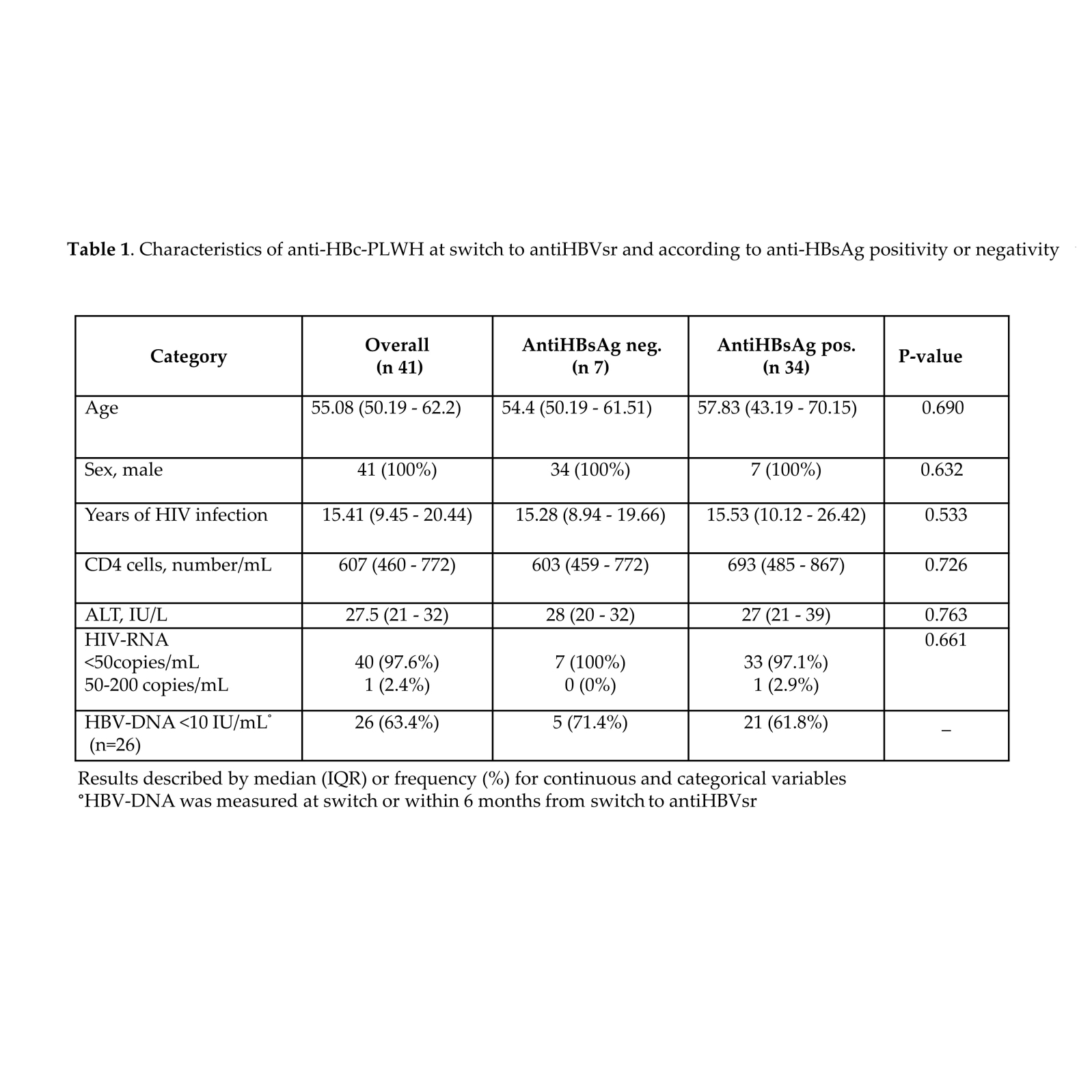
Main characteristics of antiHBc-PLWH at antiHBVsr according to antiHBsAg status (antiHBsAg positive N=34 or negative, N=7) are described in Table 1. All variables analyzed were similarly distributed in the two groups. Overall, the median post-switch follow-up was 8.91 months (interquartile range, IQR 6.78 – 24.14): 8.96 months (IQR 6.78 – 24.14) in anti-HBsAg positive PLWH and 6.97 months (IQR 5.56 – 43.22) in anti-HBsAg negative PLWH, P=0.742. Interestingly, 1/7(14.3%) PLWH with isolated antiHBc showed an increase of ALT (about 20-fold the normal values) about 3 months after switch to CAB/RPVLA, with also appearance of HBV-DNA at high levels (4.8 x10⁷ IU/mL) and HBsAg seroconversion. He was infected by HBV genotype A that was also identified in plasma sample obtained during HBV chronic infection phase, before any ART treatment.
Conclusions:
The HBV reactivation is unlikely in antiHBc-PLWH with anti-HBsAg positivity after switch to anti-HBVsr, while close monitoring of ALT and possibly HBV-DNA in PLWH with antiHBc alone, after switch to anti-HBVsr is necessary.