Non-adherence to antipsychotics is the greatest obstacle to treating schizophrenia, and it is likely to exacerbate the clinical implications of HIV and its treatment. We assessed the economic and clinical impact of non-adherence to antipsychotics among people living with HIV/AIDS (PLWH) and schizophrenia in British Columbia, Canada.
Eligible individuals were in the STOP HIV/AIDS cohort during 2001-2016, diagnosed with schizophrenia, on antipsychotics for ?1 day, and followed for ?1 year from schizophrenia diagnosis date or January 1, 2001, whichever occurred last. Adherence to antipsychotics was measured using the proportion of days covered methodology. A Two-Part model assessed the marginal effect of adherence on healthcare costs (in 2016 CAD), including hospitalizations, physician visits and medication dispensations. Logistic regression or generalized linear mixed models examined the effect on virologic failure (viral load >200 copies/mL), hospital readmissions within 30 days, and length of hospital stay. Models were adjusted for several confounders.
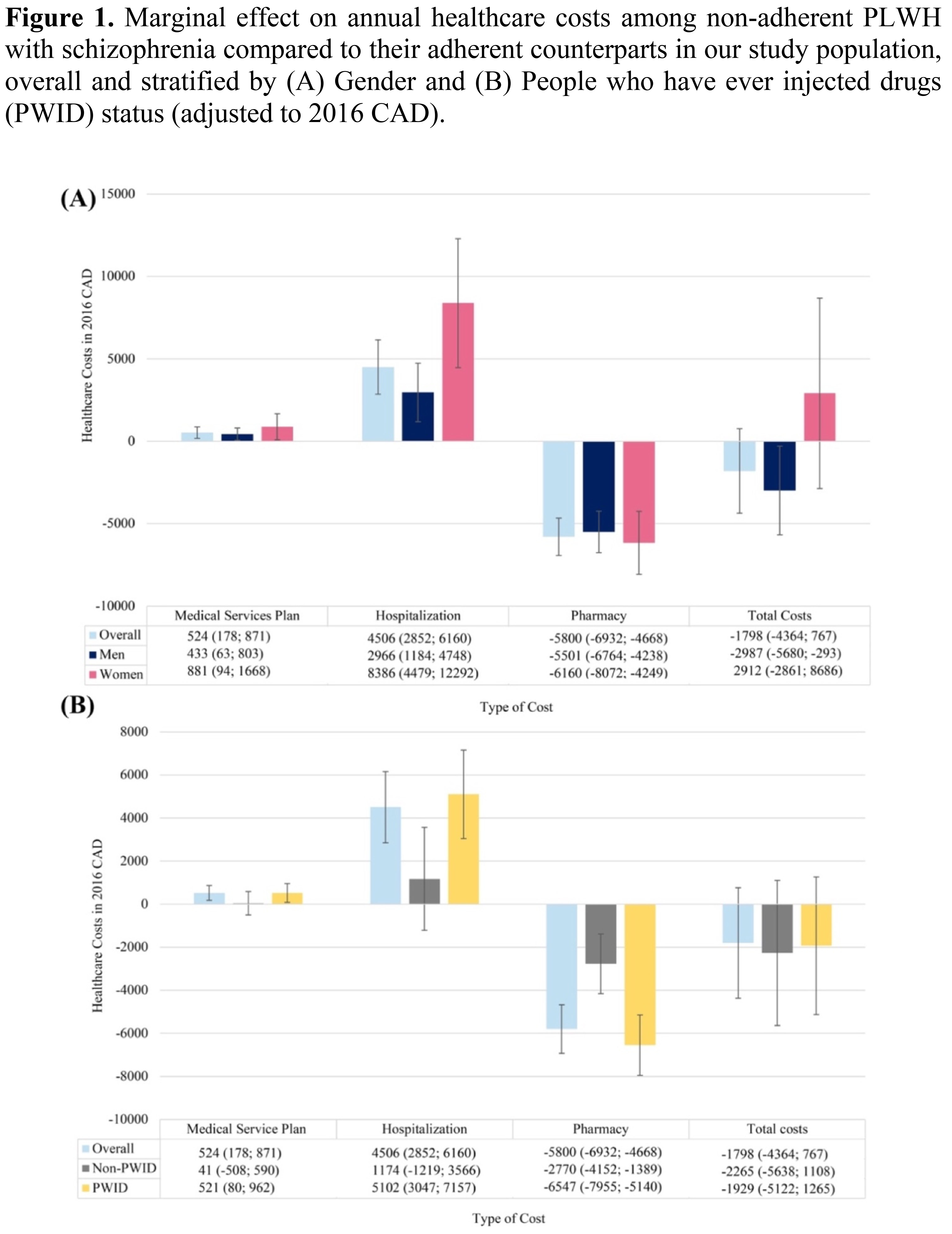
Among 726 PLWH with schizophrenia, ?80% adherence to antipsychotics increased from 34% in 2001 to 55% in 2016. We observed no difference in adherence to antipsychotics among those who used only injectable form, only non-injectable form, and a combination of both. Similarly, no difference in adherence was observed among individuals who have ever consumed typical/first-generation antipsychotics and those who consumed only atypical/second-generation antipsychotics. We observed that individuals with poor adherence to antipsychotics were also poorly adhered to antiretrovirals, especially in the earlier study years. Compared to adherent individuals, annual hospitalization and physician visit costs were higher among non-adherent individuals ($5030), particularly among women ($8386) and people who ever injected drugs ($5102) (Figure 1). Non-adherent individuals also experienced higher virologic failure (adjusted Odds Ratio [aOR]=1.65, 95% 95%CI: 1.06-2.56), more hospital readmissions (aOR=1.52, 95%CI: 1.29-1.79), and longer hospital stays (adjusted Mean Ratio=1.51, 95%CI:1.39-1.64).
Our results showed that implementing strategies and interventions to increase antipsychotic adherence, focusing on women and people who have ever injected drugs, will be critical in addressing this public health challenge.