HIV exposed but uninfected infants (HEU) are at increased risk of impaired early linear growth and cognitive development. We examined associations between pre and postnatal growth and subsequent neurodevelopment in Ugandan HEUs, hypothesizing that early insults may explain alterations in both somatic growth and brain development.
We prospectively followed a cohort of HEUs from birth to 18 months of age. The height, weight, head circumference, and mid-upper arm circumference (MUAC) were collected and compared to the World Health Organization growth charts. The Malawi Development Assessment Test (MDAT) was performed at 12 and 18 months of age to examine developmental milestones. The Color Object Association Test (COAT) was used at 18 months of age to assess declarative memory.
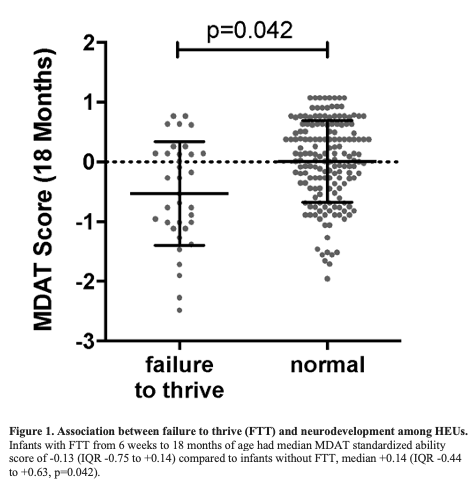
375 mother-child pairs were enrolled. Mothers were median 28 years old and 32% had a known diagnosis of HIV prior to pregnancy. The cohort included HEUs who were female (53%), premature (11%) and had low birth weight (LBW) (7.6%). Follow up was completed at 6 weeks (n=147 HEUs), 12 months (n=109 HEUs), and 18 months (n=170 HEUs) of age. Eight infants tested positive for HIV and were excluded from the study. 197 HEUs were lost to follow-up at 18 months of age. The final cohort consisted of 170 HEUs who completed the MDAT at 18 months of age. The number of HEUs stunted (32%, 43%, and 58%) and underweight (7.4%, 15% and 15%) increased at 6 weeks, 12 months and 18 months of age respectively. HEUs had behavioral scores on the MDAT that were similar to the reference children population. The mean score on the COAT was 5.5 compared to 6.9 in the reference children population. The MDAT score at 18 months of age showed cross-sectional correlation with weight- (?=0.36, p<0.0001), height- (?=0.41, p<0.0001), head circumference- (?=0.26, p=0.0011), and MUAC-for-age (?=0.34, p=0.0014). Failure to thrive (FTT), defined as crossing two major percentile lines downward on the weight-for-age growth chart, was observed in 21% HEUs during the first 18 months of life. Failure to thrive (FTT) was associated with lower MDAT scores (p=0.042) at 18 months of age. Lower weight-for-height z-scores were associated with lower COAT scores (?=0.32, p=0.0017). LBW (<2500g) predicted lower MDAT score (p=0.0010) at 18 months of age.
In a prospective cohort of HEUs in Uganda, LBW, stunting, and FTT were common and were associated with lower attainment of developmental milestones and lower declarative memory at 18 months.