Background:
Broadly neutralizing antibodies (bNAbs) are being clinically tested to cure HIV. Such bNAbs are recognized for their potent neutralizing activity. However, beyond neutralization, the constant domains (Fc) of antibodies can elicit several innate immune functions, such as antibody-dependent cellular cytotoxicity by natural killer (NK) cells (ADCC). Antibody Fc glycosylation impacts these functions; however, whether Fc glycans (fucose, galactose, and sialic acid) impact the ADCC of bNAbs currently being tested clinically to cure HIV, such as the V3-glycan targeting antibody 10-1074, is unknown.
Methods:
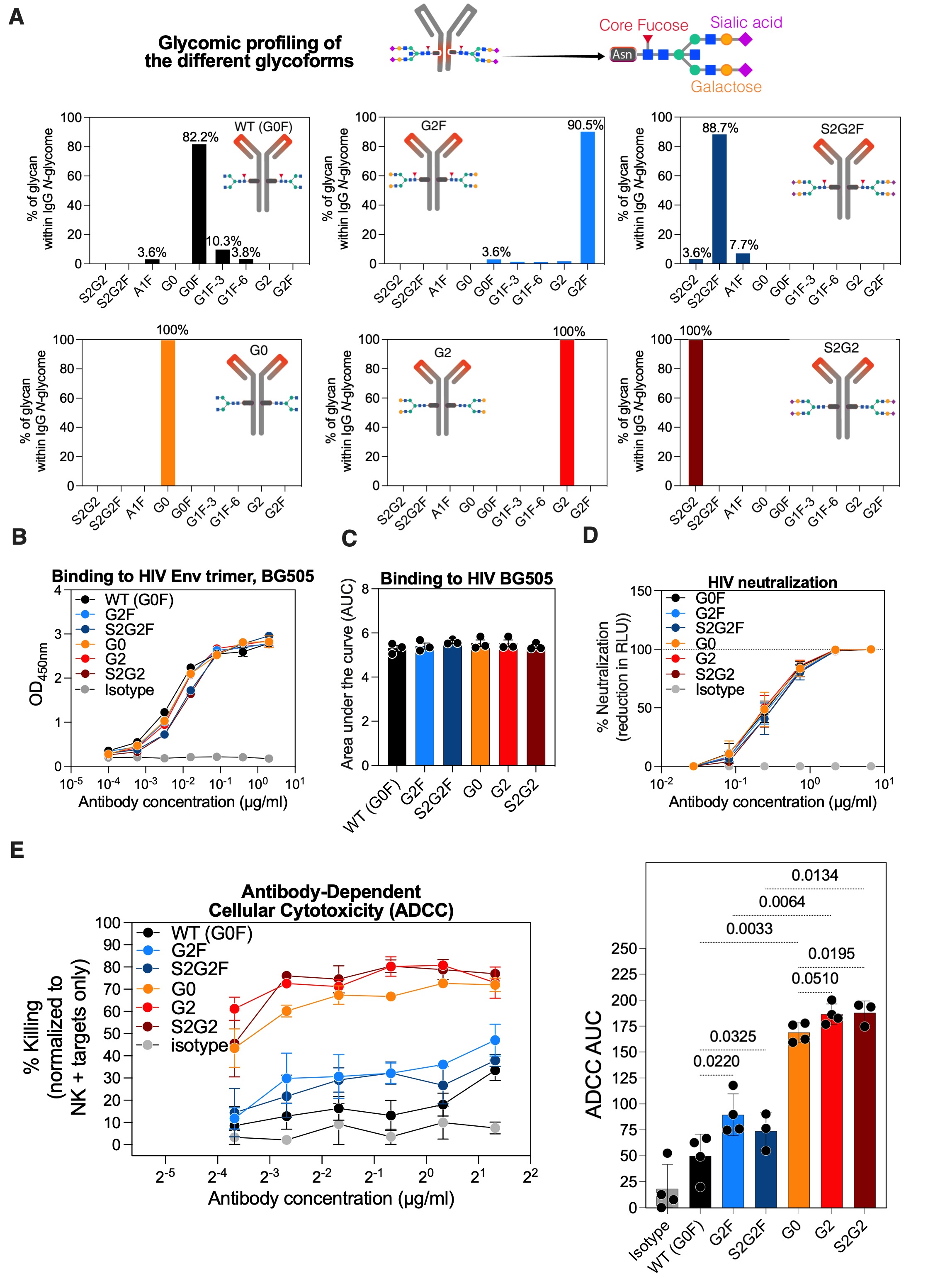
We chemoenzymatically glycoengineered 10-1074 to yield six highly homogenous ( >80% purity) antibody glycoforms, as determined by capillary electrophoresis (Fig. 1A). The glycoforms either expressed or not fucose (F), galactose (G), and/or sialic acid (S): wild type (WT) 10-1074 (mainly G0F); G2F; G2S2F; G2; and G2S2. Using these glycoforms, we examined the impact of glycosylation on 10-1074 binding to the HIV envelope glycoprotein (Env) using a clade A gp140 BG505 SOSIP trimer [ELISA] and to the Fcγ3a receptor [ELISA], neutralization of HIVJR-CSF [TZM-bl assay], and ADCC [using primary NK cells from healthy donors and HIVIIIB-infected CEM.NKR CCR5+ Luc+ cells].
Results:
Glyco-engineering 10-1074 did not impact its ability to bind to Env or neutralize live virus (Fig. 1B-D). However, non-fucosylated glycoforms exhibited higher levels of ADCC compared to fucosylated glycoforms (Fig. 1E; P< 0.013). Galactosylated glycoforms also exhibited higher ADCC than agalactosylated glycoforms within fucosylated and non-fucosylated glycoforms (P≤0.05). Furthermore, the G2 glycoform (non-fucosylated, galactosylated, non-sialylated) exhibited ~4-fold enhancement of ADCC compared to WT 10-1074 (from 17.46% cytotoxicity with WT 10-1074 to 68.02% cytotoxicity with the G2 glycoform; Fig. 1E). As expected, the ADCC activity correlated strongly with antibody binding to Fcγ3a receptor (P< 0.0001; not shown).
Conclusions:
Removing fucose and adding galactose to 10-1074 can significantly enhance its ADCC activity, which may improve its overall efficiency. Further studies are warranted to examine the impact of bNAbs glycosylation on other innate immune functions, such as antibody-dependent cellular phagocytosis and antibody-dependent complement deposition ex vivo and in vivo. Together, these findings highlight the importance of optimizing bNAb glycosylation to potentially eliminate or functionally cure HIV.
[1:05 PM] Mohamed Abdel-Mohsen Removing Fucose and Adding Galactose Significantly Enhance the Antibody-dependent Cellular Cytotoxicity of the HIV Broadly Neutralizing Antibody 10-1074