Neuropsychological impairment (NPI) remains prevalent among people with HIV (PWH) in the combination antiretroviral therapy (ART) era. The mechanisms for NPI during ART remain unclear, but accumulating evidence suggests that chronic inflammation may have a role. GlycA, a novel blood biomarker representing the nuclear magnetic resonance signal from glycosylated acute phase reactants, is associated with coronary artery disease in PWH and may have additional promise as a marker of NPI.
We performed a cross-sectional analysis of HIV+ and HIV-negative men within the Multicenter AIDS Cohort Study (MACS), in which participants underwent regular comprehensive neuropsychological (NP) testing involving six domains. NP test scores are normalized based on age, sex, race, education, and previous test administration. NPI was present if two or more domains were at least one standard deviation below the mean, as per 2007 HIV Frascati criteria. In addition to GlycA, plasma concentrations of CRP, IL-6, CCL2, sCD163, and sCD14 were measured. We examined associations between NPI and blood biomarkers using univariable and multivariable logistic regression incorporating medical covariables.
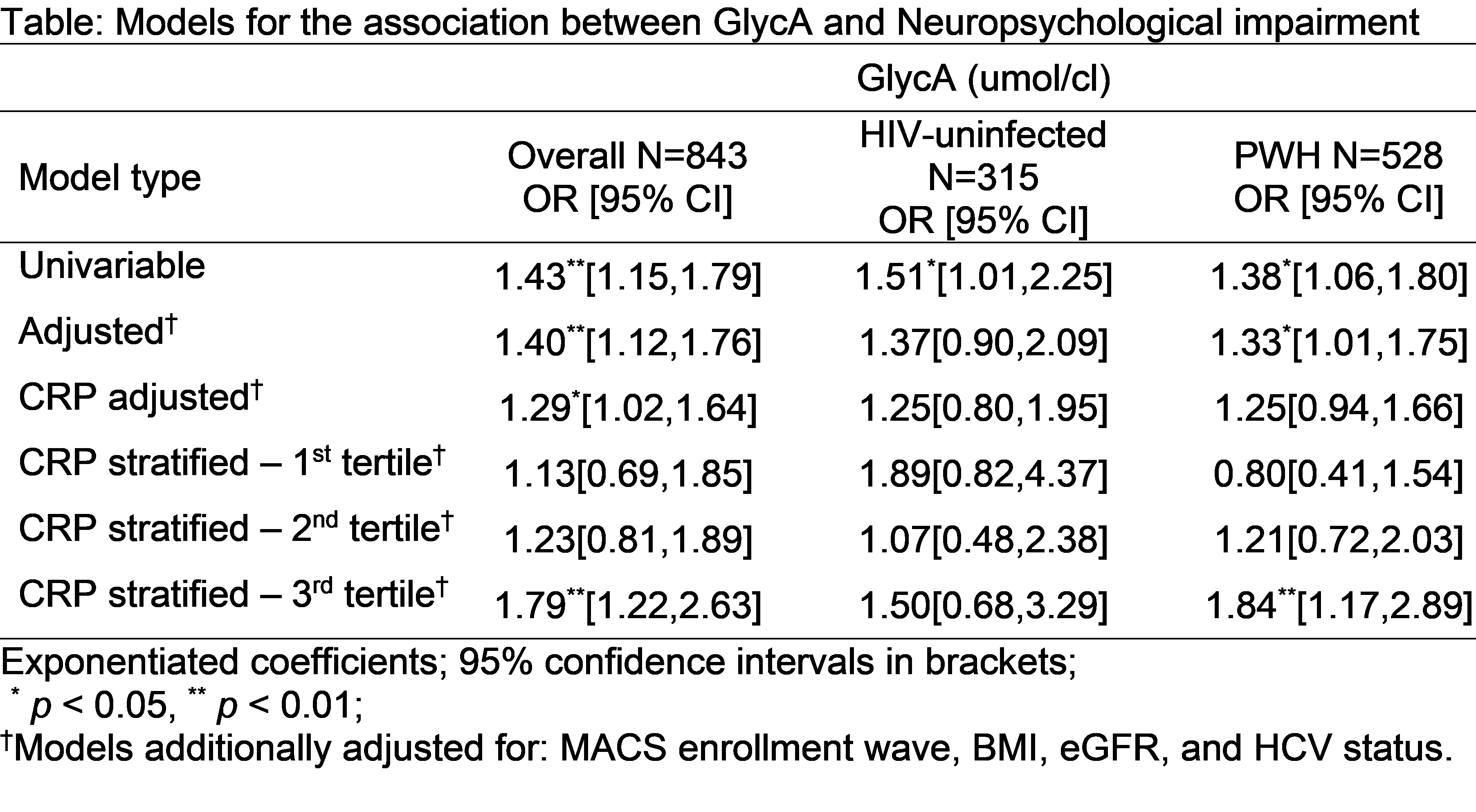
A total of 843 men were studied. 63% were HIV+, of whom 92% were on ART. In univariable analysis, increased levels of GlycA, CRP, and sCD14 (all p<0.01) as well as increased sCD163 (p<0.05) were associated with the presence of NPI. Hepatitis C (HCV) positivity was also associated with NPI. Among HIV+ participants, current detectable HIV RNA as well as cumulative HIV RNA over time (both p <0.01) were associated with NPI. In multivariable analysis that adjusted for enrollment wave, BMI, estimated GFR (eGFR), and HCV status (Table), GlycA remained significantly associated with impairment. This was particularly true in HIV+ participants. Of models that incorporated the inflammatory biomarkers individually, CRP was the only biomarker significantly associated with NPI in addition to GlycA. When examining the association by tertile of CRP, GlycA was significantly associated with NPI only in the highest tertile of CRP.
Higher GlycA levels were independently associated with NPI in the MACS. GlycA therefore may be a durable window into NPI pathogenesis during HIV. Participants with higher CRP levels contributed significantly to this finding, suggesting that GlycA may be most valuable in the setting of increased overall inflammation, which is common during HIV.