Background:
Dolutegravir (DTG)-based regimens are recommended as first-line antiretroviral therapy (ART) for all children and adolescents living with HIV (CALHIV). We describe transition to DTG in the multiregional IeDEA cohort.
Methods:
We included all CALHIV enrolled in IeDEA sites where DTG was available from 6 regions (Asia-Pacific, Latin America, Central Africa, West Africa, East Africa, Southern Africa). The observation period of the study was from January 2018 through March 2023. Follow-up (FU) for individual patients began on the date at which their site began to use DTG or at ART initiation, whichever occurred later (i.e., baseline); FU ended at DTG initiation or database closure/death/loss to FU (LTFU; no visit >7 months), whichever came first. We computed regional cumulative incidence functions (CIF) for DTG initiation. Associated factors were explored in a Cox proportional hazard model adjusted for sex, age, ART regimen and viral load (VL), and stratified by region, using a calendar time scale.
Results:
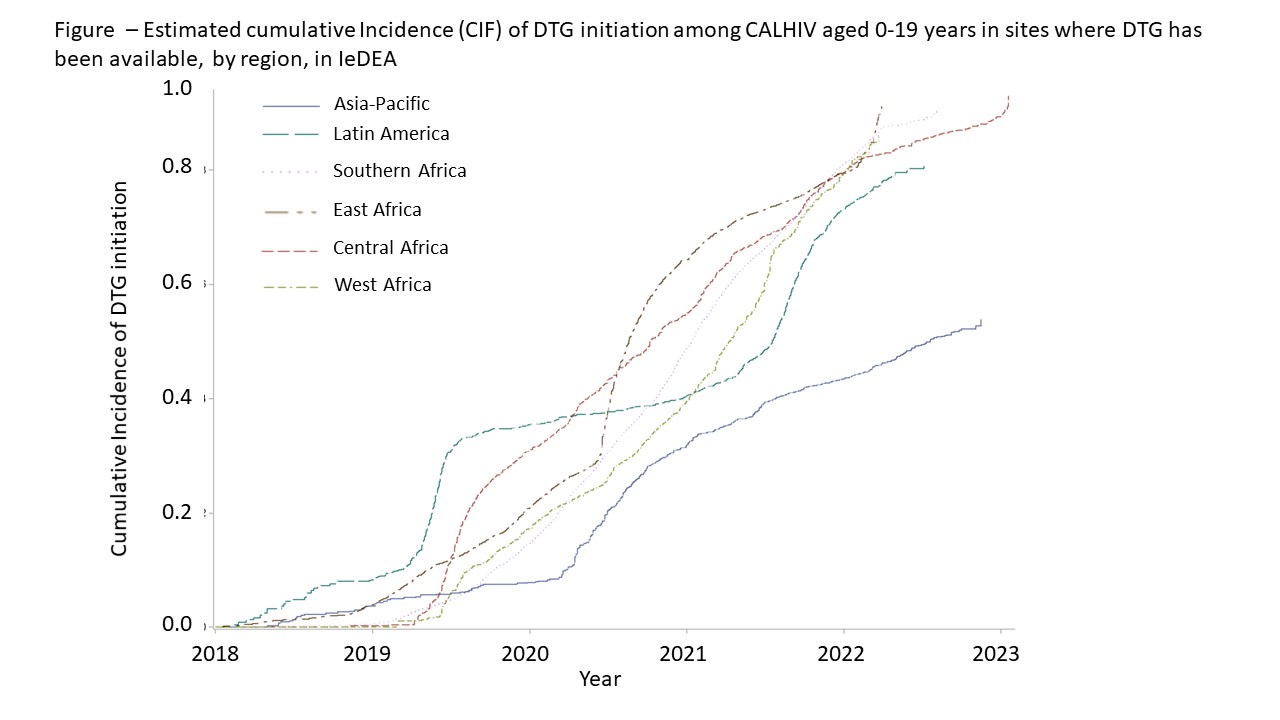
Overall, 80% of sites had access to DTG and 61,324 CALHIV were included in our study; 55% were female and 60% were from Southern Africa. At baseline, median age was 12.2 years (IQR: 7.3-16.3), and 37% had VL assessments, of whom 51% were suppressed (<50 copies/mL). Median follow-up was 16.6 months (IQR: 6.0-27.8) during which 711 (1%) CALHIV died and 14,514 (24%) were LTFU. The overall CIF for DTG initiation reached 92% (95%CI: 91-93) and was significantly lower in the Asia-Pacific (44%; 95%CI:41-47) compared to other regions (Figure). In adjusted models, CALHIV <5 years (compared with older CALHIV), those with detectable VL (compared to those with undetectable VL), and those on protease inhibitor-based regimens (compared with non-nucleoside-based regimens) were less likely to initiate or transition to DTG. Additionally, we found in all 4 African regions that female CALHIV were significantly less likely to access DTG than their male counterparts. In other regions, sex was not associated with initiation or transition to DTG.
Conclusions:
We report an unequal transition to DTG in sites where it has been available. Access to pediatric DTG should be scaled up for younger CALHIV. Moreover, our results highlight the need to promote equitable use of DTG regardless of sex and VL. Continued documentation of treatment practices is required to ensure universal and equal access to DTG for all CALHIV.