Evidence of biological interactions between herpes simplex virus type 2 (HSV-2) and HIV suggests that HSV-2 plays an important role in HIV epidemics. We improved previous estimates of the contribution of HSV-2 to incident HIV infections using a dynamic-transmission model accounting for direct/indirect transmissions (using population-attributable fractions (tPAFs)).
We developed a mathematical model of HSV-2/HIV transmission among 15-49-year-old heterosexual, non-drug injecting populations, calibrated to each of the six WHO regions using region-specific demographic and HSV-2/HIV epidemiological data. We derived global and regional estimates of the 10-year tPAF under three additive scenarios, assuming: (1) HSV-2 only increases HIV acquisition (‘conservative’ scenario), (2) HSV-2 increases HIV acquisition and transmission (‘liberal’), (3) HIV/ART (antiretroviral therapy) also modifies HSV-2 transmission and HSV-2 decreases ART effect on HIV transmission (‘fully liberal’). We compared predicted numbers of incident HIV infections (over 2009-2018) between each scenario and its counterfactual: no biological interactions.
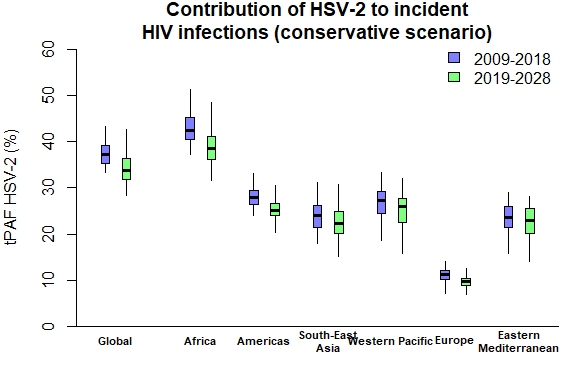
HSV-2/HIV biological interactions were necessary to reproduce empirical data on HIV incidence by HSV-2 status in Africa. Under the conservative scenario, our model predicted a tPAF of 37.3% (95% uncertainty interval 33.4-43.2%) and 5.6 (4.5-7.0) million incident heterosexual HIV infections due to HSV-2 globally over 2009-2018. The contribution of HSV-2 to incident HIV infections was largest for the African region (42.6% (38.0-51.2%) and 4.8 (3.6-6.5) million infections, respectively), and lowest for the European region (11.2% (7.9- 13.8%) and 0.11 (0.07-0.15) million) (Figure). The tPAF was higher among female sex workers, their clients, and older adults, reflecting their higher HSV-2 prevalence. Under the liberal scenario, the tPAF was 51.0% (42.7-58.2%) globally, 1.3-2.4-fold higher compared to the conservative scenario across regions. Accounting for additional modifying effects between HSV-2 and HIV/ART in the fully liberal scenario did not influence tPAF estimates, and tPAF did not substantially change when calculated over 2019-2028
Our results suggest that HSV-2 contributed to over a third of new HIV infections worldwide over 2009-2018 and will contribute similarly over 2019-2028. This was highest in Africa, despite increased ART access. Improved HSV-2 control measures, such as future vaccines could have a substantial impact on HIV incidence.