Background:
Children and adolescents with HIV experience high rates of treatment failure. Genotypic resistance testing (GRT) to inform onward antiretroviral therapy (ART) is often inaccessible, and its effect on clinical outcomes in the context of viremia is unknown.
Methods:
The Genotype-Informed Versus Empiric Management Of VirEmia (GIVE MOVE) open-label randomized clinical trial enrolled children and adolescents <19 years who were receiving ART and had a recent (<16 weeks before enrolment) viral load (VL) ≥400 copies/mL. Participants were randomised 1:1 to receive either GRT with expert recommendation (GRT arm) or repeat VL testing and empiric decision-making (usual care arm) to inform onward treatment. The composite primary endpoint was the occurrence of i) death, ii) hospitalisation, iii) a new World Health Organization (WHO) clinical stage 4 event, or iv) no documented viral resuppression (<50 copies/mL) at 36 weeks. Secondary endpoints included separate analyses of the primary endpoint components and 36-week VL ≥50 copies/mL among those with a 36-week VL result. Adjusted odds ratios and adjusted risk differences were estimated in the modified intention-to-treat (mITT) population. The trial was conducted at ten sites in Lesotho and Tanzania. Trial registration: ClinicalTrials.gov (NCT04233242).
Results:
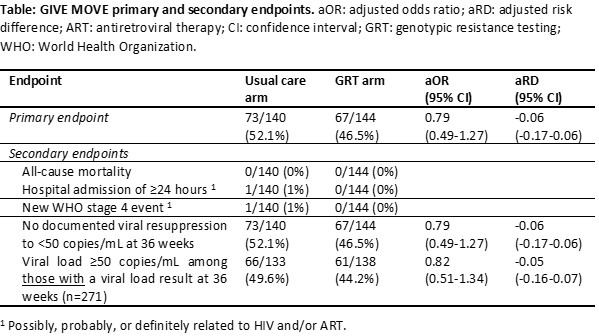
Between March 2020 and July 2022, 286 participants were enrolled of whom 284 were included in the mITT analyses (144 GRT arm; 140 usual care arm). Of these, 158 (55.6%) were female (versus male); 116 (40.8%) were aged 0-11 years (versus 12-18 years); and 13 (4.6%), 101 (35.6%), and 170 (59.9%) were taking non-nucleoside reverse transcriptase inhibitor-, protease inhibitor-, and integrase inhibitor-based ART, respectively, at enrolment. The composite primary endpoint was reached by 67 (46.5%) in the GRT arm and 73 (52.1%) in the usual care arm (adjusted odds ratio [95% confidence interval]: 0.79 [0.49-1.27]; adjusted risk difference: -0.06 [-0.17-0.06]) (Table). No differences were observed for secondary endpoints (Table). No deaths were recorded; one WHO clinical stage 4 event requiring hospitalisation occurred in the usual care arm (Table).
Conclusions:
In this randomized trial conducted in Tanzania and Lesotho, GRT-informed management did not improve viral resuppression rates or clinical treatment outcomes in children and adolescents with viremia while taking ART.