Background:
Knowing the time since infection in people with HIV (PWH) is relevant for transmission epidemiology, HIV pathogenesis and for many research questions in general. As viral genetic diversity accumulates over time in the absence of ART, diversity-based scores measured from ART-naive viral RNA sequences have been shown to be predictive of the time since infection. However, the validity of this approach is unclear for proviral NGS sequences sampled on ART. A particular challenge is noise from APOBEC3G/F induced hypermutations.
Methods:
We assessed the association between time since infection (date of infection until ART initiation) and viral genetic diversity calculated as the average pairwise diversity score from proviral pol-, gag-, and env NGS sequences. Samples were taken after ART initiation from PWH with exact infection dates known via a comprehensive assessment of the medical history. All samples were from PWH enrolled in the Swiss HIV Cohort Study or Zurich Primary HIV Infection Cohort study. We used linear regression to determine the R2 and mean absolute error (MAE) of genetic diversity as a proxy for time since infection. We used AUC-ROC to quantify infection recency prediction. Over all analyses we applied different hypermutation filtering thresholds on NGS read level to account for APOBEC3G/F induced G-to-A mutations.
Results:
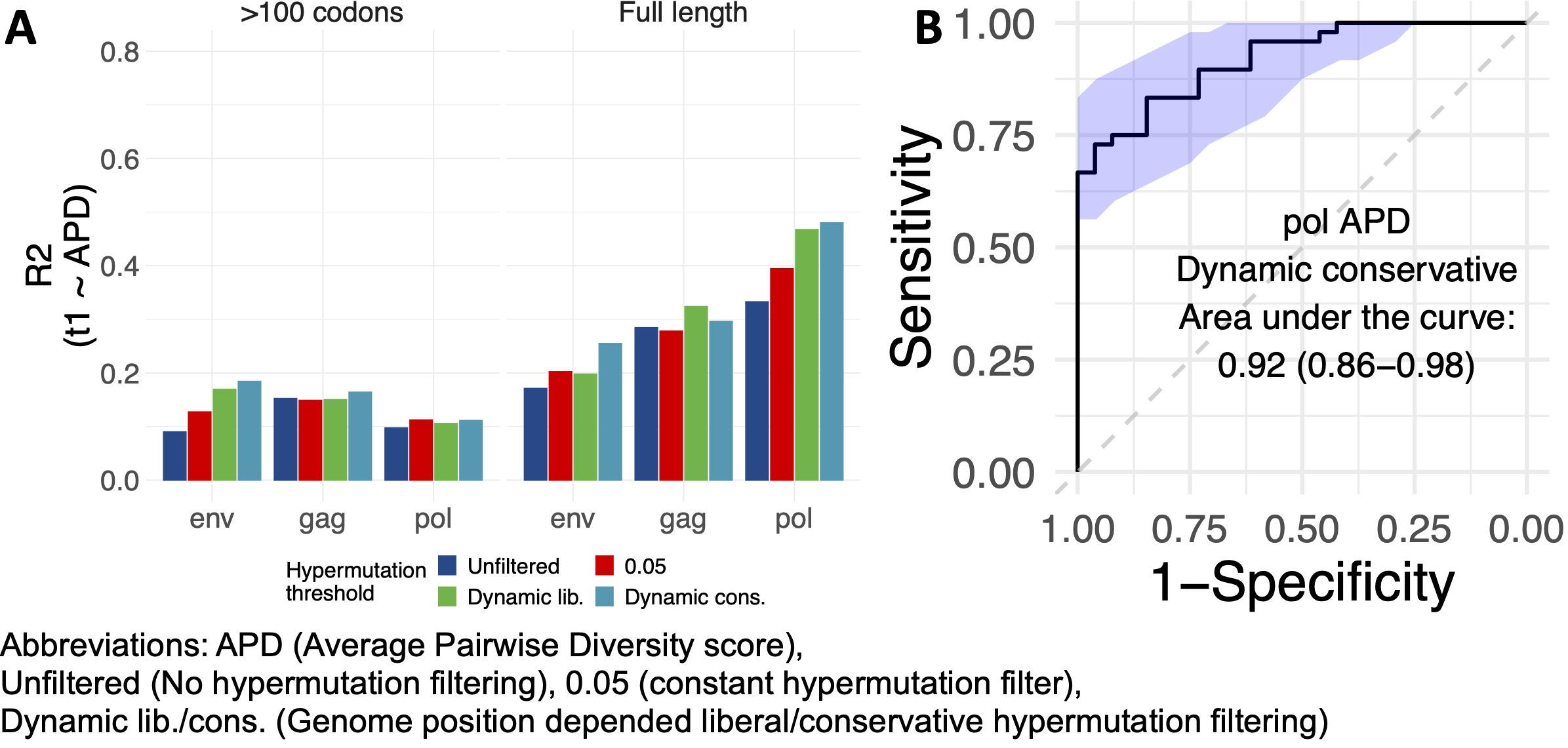
We identified 261 PWH with accurate HIV infection dates and available NGS sequences for at least one gene (with >100 codon coverage) across all hypermutation thresholds (n= 233 gag, 233 pol, 208 env). Among those, 146 PWH had full codon coverage (n= 91 gag, 74 pol, 67 env). We found that proviral genetic diversity was predictive for the time since infection: average pairwise diversity scores calculated both with and without hypermutation filters were significantly associated with time since infection (p<5*10-10). The R2 ranged from 6% for env without hypermutation filtering to 48% for pol with the strictest filter (FigureA). The MAE ranged from +/-1.01 to +/-1.77 years. Recent infection prediction showed an AUC of 0.92 (95% CI 0.86, 0.98) for pol with the strictest filter (FigureB).
Conclusions:
This work shows the utility of genetic diversity measured from proviral sequences as a proxy for the time between ART initiation and infection. While genetic diversity measured in ART-naive viral RNA is more accurate, a good performance can be achieved with hypermutation filtering and hence allows to determine infection recency in PWH without a baseline RNA sequence.