Background:
Globally, 54% of people living with HIV (PLWH) are female (UNAIDS). Therapies containing long-acting injectable (LA-I) agents are included in treatment guidelines and licensed for pre-exposure prophylaxis (PrEP). In female participants, LA-I cabotegravir (CAB) is superior to oral PrEP. However, cisgender and transgender women are historically underrepresented in wider HIV research.
Methods:
We report an ongoing scoping review to evaluate inclusion of women (cis/trans) and non-binary people (NBP) in Phase I-III clinical trials, implementation and real-world studies evaluating any LA-I agent for HIV treatment or PrEP. We searched electronic databases (PubMed, MEDLINE, Embase) and peer reviewed abstracts excluding studies with no report of sex or gender. Statistics were descriptive.
Results:
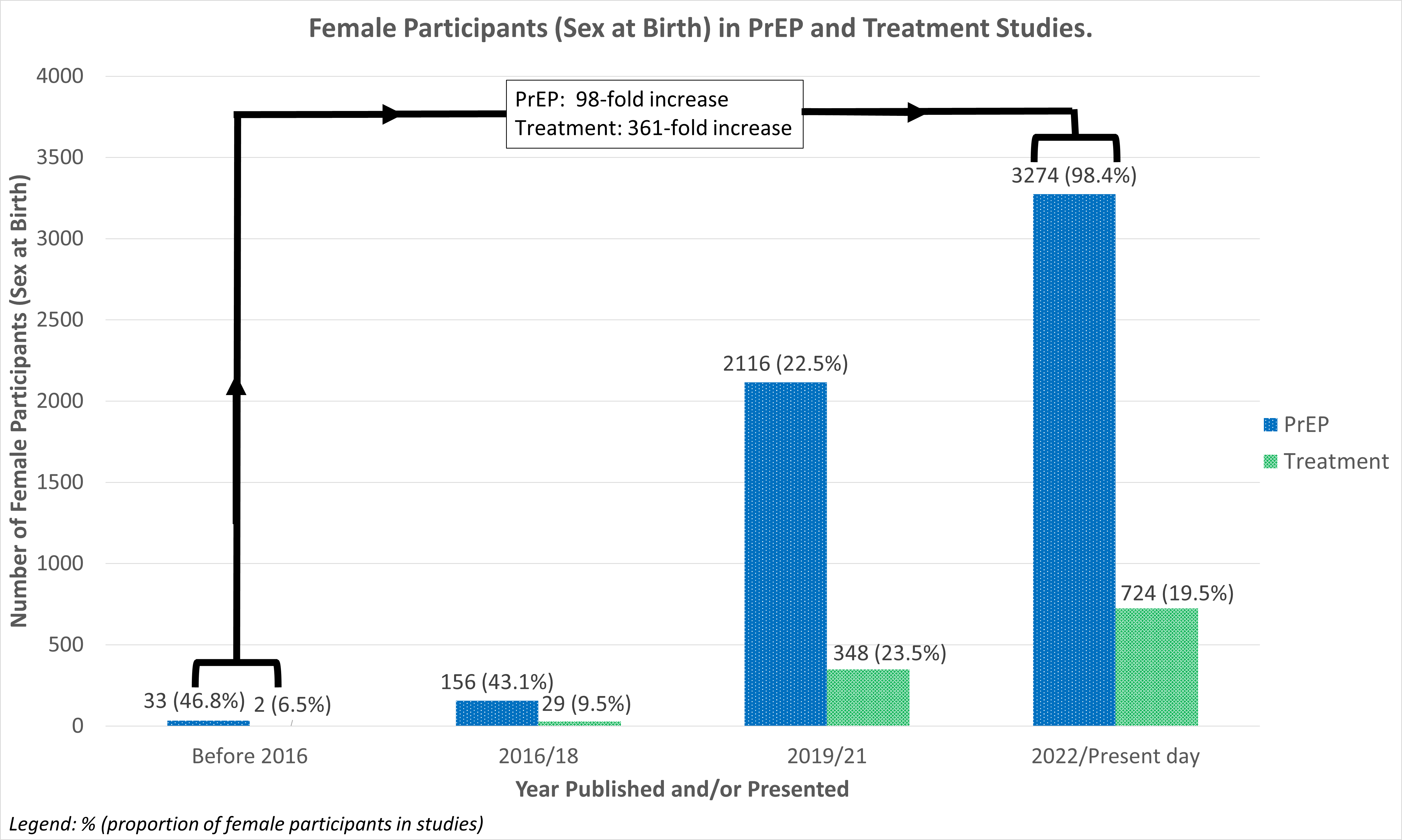
We included 41 studies, 14 evaluated PrEP (34%) and 27 (66%) evaluated treatment. We included 27 clinical trials [Phase I (n=8); Phase II (n=12); Phase III (n=7)], 6 implementation and 8 real-world studies. 38 studies included sites in high-income countries and 13 included sites in low- and middle-income countries. PrEP studies evaluated CAB 8 (57%), rilpivirine (RPV) 2(14%) and mono-clonal antibodies 4 (29%). Treatment studies evaluated CAB+RPV, lenacapavir, albuvirtide and monoclonal antibodies, [18 (67%), 5 (18%), 3 (11%), 1 (4%), respectively]. The number of female participants increased 98-fold in PrEP studies (2014-present), and 361-fold in treatment studies (2010-present). However, the percentage of female participants in LA-I treatment studies during 2022/3 remains disappointing [724/3709 (19%)]. From 2020, gender-targeted PrEP studies were established to ensure inclusive recruitment. Between 2019-2023, 42% of participants in PrEP studies were female (n=5390). Only 13/41 (32%) studies reported on self-identified gender. The number and proportion of transgender women, transgender men, and NBP included in treatment and PrEP studies was 728 (4%), 28 (0.2%) and 58 (0.3%), respectively.
Conclusions:
The number of female participants in studies on LA-I treatment have significantly increased, but remain unacceptably low at 19% (2022/3) and do not reflect the global population. Gender-targeted PrEP studies have been effective at increasing numbers of females recruited. Transgender and NBP remain very poorly represented. A gender-targeted approach to inclusion in treatment studies is urgently needed and long overdue.